A man takes half time in rowing a certain distance downstream than upstream. What is the ratio or the speed in still water to the speed of current?

- A1:2
- B2:1
- C1:3
- D3:1Correct
Explanation
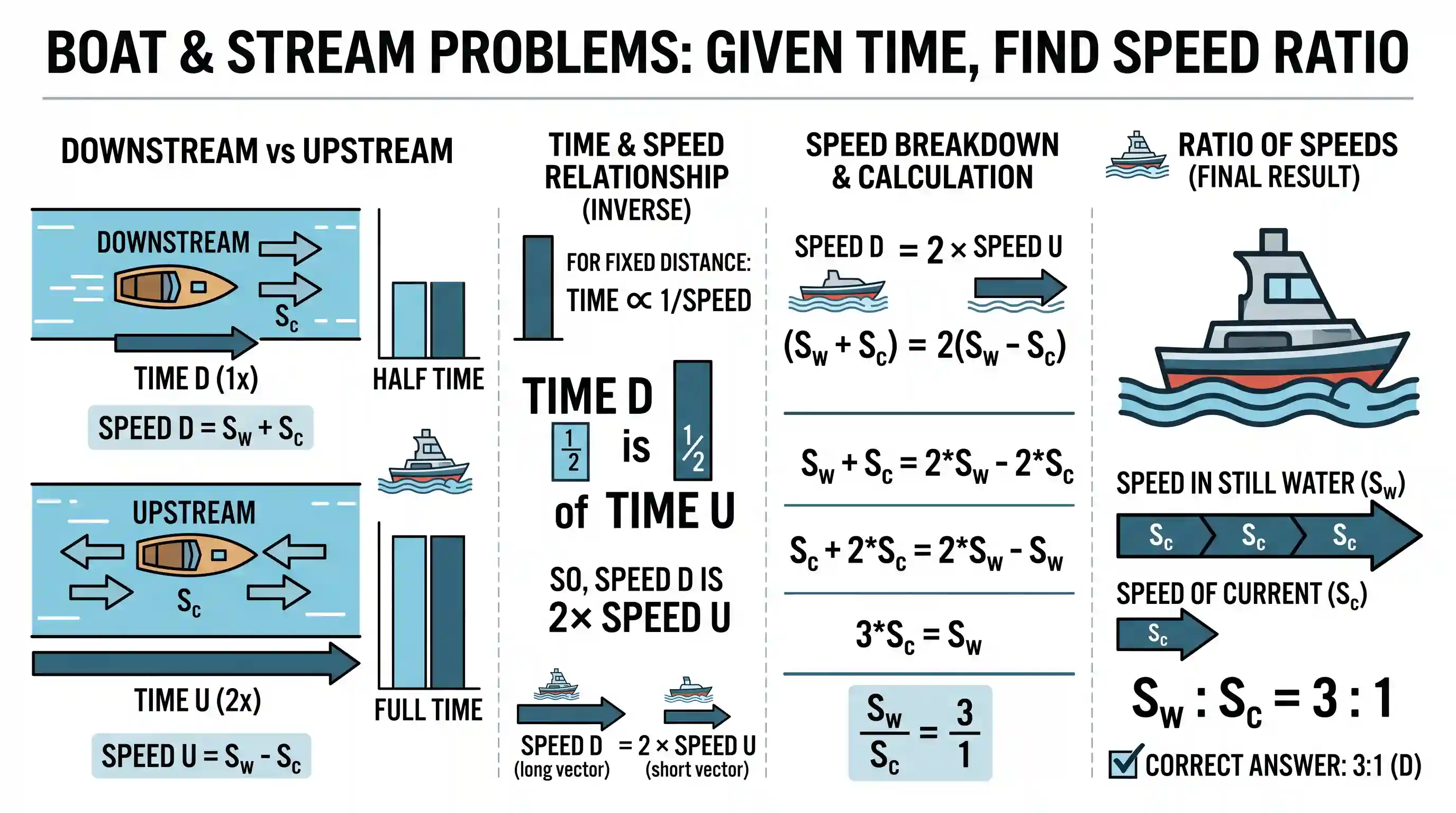
Let the speed of the man in still water be S_m and the speed of the current be S_c.
-
Define speeds:
- Downstream speed = S_m + S_c (speed with the current)
- Upstream speed = S_m - S_c (speed against the current)
-
Define time and distance:
- Let the certain distance be D.
- Time taken downstream (T_d) = D / (S_m + S_c)
- Time taken upstream (T_u) = D / (S_m - S_c)
-
Apply the given condition: The problem states that the man takes half time downstream than upstream: T_d = (1/2) * T_u
-
Substitute and solve: D / (S_m + S_c) = (1/2) * [D / (S_m - S_c)] Cancel D from both sides: 1 / (S_m + S_c) = 1 / [2 * (S_m - S_c)] Cross-multiply: 2 * (S_m - S_c) = S_m + S_c 2S_m - 2S_c = S_m + S_c Rearrange the terms to group S_m and S_c: 2S_m - S_m = S_c + 2S_c S_m = 3*S_c
-
Determine the ratio: The question asks for the ratio of the speed in still water to the speed of current, which is S_m : S_c. From S_m = 3*S_c, we can write: S_m / S_c = 3 / 1 So, the ratio S_m : S_c = 3:1.
Analysis of Options:
- A) 1:2: Incorrect. This would imply the current is twice as fast as the man in still water, which is physically impossible for the man to move upstream.
- B) 2:1: Incorrect. This would mean S_m = 2*S_c.
- C) 1:3: Incorrect. This would mean S_m = (1/3)*S_c, again implying current is much faster.
- D) 3:1: Correct. This matches our derived ratio S_m : S_c = 3:1.
The final answer is D.
Related questions
More UPSC Prelims practice from the same subject and topic.
- Prelims 2020CSATQuantitative Aptitude
A car travels from a place X to place Y at an average speed of v km/hr from y to X at an average speed of 2v km/hr, again from X to y at an average speed of 3v km/hr and again from y to x at an averag…
- Prelims 2020CSATQuantitative Aptitude
How many zeroes are there at the end of the following product? 1 × 5 × 10 × 15 × 20 × 25 × 30 × 35 × 40 × 45 × 50 × 55 × 60
- Prelims 2020CSATQuantitative Aptitude
Let XYZ be a three-digit number, where (x + y + z) is not a multiple of 3. Then (XYZ + YZX + ZXY) is not divisible by
- Prelims 2020CSATQuantitative Aptitude
Let p, q, r and s be natural numbers such that p - 2016 = q + 2017 = r - 2018 = s + 2019 which one of the following is the largest natural number?
- Prelims 2020CSATQuantitative Aptitude
How many five-digit prime numbers can be obtained by using all the digits 1, 2, 3, 4 and 5 without repetition of digits?
- Prelims 2020CSATQuantitative Aptitude
In the sum A + 1A + 5A + AA + A1 = 1AA for which digit does the symbol A stand?