How many pairs of natural numbers are there such that the difference of whose squares is 63?

- A3Correct
- B4
- C5
- D2
Explanation
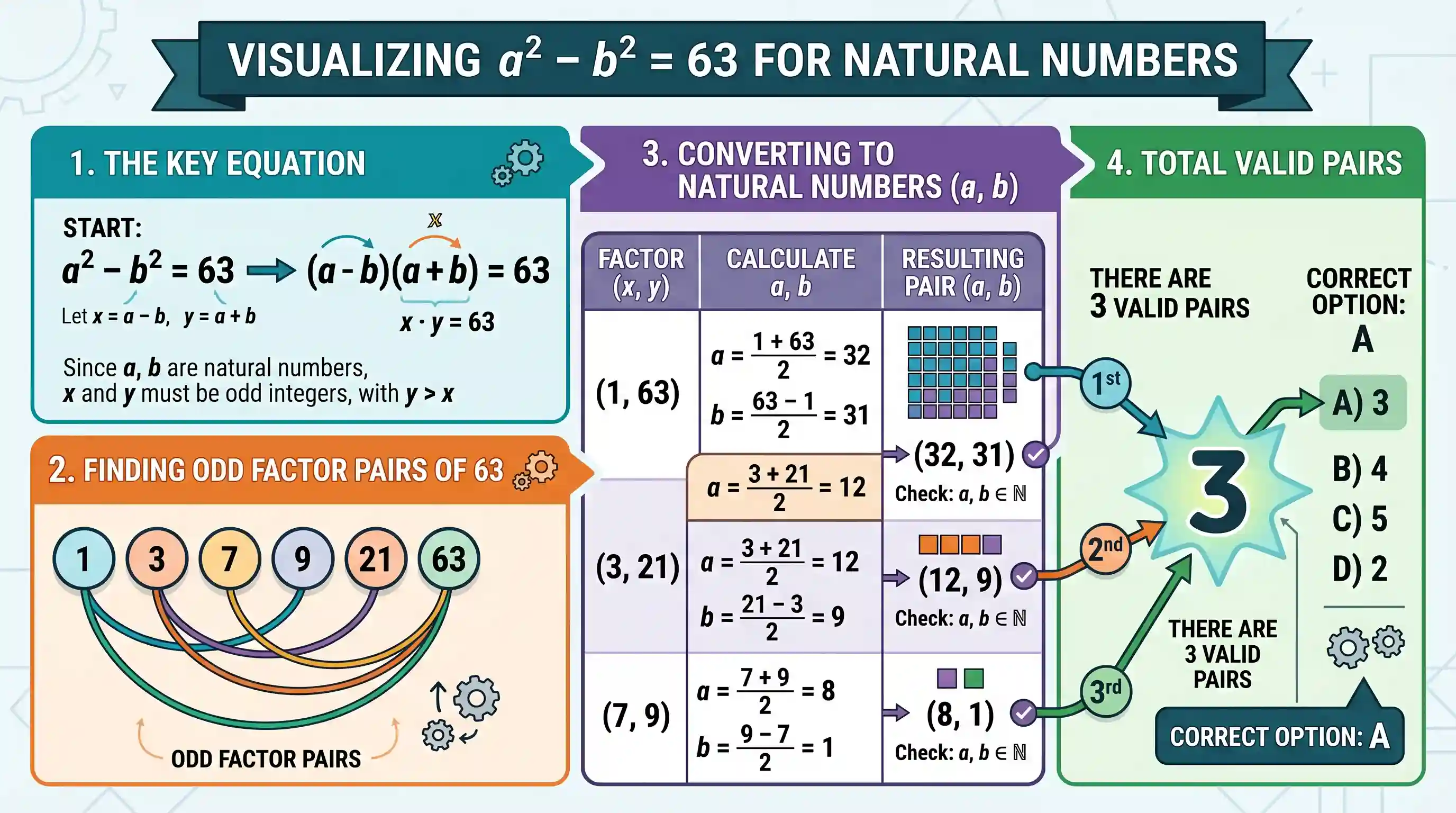
The problem asks for the number of pairs of natural numbers (a, b) such that the difference of their squares is 63. This can be written as: a^2 - b^2 = 63.
Using the difference of squares formula, a^2 - b^2 = (a - b)(a + b). So, we have (a - b)(a + b) = 63.
Let x = a - b and y = a + b. Then, x * y = 63.
Since a and b are natural numbers (positive integers), we can deduce some properties for x and y:
- a^2 - b^2 = 63 > 0 implies a^2 > b^2, so a > b. This means x = a - b must be a positive integer.
- Since a and b are positive, y = a + b must also be a positive integer.
- From a > b, it follows that a + b > a - b, so y > x.
- We can express a and b in terms of x and y: a = (x + y) / 2 b = (y - x) / 2 For a and b to be integers, (x + y) and (y - x) must both be even. This implies that x and y must have the same parity (both even or both odd).
- Since their product x * y = 63 (an odd number), both x and y must be odd.
Now, we need to find pairs of factors (x, y) for 63 that satisfy these conditions (x * y = 63, x and y are odd, y > x): The factors of 63 are 1, 3, 7, 9, 21, 63.
Let's list the possible pairs (x, y) such that x * y = 63 and y > x:
-
x = 1, y = 63. (Both are odd, y > x) a = (1 + 63) / 2 = 64 / 2 = 32 b = (63 - 1) / 2 = 62 / 2 = 31 This gives the pair (32, 31). (Check: 32^2 - 31^2 = 1024 - 961 = 63)
-
x = 3, y = 21. (Both are odd, y > x) a = (3 + 21) / 2 = 24 / 2 = 12 b = (21 - 3) / 2 = 18 / 2 = 9 This gives the pair (12, 9). (Check: 12^2 - 9^2 = 144 - 81 = 63)
-
x = 7, y = 9. (Both are odd, y > x) a = (7 + 9) / 2 = 16 / 2 = 8 b = (9 - 7) / 2 = 2 / 2 = 1 This gives the pair (8, 1). (Check: 8^2 - 1^2 = 64 - 1 = 63)
These are all the possible pairs of factors (x, y) that satisfy the conditions. Each pair yields a unique pair of natural numbers (a, b). There are 3 such pairs of natural numbers.
The final answer is A) 3.
Related questions
More UPSC Prelims practice from the same subject and topic.
- Prelims 2020CSATQuantitative Aptitude
How many zeroes are there at the end of the following product? 1 × 5 × 10 × 15 × 20 × 25 × 30 × 35 × 40 × 45 × 50 × 55 × 60
- Prelims 2020CSATQuantitative Aptitude
Let XYZ be a three-digit number, where (x + y + z) is not a multiple of 3. Then (XYZ + YZX + ZXY) is not divisible by
- Prelims 2020CSATQuantitative Aptitude
How many five-digit prime numbers can be obtained by using all the digits 1, 2, 3, 4 and 5 without repetition of digits?
- Prelims 2020CSATQuantitative Aptitude
In the sum A + 1A + 5A + AA + A1 = 1AA for which digit does the symbol A stand?
- Prelims 2020CSATQuantitative Aptitude
One page is torn from a booklet whose pages are numbered in the usual manner starting from the first page as 1. The sum of the numbers on the remaining pages is 195. The torn page contains which of th…
- Prelims 2020CSATQuantitative Aptitude
Let A3BC and DE2F be four-digit numbers where each letter represents a different digit greater than 3. If the sum of the numbers is 15902, then what is the difference between the values of A and D?