Which of the following statements correctly explains the impact of Industrial Revolution on India during the first half of the nineteenth century?

- AIndian handicrafts were ruined.Correct
- BMachines were introduced in the Indian textile industry in large numbers.
- CRailway lines were laid in many parts of the country.
- DHeavy duties were imposed on the imports of British manufactures.
Explanation
The first half of the nineteenth century (roughly 1800-1850) witnessed the significant impact of the Industrial Revolution in Britain on India, primarily leading to the economic subjugation of the Indian subcontinent. Among the given options, the most direct and devastating impact was on India's indigenous industries:
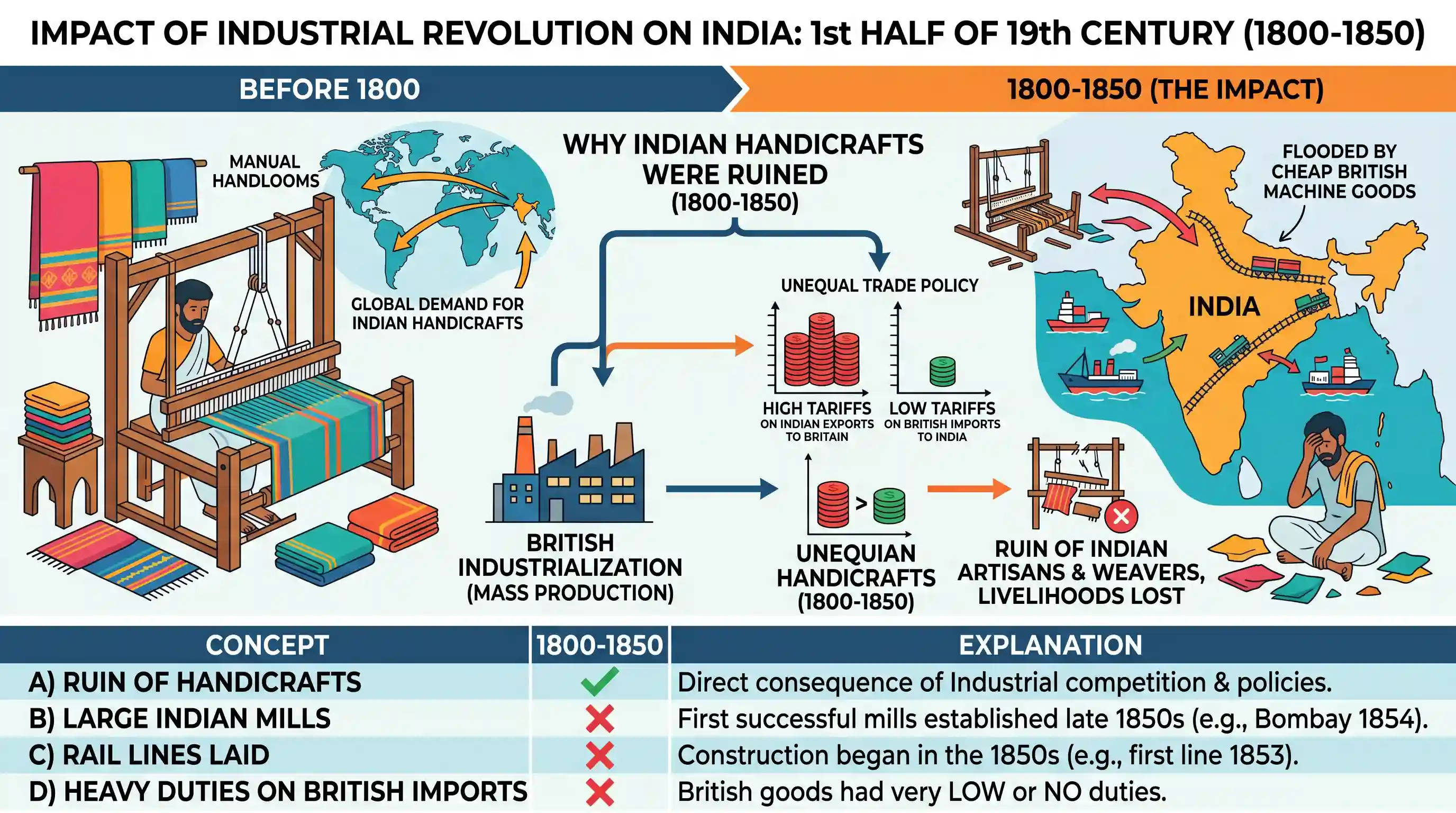
A) Indian handicrafts were ruined. This statement is correct. The Industrial Revolution transformed Britain into a manufacturing hub. The East India Company's policies (and later the British Crown's) were designed to make India a source of raw materials for British industries and a market for British manufactured goods. Cheap, machine-made British textiles and other goods flooded the Indian market, and these goods were imported at negligible or no duties. In contrast, Indian manufactured goods faced high tariffs when exported to Britain. This unequal trade policy and the superior efficiency of machine production led to the decline and eventual ruin of India's once-flourishing handicraft industries, especially cotton textiles, displacing millions of artisans and weavers.
Let's analyze why other options are less accurate for the first half of the 19th century:
B) Machines were introduced in the Indian textile industry in large numbers. This happened predominantly in the latter half of the 19th century. The first successful cotton textile mill in Bombay was established in 1854, marking the beginning of modern industrialization in India, which is outside the first half of the century. C) Railway lines were laid in many parts of the country. Significant railway construction in India began in the 1850s, with the first railway line opening in 1853 (Bombay to Thane). So, this impact falls primarily in the latter half of the 19th century. D) Heavy duties were imposed on the imports of British manufactures. This statement is incorrect. The British government and the East India Company ensured that British manufactured goods could be imported into India with very low or no tariffs, making them competitive against Indian goods. Conversely, heavy duties were imposed on Indian manufactured goods exported to Britain. Thus, the ruin of Indian handicrafts was the most significant and defining impact of the Industrial Revolution on India during the first half of the nineteenth century.
Related questions
More UPSC Prelims practice from the same subject and topic.
- Prelims 2020GS1history
With reference to the book "Desher Katha" written by Sakharam Ganesh Deuskar during the freedom struggle, consider the following statements: 1. It warned against the Colonial State's hypnotic conquest…
- Prelims 2020GS1history
The Gandhi-Irwin Pact included which of the following? 1. Invitation to Congress to participate in the Round Table Conference 2. Withdrawal of Ordinances promulgated in connection with the Civil Disob…
- Prelims 2020GS1history
The Vital-Vidhvansak, the first monthly journal to have the untouchable people as its target audience was published by
- Prelims 2020GS1history
In the context of Indian history, the Rakhmabai case of 1884 revolved around 1. women's right to gain education 2. age of consent 3. restitution of conjugal rights Select the correct answer using the …
- Prelims 2020GS1history
Indigo cultivation in India declined by the beginning of the 20th century because of
- Prelims 2020GS1history
Wellesley established the Fort William College at Calcutta because