With reference to the religious history of India, consider the following statements: 1. Sthaviravadins belong to Mahayana Buddhism. 2. Lokottaravadin sect was an offshoot of Mahasanghika sect of Buddhism. 3. The deification of Buddha by Mahasanghikas fostered the Mahayana Buddhism. Which of the statements given above is/are correct?

- A1 and 2 only
- B2 and 3 onlyCorrect
- C3 only
- D1, 2 and 3
Explanation
Let's analyze each statement regarding the religious history of India, specifically Buddhism:
-
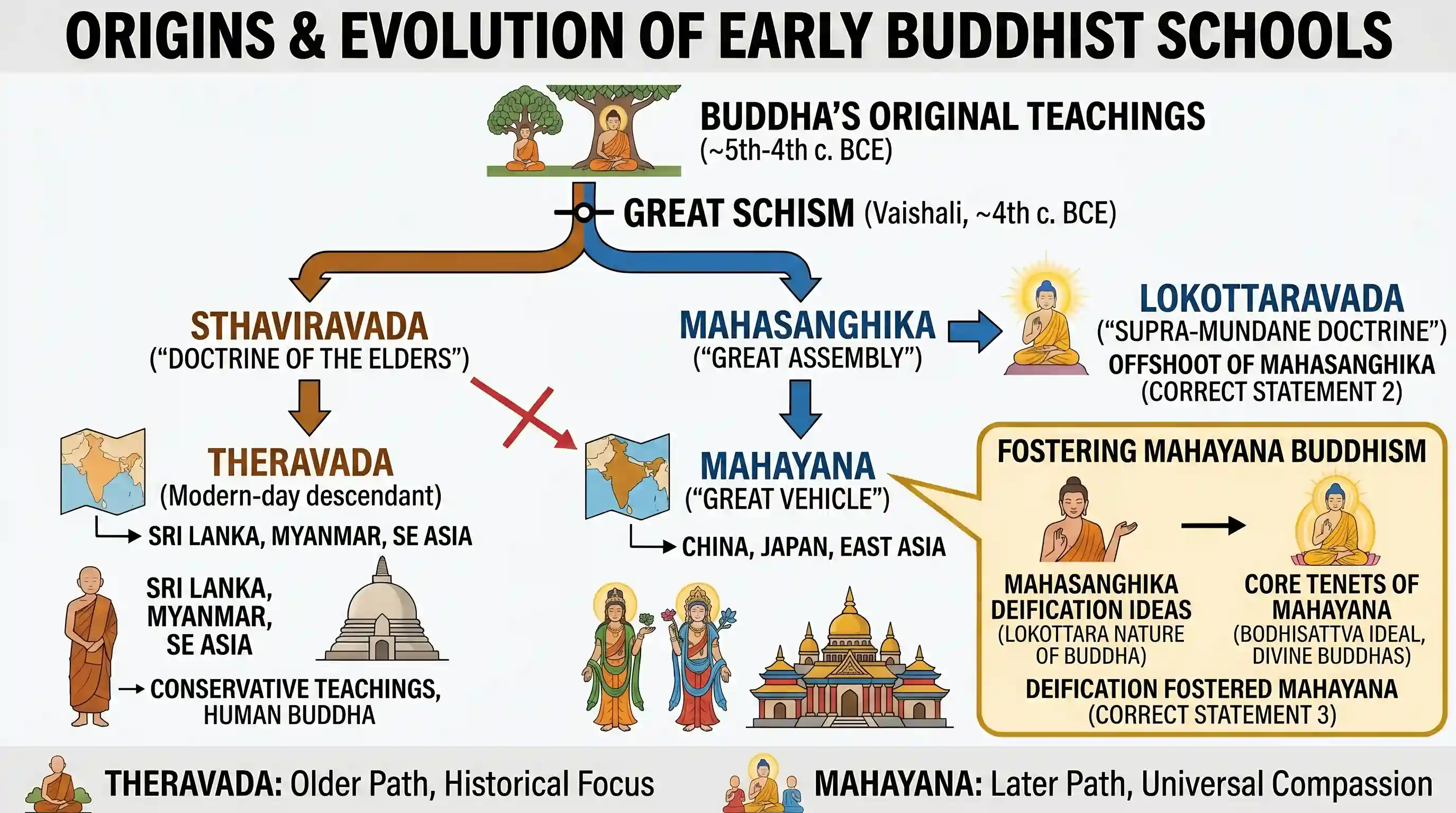
Sthaviravadins belong to Mahayana Buddhism. This statement is incorrect. Sthaviravada (meaning 'Doctrine of the Elders') is the precursor to what is known today as Theravada Buddhism. It is an older, more conservative school that claims to adhere more closely to the original teachings of Buddha. Mahayana Buddhism (meaning 'Great Vehicle') emerged later and represents a different path to enlightenment, focusing on the Bodhisattva ideal and developing more elaborate cosmological concepts. Theravada and Mahayana are two distinct major branches of Buddhism, not sub-schools of each other.
-
Lokottaravadin sect was an offshoot of Mahasanghika sect of Buddhism. This statement is correct. The Mahasanghika ('Great Assembly') school was one of the earliest schismatic schools of Buddhism, emerging after the Second Buddhist Council. The Lokottaravada ('Supra-mundane Doctrine' or 'Transcendentalist') was indeed a prominent sub-school or offshoot of the Mahasanghika tradition. They held the view that Buddha was 'Lokottara' or supra-mundane, i.e., transcendental and beyond the worldly realm, differing from the more human portrayal in early Buddhism.
-
The deification of Buddha by Mahasanghikas fostered the Mahayana Buddhism. This statement is correct. The Mahasanghikas were instrumental in the doctrinal developments that paved the way for Mahayana Buddhism. Their emphasis on the 'Lokottara' nature of Buddha (viewing him as a divine or semi-divine figure rather than just a human teacher) and their early ideas about Bodhisattvas (enlightened beings who delay their own nirvana to help others) were crucial elements that evolved into the core tenets of Mahayana Buddhism.
Therefore, statements 2 and 3 are correct.
Related questions
More UPSC Prelims practice from the same subject and topic.
- Prelims 2020GS1art-and-culture
With reference to the cultural history of India, which one of the following is the correct description of the term 'paramitas'?
- Prelims 2025GS1art-and-culture
The first Gandharva Mahavidyalaya, a music training school, was set up in 1901 by Vishnu Digambar Paluskar in
- Prelims 2025GS1art-and-culture
Consider the following statements in respect of the first Kho Kho World Cup : I. The event was held in Delhi, India. II. Indian men beat Nepal with a score of 78-40 in the final to become the World Ch…
- Prelims 2025GS1art-and-culture
Consider the following statements : I. In the finals of the 45th Chess Olympiad held in 2024, Gukesh Dommaraju became the world's youngest winner after defeating the Russian player Ian Nepomniachtchi.…
- Prelims 2024GS1art-and-culture
Consider the following statements : 1. There are no parables in Upanishads. 2. Upanishads were composed earlier than the Puranas. Which of the statements given above is/are correct?
- Prelims 2024GS1art-and-culture
Which one of the following was the latest inclusion in the Intangible Cultural Heritage List of UNESCO?