With reference to the cultural history of India, which one of the following is the correct description of the term 'paramitas'?

- AThe earliest Dharmashastra texts written in aphoristic (sutra) style
- BPhilosophical schools that did not accept the authority of Vedas
- CPerfections whose attainment led to the Bodhisattva pathCorrect
- DPowerful merchant guilds of early medieval South India
Explanation
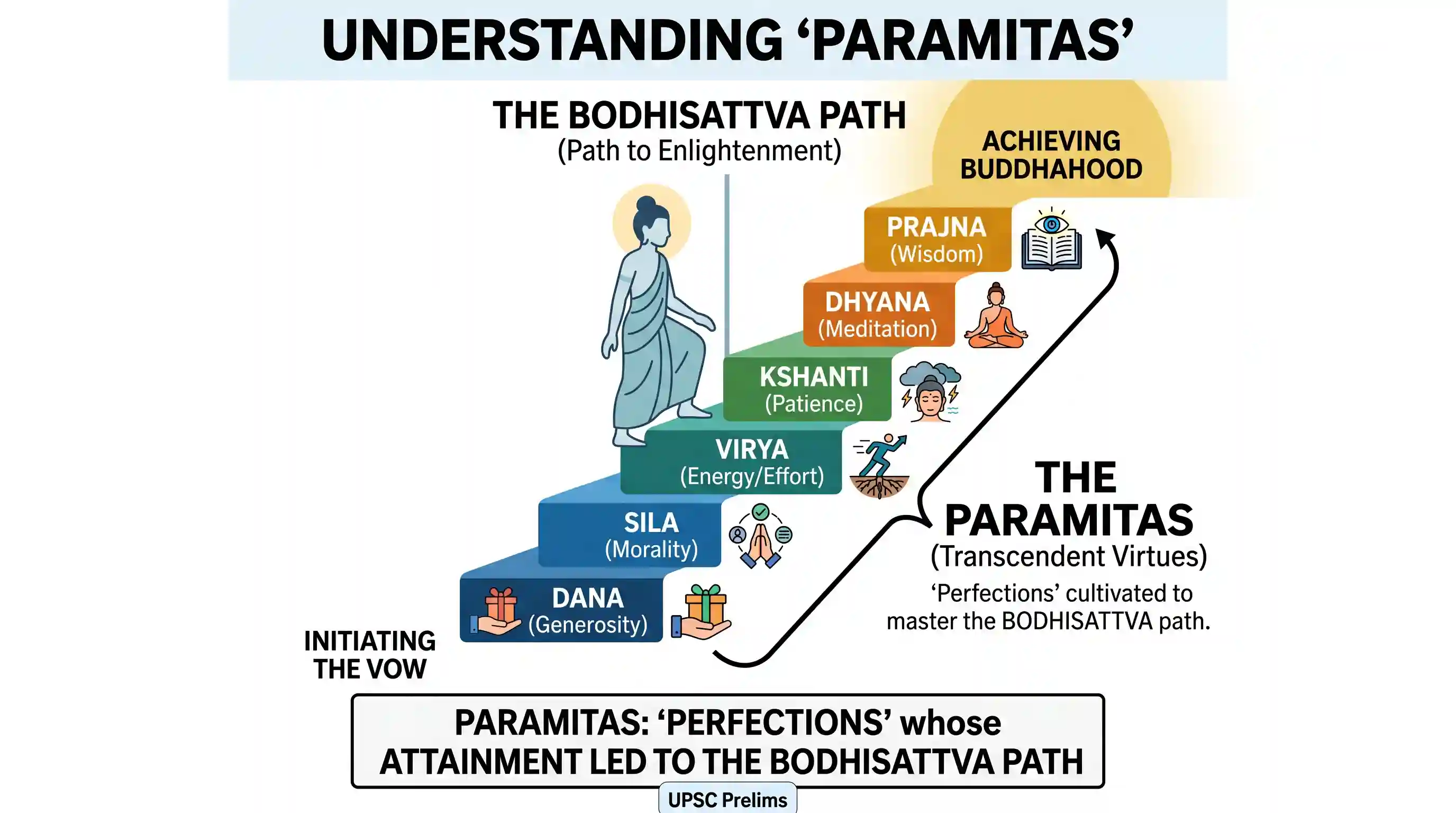
In the context of the cultural history of India, particularly within Buddhism (especially Mahayana Buddhism), 'paramitas' (Pali: pāramī) refer to the 'perfections' or 'transcendent virtues'. These are the qualities and practices that a Bodhisattva (one who has vowed to achieve Buddhahood for the benefit of all sentient beings) cultivates and masters to progress on the path to enlightenment. Traditionally, there are six or ten paramitas, including generosity (dana), morality (sila), patience (kshanti), effort (virya), meditation (dhyana), and wisdom (prajna). Their attainment is crucial for the spiritual development and ultimate awakening of a Bodhisattva.
Related questions
More UPSC Prelims practice from the same subject and topic.
- Prelims 2020GS1art-and-culture
With reference to the religious history of India, consider the following statements: 1. Sthaviravadins belong to Mahayana Buddhism. 2. Lokottaravadin sect was an offshoot of Mahasanghika sect of Buddh…
- Prelims 2025GS1art-and-culture
The first Gandharva Mahavidyalaya, a music training school, was set up in 1901 by Vishnu Digambar Paluskar in
- Prelims 2025GS1art-and-culture
Consider the following statements in respect of the first Kho Kho World Cup : I. The event was held in Delhi, India. II. Indian men beat Nepal with a score of 78-40 in the final to become the World Ch…
- Prelims 2025GS1art-and-culture
Consider the following statements : I. In the finals of the 45th Chess Olympiad held in 2024, Gukesh Dommaraju became the world's youngest winner after defeating the Russian player Ian Nepomniachtchi.…
- Prelims 2024GS1art-and-culture
Consider the following statements : 1. There are no parables in Upanishads. 2. Upanishads were composed earlier than the Puranas. Which of the statements given above is/are correct?
- Prelims 2024GS1art-and-culture
Which one of the following was the latest inclusion in the Intangible Cultural Heritage List of UNESCO?