In the context of Indian history, the Rakhmabai case of 1884 revolved around 1. women's right to gain education 2. age of consent 3. restitution of conjugal rights Select the correct answer using the code given below:

- A1 and 2 only
- B2 and 3 onlyCorrect
- C1 and 3 only
- D1, 2 and 3
Explanation
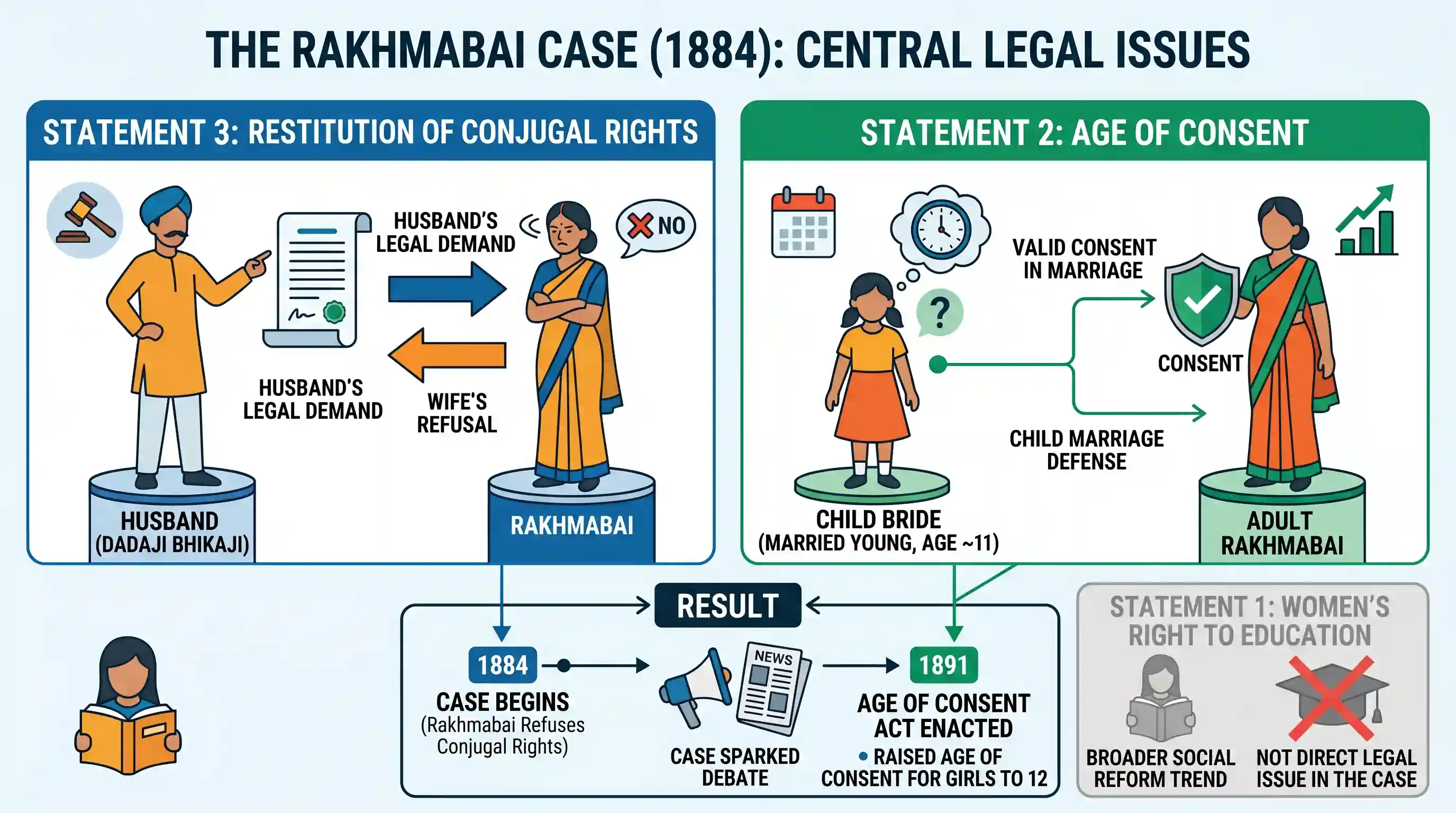
The Rakhmabai case of 1884 was a landmark legal case in colonial India that brought to the forefront significant social issues, primarily concerning women's rights within marriage. The case revolved around two main issues: Statement 2, the 'age of consent' for marriage, as Rakhmabai had been married as a child and refused to live with her husband upon reaching maturity. Statement 3, 'restitution of conjugal rights', which was the legal demand made by her husband for her to return and fulfill her marital duties. The case sparked widespread debate and played a crucial role in the eventual enactment of the Age of Consent Act, 1891. While 'women's right to gain education' (Statement 1) was a broader social reform movement and a long-term aspiration, it was not the specific legal issue at the heart of the Rakhmabai case itself. The immediate legal dispute centered on her marriage and marital obligations.
Related questions
More UPSC Prelims practice from the same subject and topic.
- Prelims 2020GS1history
Which of the following statements correctly explains the impact of Industrial Revolution on India during the first half of the nineteenth century?
- Prelims 2020GS1history
With reference to the book "Desher Katha" written by Sakharam Ganesh Deuskar during the freedom struggle, consider the following statements: 1. It warned against the Colonial State's hypnotic conquest…
- Prelims 2020GS1history
The Gandhi-Irwin Pact included which of the following? 1. Invitation to Congress to participate in the Round Table Conference 2. Withdrawal of Ordinances promulgated in connection with the Civil Disob…
- Prelims 2020GS1history
The Vital-Vidhvansak, the first monthly journal to have the untouchable people as its target audience was published by
- Prelims 2020GS1history
Indigo cultivation in India declined by the beginning of the 20th century because of
- Prelims 2020GS1history
Wellesley established the Fort William College at Calcutta because