With reference to the history of India, consider the following pairs: 1. Aurang : In-charge of treasury of the State 2. Banian : Indian agent of the East India Company 3. Mirasidar : Designated revenue payer to the State Which of the pairs given above is/are correctly matched?

- A1 and 2 only
- B2 and 3 onlyCorrect
- C3 only
- D1, 2 and 3
Explanation
Let's analyze each pair of historical terms:
-
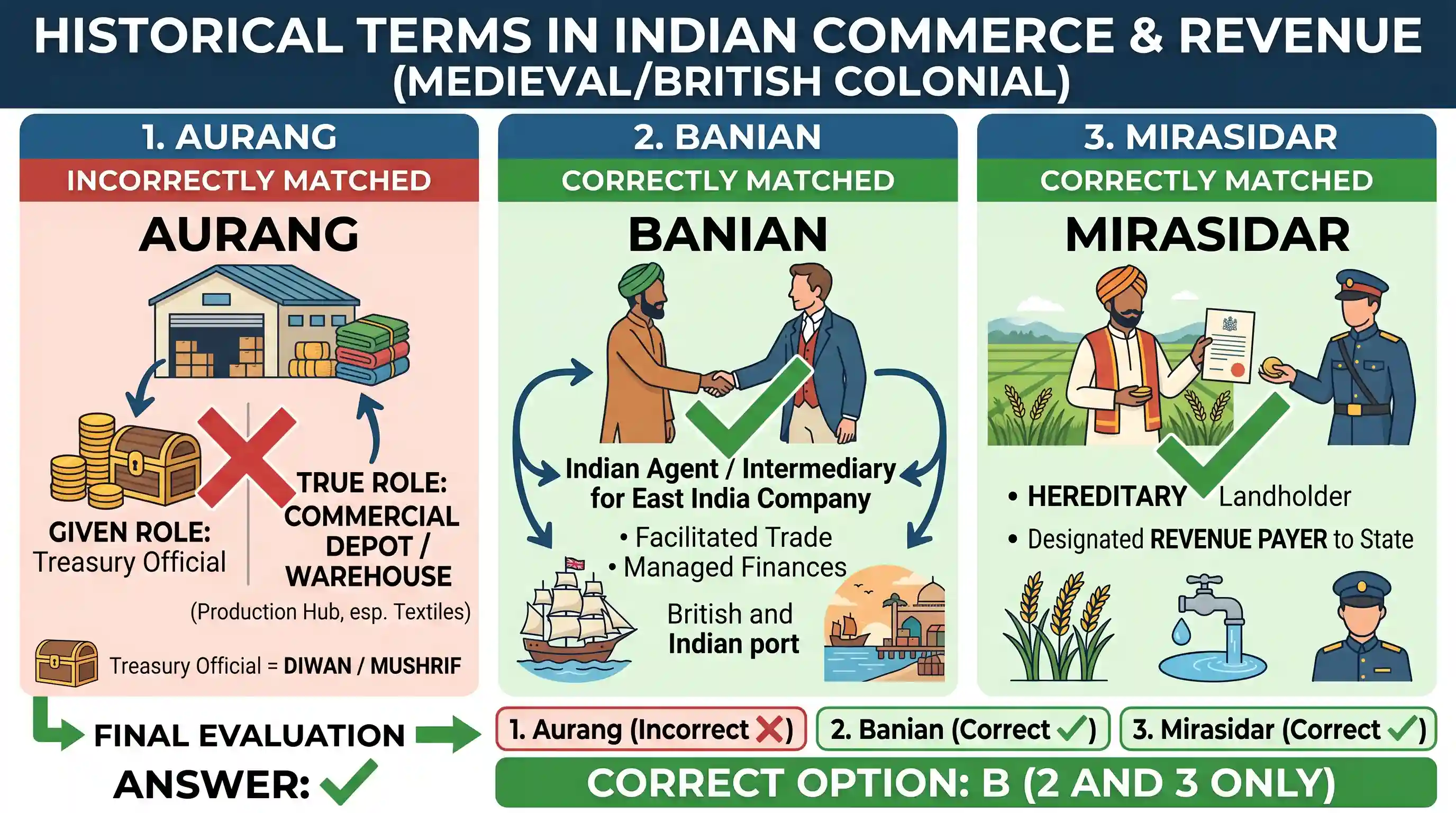
Aurang : In-charge of treasury of the State - This pair is incorrectly matched. The term 'Aurang' (or 'Owrang') in historical contexts, particularly during the Mughal and post-Mughal periods, referred to a commercial depot, a factory, or a warehouse where goods were manufactured or collected, especially textiles. It was a place of production or storage, not an official in charge of the treasury. The treasury official was typically known as 'Diwan' or 'Mushrif'.
-
Banian : Indian agent of the East India Company - This pair is correctly matched. 'Banian' (derived from Bania, a merchant caste) was a term used by the British to refer to an Indian trader, merchant, or broker. These individuals acted as intermediaries or agents for the European trading companies, including the East India Company, helping them in procuring goods, managing local finances, and facilitating trade with Indian merchants and artisans.
-
Mirasidar : Designated revenue payer to the State - This pair is correctly matched. In South India, especially during the British colonial period, a 'Mirasidar' was a hereditary landholder or proprietor who held a 'miras' (hereditary right) over land. They were typically responsible for paying land revenue to the state and held significant social and economic standing in their villages.
Therefore, statements 2 and 3 are correctly matched.
Related questions
More UPSC Prelims practice from the same subject and topic.
- Prelims 2020GS1history
Which of the following statements correctly explains the impact of Industrial Revolution on India during the first half of the nineteenth century?
- Prelims 2020GS1history
Consider the following events in the history of India: 1. Rise of Pratiharas under King Bhoja 2. Establishment of Pallava power under Mahendravarman - I 3. Establishment of Chola power by Parantaka - …
- Prelims 2020GS1history
With reference to the book "Desher Katha" written by Sakharam Ganesh Deuskar during the freedom struggle, consider the following statements: 1. It warned against the Colonial State's hypnotic conquest…
- Prelims 2020GS1history
The Gandhi-Irwin Pact included which of the following? 1. Invitation to Congress to participate in the Round Table Conference 2. Withdrawal of Ordinances promulgated in connection with the Civil Disob…
- Prelims 2020GS1history
The Vital-Vidhvansak, the first monthly journal to have the untouchable people as its target audience was published by
- Prelims 2020GS1history
With reference to the history of India, the terms "kulyavapa" and "dronavapa" denote