Consider the following statements: 1. The President of India can summon a session of the Parliament at such place as he/she thinks fit. 2. The Constitution of India provides for three sessions of the Parliament in a year, but it is not mandatory to conduct all three sessions. 3. There is no minimum number of days that the Parliament is required to meet in a year. Which of the statements given above is/are correct?

- A1 only
- B2 only
- C1 and 3 onlyCorrect
- D2 and 3 only
Explanation
Let's examine each statement regarding Parliamentary sessions:
-
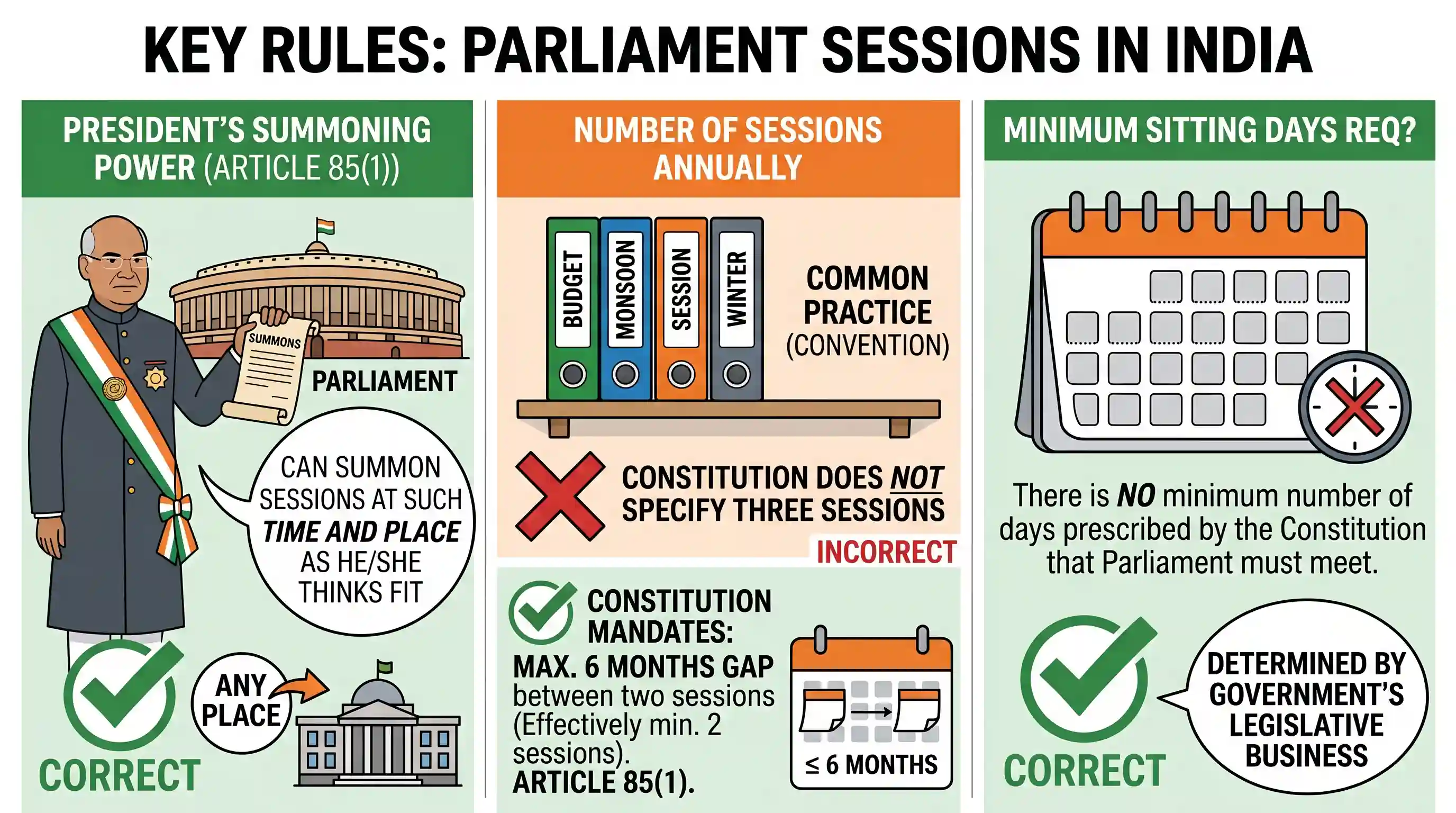
The President of India can summon a session of the Parliament at such place as he/she thinks fit. This statement is correct. Article 85(1) of the Constitution states: "The President shall from time to time summon each House of Parliament to meet at such time and place as he thinks fit, but six months shall not intervene between its last sitting in one session and the date appointed for its first sitting in the next session." This grants the President the power to determine the place of a session.
-
The Constitution of India provides for three sessions of the Parliament in a year, but it is not mandatory to conduct all three sessions. This statement is incorrect. The Constitution does not specify or mandate the number of sessions (e.g., Budget, Monsoon, Winter) that Parliament must hold in a year. It only mandates that there should not be a gap of more than six months between two sessions (Article 85(1)). This effectively means Parliament must meet at least twice a year. The practice of holding three sessions is a convention, not a constitutional mandate.
-
There is no minimum number of days that the Parliament is required to meet in a year. This statement is correct. The Constitution does not prescribe a minimum number of sitting days for Parliament in a year. It only specifies the maximum permissible gap between two sessions (six months). The number of days Parliament meets is determined by the government's legislative agenda and prevailing political circumstances.
Therefore, statements 1 and 3 are correct.
Related questions
More UPSC Prelims practice from the same subject and topic.
- Prelims 2020GS1polity-and-governance
A Parliamentary System of Government is one in which
- Prelims 2020GS1polity-and-governance
Consider the following statements: 1. Aadhaar metadata cannot be stored for more than three months. 2. State cannot enter into any contract with private corporations for sharing of Aadhaar data. 3. Aa…
- Prelims 2020GS1polity-and-governance
Rajya Sabha has equal powers with Lok Sabha in
- Prelims 2020GS1polity-and-governance
With reference to the funds under Members of Parliament Local Area Development Scheme (MPLADS), which of the following statements are correct? 1. MPLADS funds must be used to create durable assets lik…
- Prelims 2020GS1polity-and-governance
Which one of the following categories of Fundamental Rights incorporates protection against untouchability as a form of discrimination?
- Prelims 2020GS1polity-and-governance
In India, separation of judiciary from the executive is enjoined by