Consider the following statements: 1. According to the Constitution of India, a person who is eligible to vote can be made a minister in a State for six months even if he/she is not a member of the Legislature of that State. 2. According to the Representation of People Act, 1951, a person convicted of a criminal offence and sentenced to imprisonment for five years is permanently disqualified from contesting an election even after his release from prison. Which of the statements given above is/are correct?

- A1 onlyCorrect
- B2 only
- CBoth 1 and 2
- DNeither 1 nor 2
Explanation
Let's analyze each statement:
-
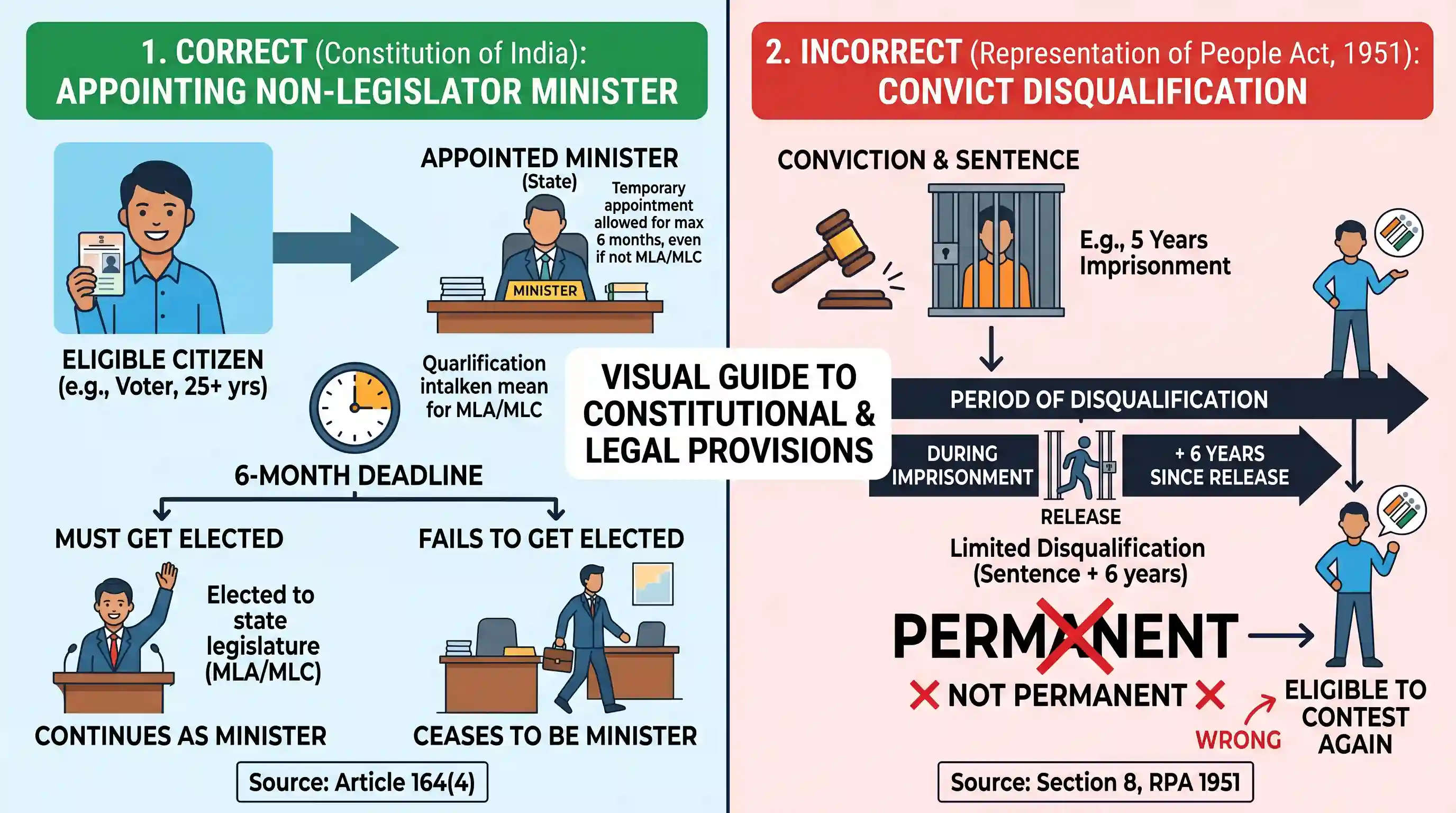
According to the Constitution of India, a person who is eligible to vote can be made a minister in a State for six months even if he/she is not a member of the Legislature of that State. This statement is correct. Article 164(4) of the Constitution states: "A Minister who for any period of six consecutive months is not a member of the Legislature of the State shall at the expiration of that period cease to be a Minister." This provision allows a non-legislator (who is otherwise qualified to be a member of the legislature, which includes being eligible to vote and being of the prescribed age) to be appointed as a minister for a maximum period of six months, during which time they must get elected or nominated to either house of the state legislature.
-
According to the Representation of People Act, 1951, a person convicted of a criminal offence and sentenced to imprisonment for five years is permanently disqualified from contesting an election even after his release from prison. This statement is incorrect. Section 8 of the Representation of People Act, 1951, deals with disqualification on conviction for certain offenses. It states that a person convicted of any offense and sentenced to imprisonment for two years or more shall be disqualified from the date of such conviction and shall continue to be disqualified for a further period of six years since his release. The disqualification is for a fixed period (sentence period + six years after release), not permanent.
Therefore, only statement 1 is correct.
Related questions
More UPSC Prelims practice from the same subject and topic.
- Prelims 2020GS1polity-and-governance
A constitutional government by definition is a
- Prelims 2020GS1polity-and-governance
Other than the Fundamental Rights, which of the following parts of the Constitution of India reflect/reflects the principles and provisions of the Universal Declaration of Human Rights (1948)? 1. Prea…
- Prelims 2020GS1polity-and-governance
Which part of the Constitution of India declares the ideal of Welfare State?
- Prelims 2020GS1polity-and-governance
Consider the following statements: 1. The Constitution of India defines its 'basic structure' in terms of federalism, secularism, fundamental rights and democracy. 2. The Constitution of India provide…
- Prelims 2020GS1polity-and-governance
The Preamble to the Constitution of India is
- Prelims 2020GS1polity-and-governance
With reference to the provisions contained in Part IV of the Constitution of India, which of the following statements is/are correct? 1. They shall be enforceable by courts. 2. They shall not be enfor…