The Preamble to the Constitution of India is

- Aa part of the Constitution but has no legal effect
- Bnot a part of the Constitution and has no legal effect either
- Ca part of the Constitution and has the same legal effect as any other part
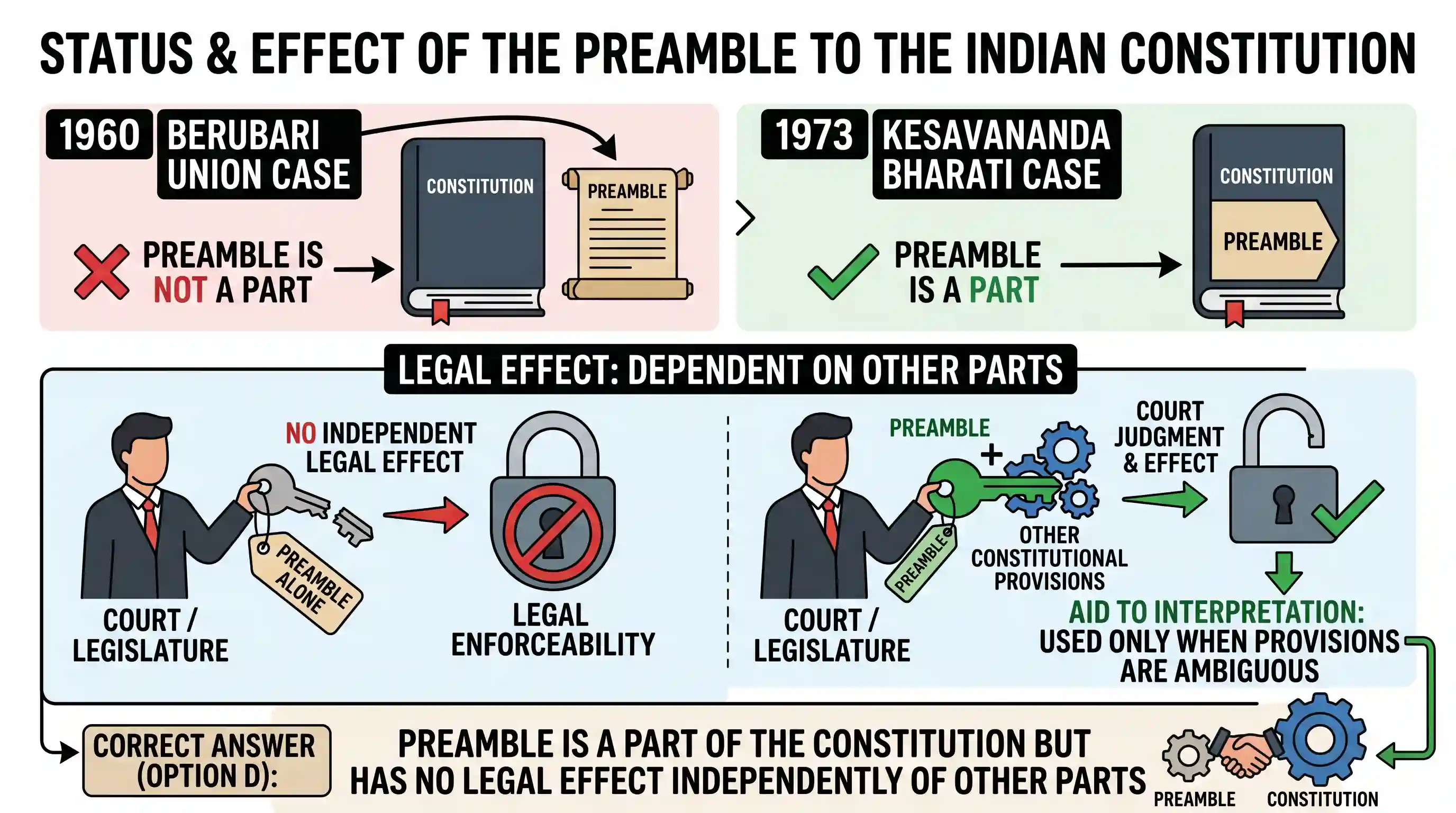
- Da part of the Constitution but has no legal effect independently of other partsCorrect
Explanation
The status of the Preamble to the Constitution of India has been a subject of judicial interpretation. The Supreme Court's stance evolved over time:
Berubari Union case (1960): The Supreme Court held that the Preamble is not a part of the Constitution. Kesavananda Bharati case (1973): This landmark judgment reversed the earlier decision and held that the Preamble is indeed a part of the Constitution. However, the Court also clarified the nature of the Preamble's legal effect:
The Preamble is not a source of power to the legislature or a source of prohibition upon the powers of the legislature. This means it cannot grant or deny powers on its own. It is not enforceable in any court of law independently. You cannot go to court to enforce a right solely based on the Preamble. Its significance lies in its role as an aid to the interpretation of the Constitution. It embodies the fundamental values and philosophy on which the Constitution is based. In case of any ambiguity in the provisions of the Constitution, the Preamble provides a key to understanding the intent of the framers. Therefore, the most accurate description is that the Preamble is a part of the Constitution but has no legal effect independently of other parts.
Related questions
More UPSC Prelims practice from the same subject and topic.
- Prelims 2020GS1polity-and-governance
A constitutional government by definition is a
- Prelims 2020GS1polity-and-governance
Other than the Fundamental Rights, which of the following parts of the Constitution of India reflect/reflects the principles and provisions of the Universal Declaration of Human Rights (1948)? 1. Prea…
- Prelims 2020GS1polity-and-governance
Which part of the Constitution of India declares the ideal of Welfare State?
- Prelims 2020GS1polity-and-governance
Consider the following statements: 1. The Constitution of India defines its 'basic structure' in terms of federalism, secularism, fundamental rights and democracy. 2. The Constitution of India provide…
- Prelims 2020GS1polity-and-governance
With reference to the provisions contained in Part IV of the Constitution of India, which of the following statements is/are correct? 1. They shall be enforceable by courts. 2. They shall not be enfor…
- Prelims 2020GS1polity-and-governance
Consider the following statements: 1. According to the Constitution of India, a person who is eligible to vote can be made a minister in a State for six months even if he/she is not a member of the Le…