A constitutional government by definition is a

- Agovernment by legislature
- Bpopular government
- Cmulti-party government
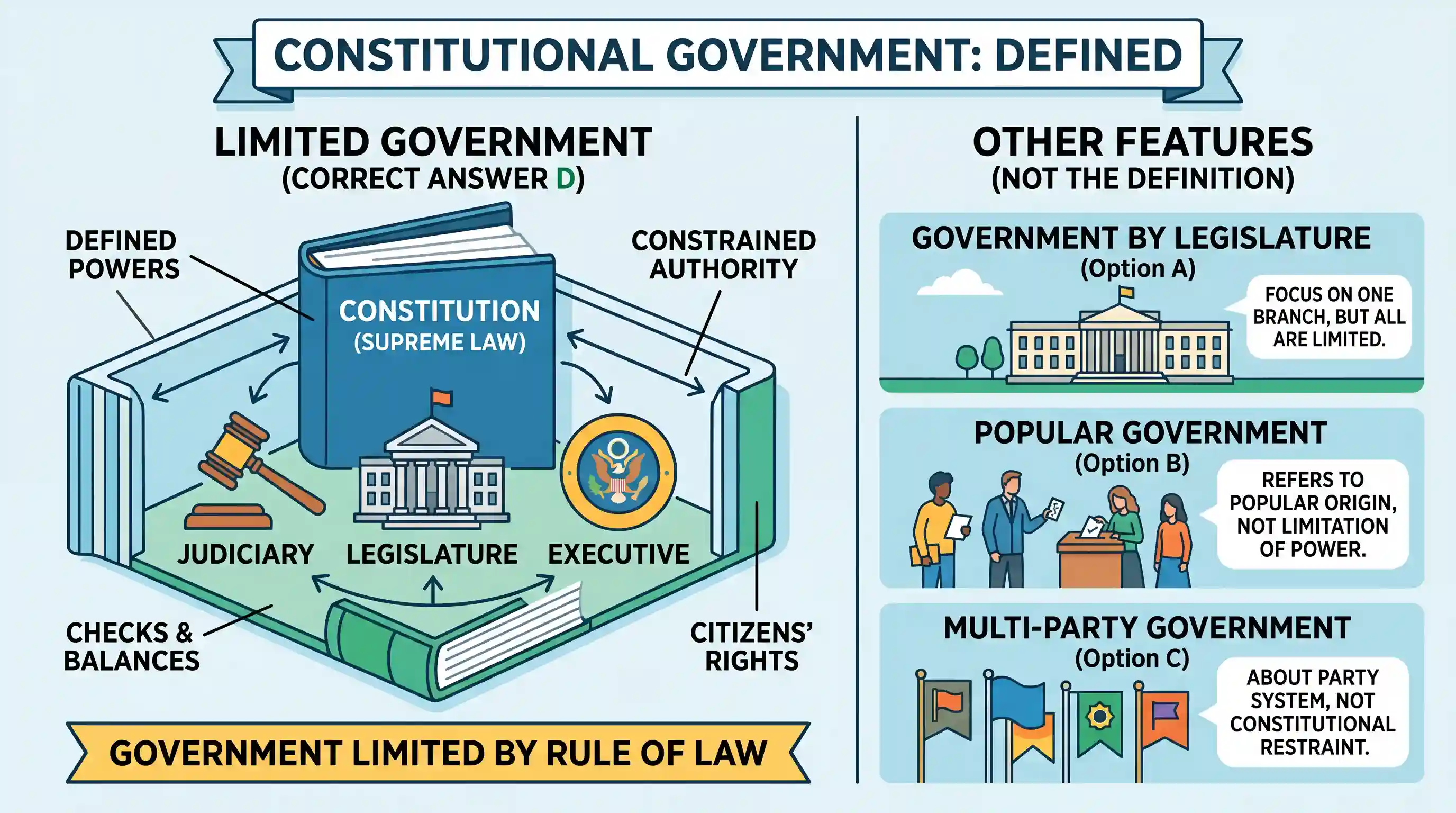
- Dlimited governmentCorrect
Explanation
A constitutional government is, by its very definition, a limited government. This means that its powers are constrained and defined by a constitution. The constitution acts as a supreme law that sets out the powers and responsibilities of the government, and also specifies the rights and freedoms of the citizens. The government cannot act arbitrarily or beyond the powers granted to it by the constitution. This concept ensures that the government is not absolute and is subject to checks and balances.
Let's consider why other options are less precise or incorrect:
A) government by legislature: While a legislature is a key component of most constitutional governments, especially parliamentary ones, it doesn't fully capture the essence of a 'constitutional' government, which primarily implies limitations on all branches of government by a constitution. B) popular government: A popular government is one based on the will of the people, usually through elections. While constitutional governments are often popular governments, the term 'constitutional' specifically refers to the limitation of power by a constitution, not necessarily its popular origin alone. An authoritarian regime could theoretically be 'popular' but would not be a constitutional government in the sense of limited power. C) multi-party government: This refers to the political system where multiple parties compete and often form coalitions to govern. While many constitutional democracies are multi-party, it is not a defining characteristic of a 'constitutional government' itself. A two-party system or even a dominant one-party system (if truly constrained by a constitution) could still be constitutional. The essence of a constitutional government is the rule of law and the limitation of governmental power, making 'limited government' the most appropriate definition.
Related questions
More UPSC Prelims practice from the same subject and topic.
- Prelims 2020GS1polity-and-governance
Other than the Fundamental Rights, which of the following parts of the Constitution of India reflect/reflects the principles and provisions of the Universal Declaration of Human Rights (1948)? 1. Prea…
- Prelims 2020GS1polity-and-governance
Which part of the Constitution of India declares the ideal of Welfare State?
- Prelims 2020GS1polity-and-governance
Consider the following statements: 1. The Constitution of India defines its 'basic structure' in terms of federalism, secularism, fundamental rights and democracy. 2. The Constitution of India provide…
- Prelims 2020GS1polity-and-governance
The Preamble to the Constitution of India is
- Prelims 2020GS1polity-and-governance
With reference to the provisions contained in Part IV of the Constitution of India, which of the following statements is/are correct? 1. They shall be enforceable by courts. 2. They shall not be enfor…
- Prelims 2020GS1polity-and-governance
Consider the following statements: 1. According to the Constitution of India, a person who is eligible to vote can be made a minister in a State for six months even if he/she is not a member of the Le…