Along with the Budget, the Finance Minister also places other documents before the Parliament which include 'The Macro Economic Framework Statement'. The aforesaid document is presented because this is mandated by

- ALong standing parliamentary convention
- BArticle 112 and Article 110(1) of the Constitution of India
- CArticle 113 of the Constitution of India
- DProvisions of the Fiscal Responsibility and Budget Management Act, 2003Correct
Explanation
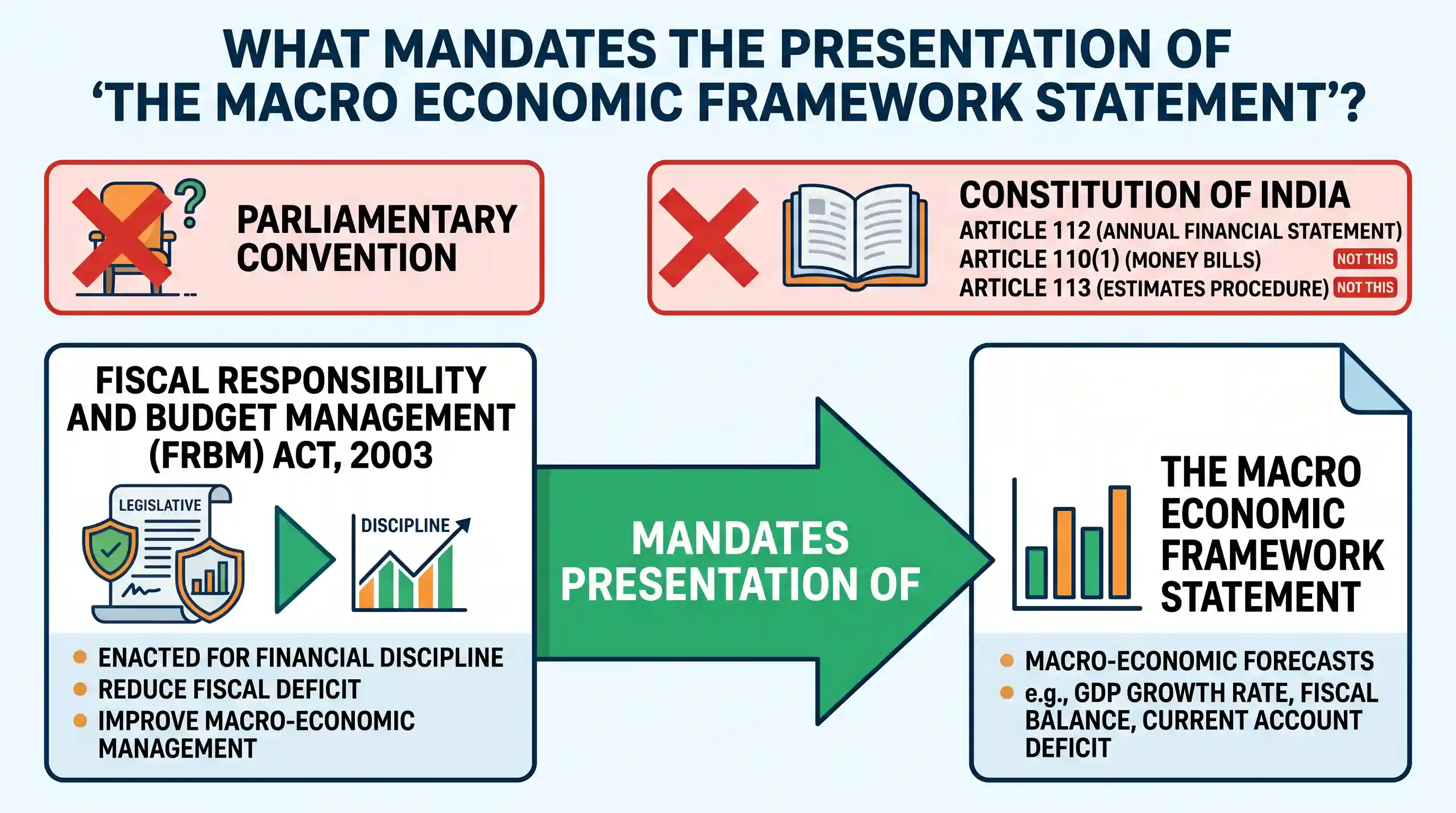
The 'Macro-Economic Framework Statement' is one of the key documents presented to the Parliament along with the Union Budget. Its presentation is mandated by the Fiscal Responsibility and Budget Management (FRBM) Act, 2003.
The FRBM Act was enacted to institutionalize financial discipline, reduce fiscal deficit, and improve macro-economic management. To achieve these objectives, the Act requires the government to present three statements along with the Budget annually:
Medium Term Fiscal Policy Statement: Sets out the fiscal policy of the Central Government for the medium-term, including fiscal projections. Fiscal Policy Strategy Statement: Lays down the fiscal policy of the Central Government for the current financial year and assesses its sustainability. Macro-Economic Framework Statement: Contains the macro-economic forecasts for the economy, including the GDP growth rate, fiscal balance, and current account deficit. This statement facilitates parliamentary scrutiny of the government's macro-economic policies and their impact. The other options are incorrect because:
A) Long standing parliamentary convention: While some practices are conventions, this specific statement's presentation is legally mandated by an Act. B) Article 112 and Article 110(1) of the Constitution of India: Article 112 deals with the Annual Financial Statement (Budget) and Article 110 defines Money Bills. Neither explicitly mandates the Macro-Economic Framework Statement. C) Article 113 of the Constitution of India: Article 113 deals with the procedure in Parliament with respect to estimates (demands for grants). It does not mandate this specific document. Therefore, the correct answer is that its presentation is mandated by the provisions of the Fiscal Responsibility and Budget Management Act, 2003.
Related questions
More UPSC Prelims practice from the same subject and topic.
- Prelims 2020GS1economy
"Gold Tranche" (Reserve Tranche) refers to
- Prelims 2020GS1economy
Which of the following phrases defines the nature of the 'Hundi' generally referred to in the sources of the post-Harsha period?
- Prelims 2020GS1economy
If another global financial crisis happens in the near future, which of the following actions/policies are most likely to give some immunity to India? 1. Not depending on short-term foreign borrowings…
- Prelims 2020GS1economy
If you withdraw ₹ 1,00,000 in cash from your Demand Deposit Account at your bank, the immediate effect on aggregate money supply in the economy will be
- Prelims 2020GS1economy
With reference to Foreign Direct Investment in India, which one of the following is considered its major characteristic?
- Prelims 2020GS1economy
With reference to the international trade of India at present, which of the following statements is/are correct? 1. India's merchandise exports are less than its merchandise imports. 2. India's import…