In India, separation of judiciary from the executive is enjoined by

- Athe Preamble of the Constitution
- Ba Directive Principle of State PolicyCorrect
- Cthe Seventh Schedule
- Dthe conventional practice
Explanation
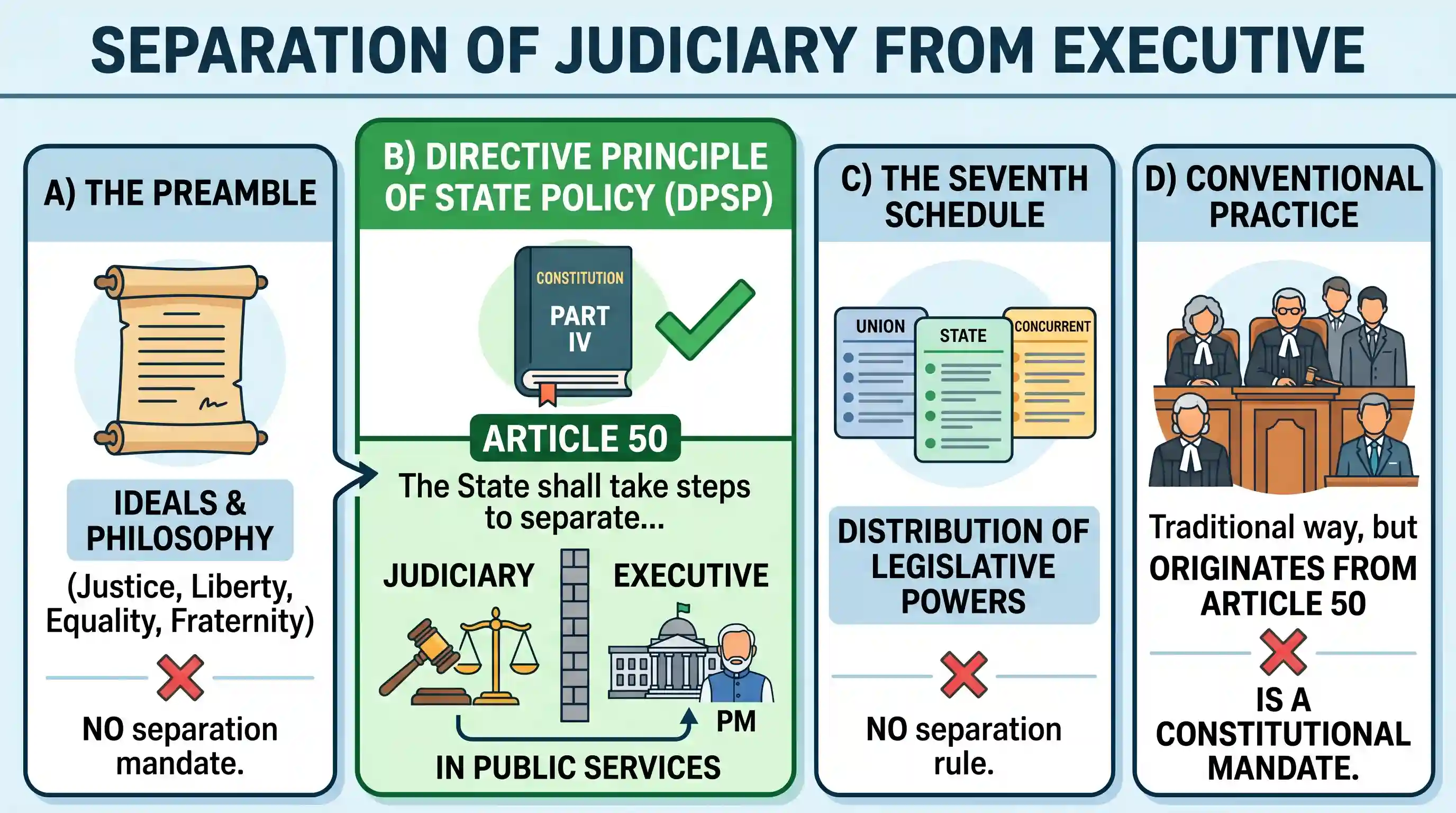
The separation of judiciary from the executive in India is mandated by Article 50 of the Constitution. Article 50 states: "The State shall take steps to separate the judiciary from the executive in the public services of the State."
Article 50 is part of Part IV of the Constitution, which deals with the Directive Principles of State Policy (DPSP). DPSPs are fundamental in the governance of the country and are meant to guide the State in making laws, but they are not enforceable by courts.
Let's look at why other options are incorrect:
A) the Preamble of the Constitution: The Preamble sets out the ideals and philosophy of the Constitution (Justice, Liberty, Equality, Fraternity) but does not explicitly enjoin the separation of judiciary from the executive. C) the Seventh Schedule: The Seventh Schedule deals with the distribution of legislative powers between the Union and the States through the Union List, State List, and Concurrent List. It does not mention the separation of judiciary from the executive. D) the conventional practice: While the separation of judiciary from the executive is indeed a practice, its origin and constitutional basis are rooted in Article 50, making it a constitutional mandate rather than merely a convention. Hence, the correct answer is a Directive Principle of State Policy.
Related questions
More UPSC Prelims practice from the same subject and topic.
- Prelims 2020GS1polity-and-governance
Consider the following statements: 1. Aadhaar metadata cannot be stored for more than three months. 2. State cannot enter into any contract with private corporations for sharing of Aadhaar data. 3. Aa…
- Prelims 2020GS1polity-and-governance
Rajya Sabha has equal powers with Lok Sabha in
- Prelims 2020GS1polity-and-governance
With reference to the funds under Members of Parliament Local Area Development Scheme (MPLADS), which of the following statements are correct? 1. MPLADS funds must be used to create durable assets lik…
- Prelims 2020GS1polity-and-governance
Which one of the following categories of Fundamental Rights incorporates protection against untouchability as a form of discrimination?
- Prelims 2020GS1polity-and-governance
A constitutional government by definition is a
- Prelims 2020GS1polity-and-governance
Other than the Fundamental Rights, which of the following parts of the Constitution of India reflect/reflects the principles and provisions of the Universal Declaration of Human Rights (1948)? 1. Prea…