Other than the Fundamental Rights, which of the following parts of the Constitution of India reflect/reflects the principles and provisions of the Universal Declaration of Human Rights (1948)? 1. Preamble 2. Directive Principles of State Policy 3. Fundamental Duties Select the correct answer using the code given below:

- A1 and 2 only
- B2 only
- C1 and 3 only
- D1, 2 and 3Correct
Explanation
The Universal Declaration of Human Rights (UDHR) of 1948 laid down fundamental human rights. The Constitution of India, drafted around the same period, incorporates many of these principles across various parts, not just Fundamental Rights.
-
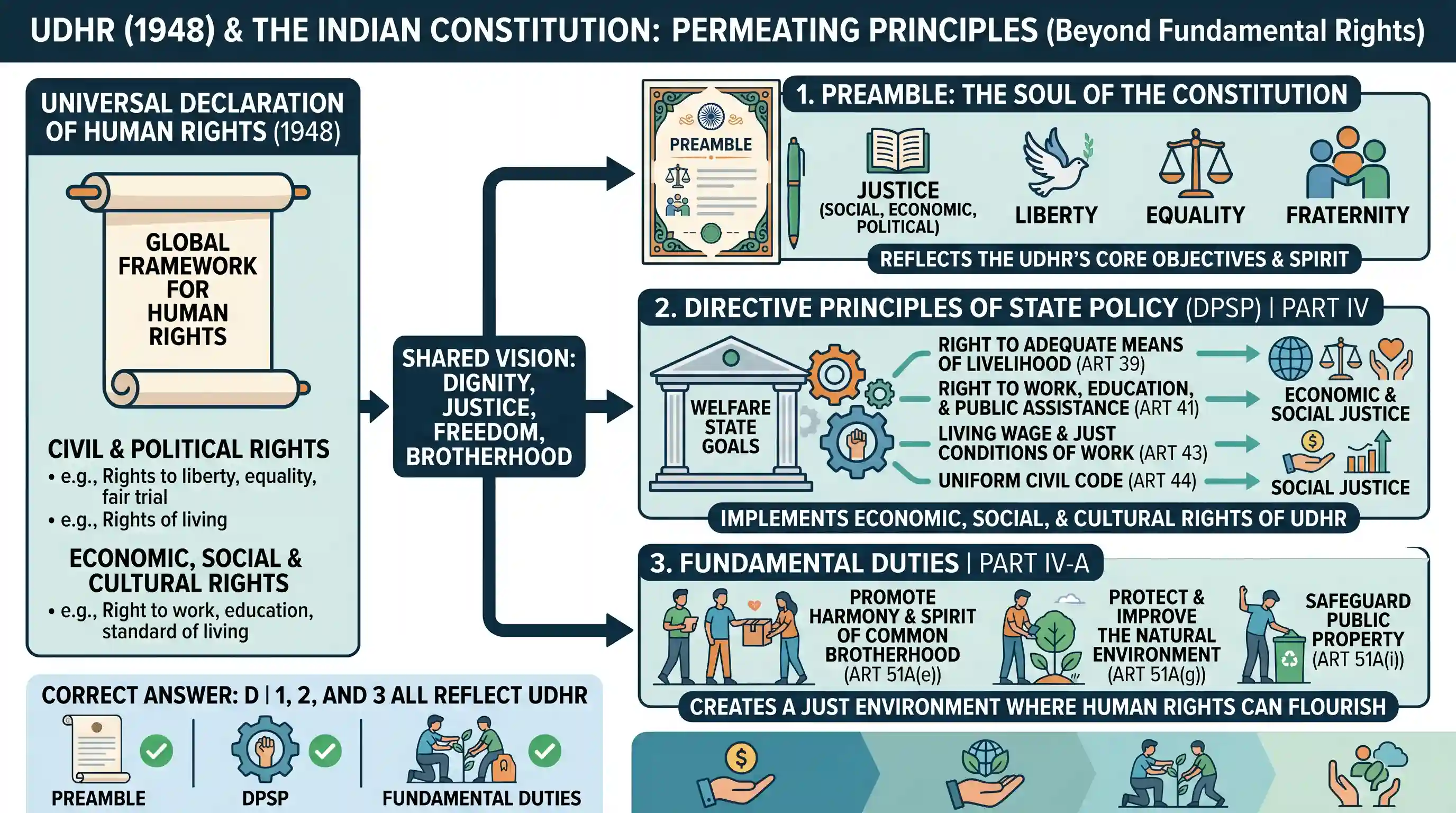
Preamble: The Preamble of the Indian Constitution, with its ideals of Justice (social, economic, and political), Liberty (of thought, expression, belief, faith, and worship), Equality (of status and of opportunity), and Fraternity, reflects the spirit and many provisions of the UDHR. These ideals are foundational to human rights.
-
Directive Principles of State Policy (DPSP): Part IV of the Constitution, containing DPSPs, aims to establish a welfare state and secures economic and social justice. Many provisions within the DPSPs, such as the right to adequate means of livelihood (Article 39), the right to work, to education and to public assistance in certain cases (Article 41), living wage (Article 43), and the right to health, align directly with the economic, social, and cultural rights enumerated in the UDHR (e.g., Articles 23, 25, 26 of UDHR).
-
Fundamental Duties: Part IVA of the Constitution, containing Fundamental Duties, while not rights themselves, imposes duties on citizens to uphold the values that are essential for a just and harmonious society, which implicitly supports the broader framework of human rights. For instance, the duty to promote harmony and the spirit of common brotherhood (Article 51A(e)) contributes to an environment where human rights can flourish.
Given that Fundamental Rights directly incorporate civil and political rights from UDHR, the question specifically asks for other parts. The Preamble sets the stage, DPSPs provide social and economic directives, and Fundamental Duties encourage a rights-respecting society. Therefore, all three parts reflect the principles and provisions of the UDHR.
Related questions
More UPSC Prelims practice from the same subject and topic.
- Prelims 2020GS1polity-and-governance
A constitutional government by definition is a
- Prelims 2020GS1polity-and-governance
Which part of the Constitution of India declares the ideal of Welfare State?
- Prelims 2020GS1polity-and-governance
Consider the following statements: 1. The Constitution of India defines its 'basic structure' in terms of federalism, secularism, fundamental rights and democracy. 2. The Constitution of India provide…
- Prelims 2020GS1polity-and-governance
The Preamble to the Constitution of India is
- Prelims 2020GS1polity-and-governance
With reference to the provisions contained in Part IV of the Constitution of India, which of the following statements is/are correct? 1. They shall be enforceable by courts. 2. They shall not be enfor…
- Prelims 2020GS1polity-and-governance
Consider the following statements: 1. According to the Constitution of India, a person who is eligible to vote can be made a minister in a State for six months even if he/she is not a member of the Le…