Consider the following statements: 1. The Constitution of India defines its 'basic structure' in terms of federalism, secularism, fundamental rights and democracy. 2. The Constitution of India provides for 'judicial review' to safeguard the citizens' liberties and to preserve the ideals on which the Constitution is based. Which of the statements given above is/are correct?

- A1 only
- B2 onlyCorrect
- CBoth 1 and 2
- DNeither 1 nor 2
Explanation
Let's examine each statement:
-
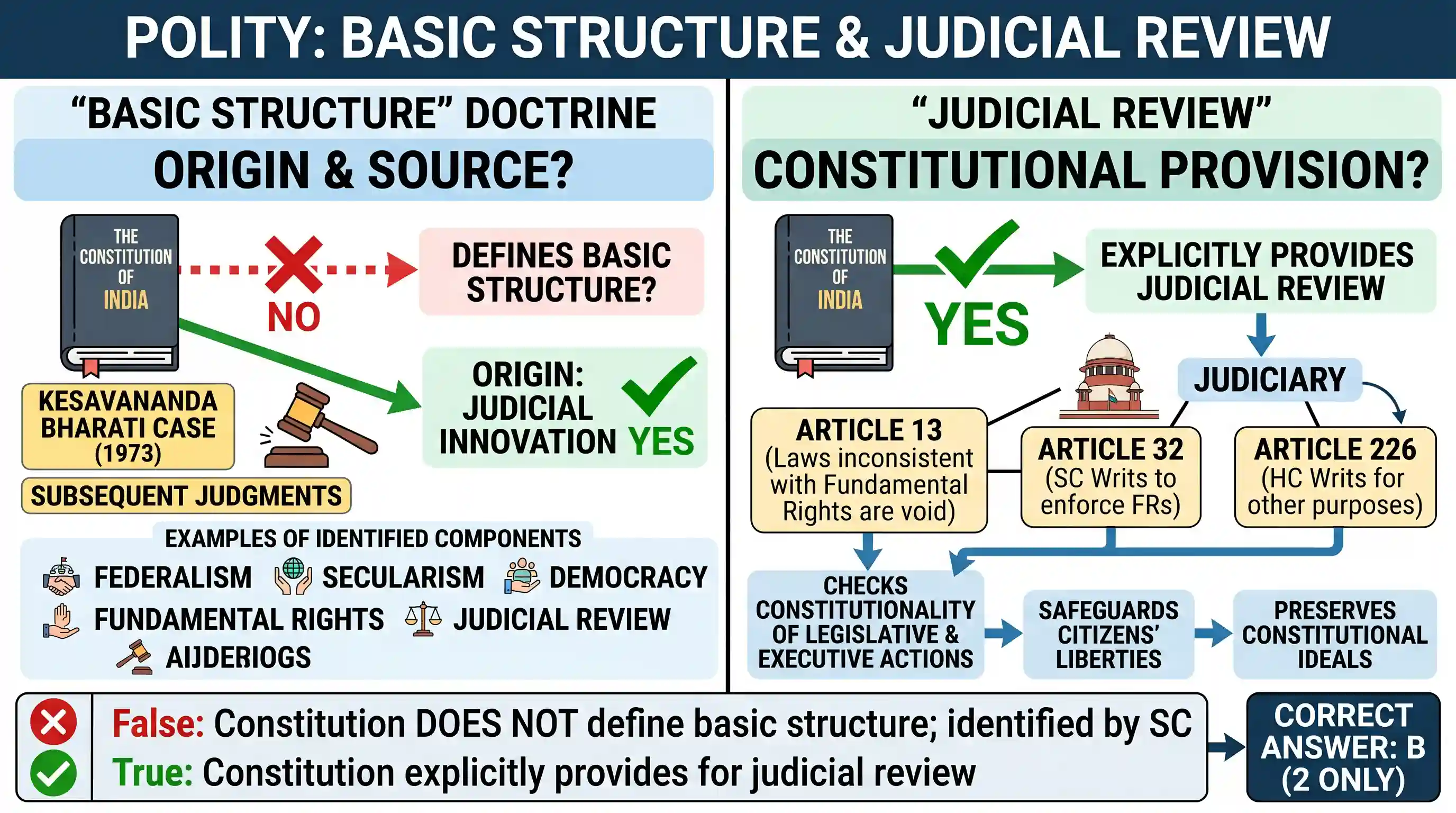
The Constitution of India defines its 'basic structure' in terms of federalism, secularism, fundamental rights and democracy. This statement is incorrect. The 'basic structure' doctrine is a judicial innovation that evolved through a series of Supreme Court judgments, most notably the Kesavananda Bharati case (1973). The Constitution of India itself does not explicitly define or list what constitutes its 'basic structure'. It is the judiciary that has, over time, identified various elements like federalism, secularism, democracy, republican nature, judicial review, etc., as part of this basic structure, which cannot be altered by parliamentary amendment.
-
The Constitution of India provides for 'judicial review' to safeguard the citizens' liberties and to preserve the ideals on which the Constitution is based. This statement is correct. The Constitution of India explicitly provides for judicial review in various articles. For example, Article 13 declares that laws inconsistent with or in derogation of Fundamental Rights shall be void. Articles 32 and 226 empower the Supreme Court and High Courts, respectively, to issue writs for the enforcement of Fundamental Rights and for other purposes. This power of judicial review is essential to check the constitutionality of legislative and executive actions, thereby safeguarding citizens' liberties and upholding constitutional ideals.
Therefore, only statement 2 is correct.
Related questions
More UPSC Prelims practice from the same subject and topic.
- Prelims 2020GS1polity-and-governance
A constitutional government by definition is a
- Prelims 2020GS1polity-and-governance
Other than the Fundamental Rights, which of the following parts of the Constitution of India reflect/reflects the principles and provisions of the Universal Declaration of Human Rights (1948)? 1. Prea…
- Prelims 2020GS1polity-and-governance
Which part of the Constitution of India declares the ideal of Welfare State?
- Prelims 2020GS1polity-and-governance
The Preamble to the Constitution of India is
- Prelims 2020GS1polity-and-governance
With reference to the provisions contained in Part IV of the Constitution of India, which of the following statements is/are correct? 1. They shall be enforceable by courts. 2. They shall not be enfor…
- Prelims 2020GS1polity-and-governance
Consider the following statements: 1. According to the Constitution of India, a person who is eligible to vote can be made a minister in a State for six months even if he/she is not a member of the Le…