One common agreement between Gandhism and Marxism is

- Athe final goal of a stateless societyCorrect
- Bclass struggle
- Cabolition of private property
- Deconomic determinism
Explanation
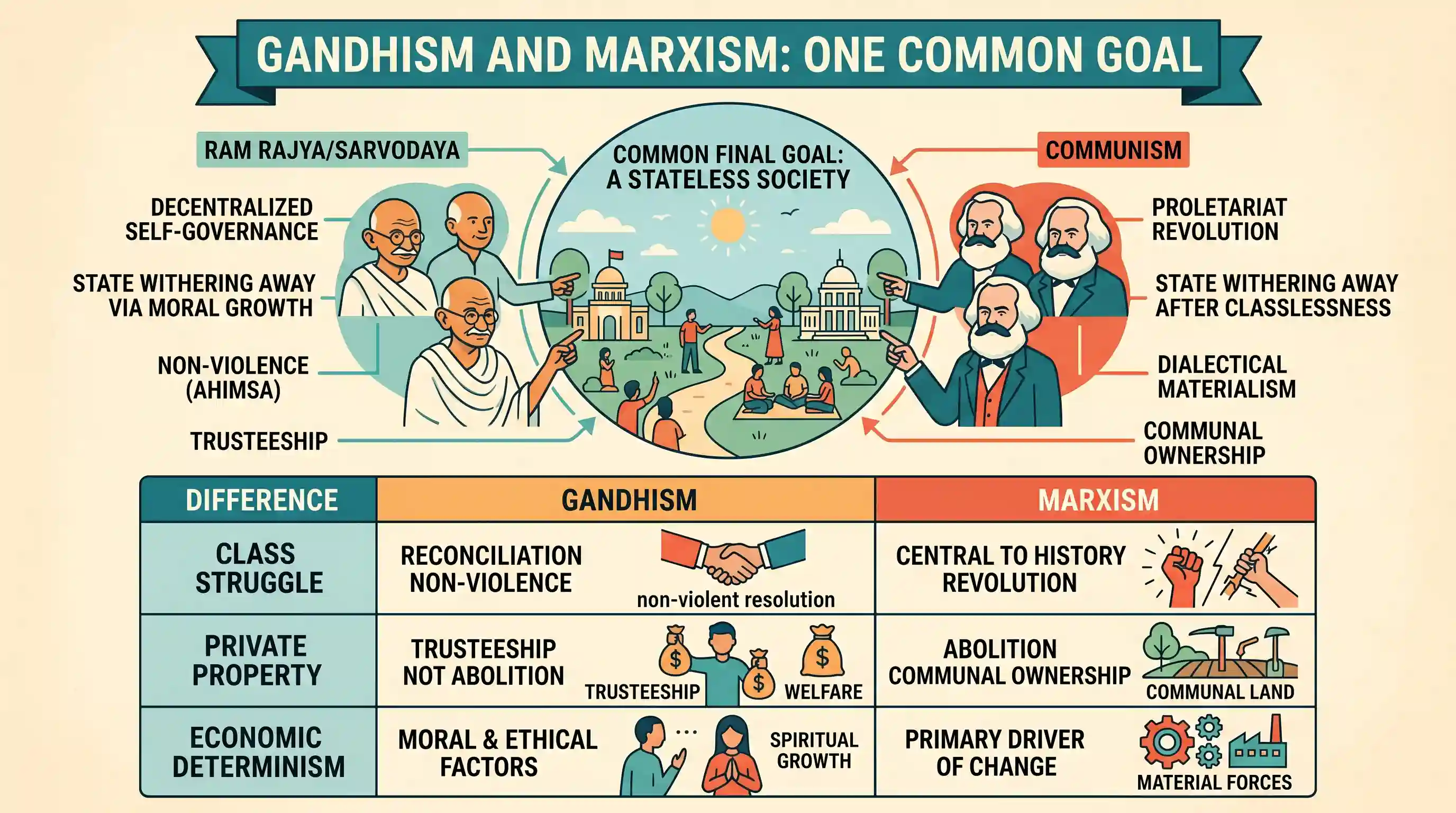
Despite their vastly different ideologies, methods, and philosophical foundations, Mahatma Gandhi and Karl Marx shared one common long-term goal for human society: a stateless society.
Mahatma Gandhi's vision (Ram Rajya/Sarvodaya): Gandhi believed in a decentralized, self-governing society (often termed 'Ram Rajya' or 'Sarvodaya') where people would be largely self-regulated, and the state, with its coercive power, would eventually wither away as individuals achieved moral perfection and self-control. His ideal society was based on voluntary cooperation, non-violence (ahimsa), and trusteeship, aiming for minimal government intervention. Karl Marx's vision (Communism): Marx envisioned communism as the final stage of historical development. In this stage, after the proletariat revolution and a transitional period of the 'dictatorship of the proletariat', class distinctions would disappear, and with them, the need for a state (which Marx viewed as an instrument of class oppression). The state would 'wither away', leading to a stateless, classless society. Let's examine why other options are incorrect:
B) class struggle: Marxism views history as a series of class struggles. Gandhism, in contrast, emphasized non-violent conflict resolution, trusteeship, and the potential for moral persuasion to transform oppressors, rather than advocating class struggle. C) abolition of private property: Marxism advocates for the abolition of private property, especially means of production, and communal ownership. Gandhism did not advocate for the outright abolition of private property but promoted the concept of 'trusteeship', where the wealthy would hold their property in trust for the welfare of society. D) economic determinism: Marxism is based on economic determinism, where economic forces are the primary drivers of historical change and societal structure. Gandhism, while acknowledging economic realities, placed greater emphasis on moral, ethical, and spiritual factors as drivers of individual and societal transformation. Therefore, the common agreement is the final goal of a stateless society.
Related questions
More UPSC Prelims practice from the same subject and topic.
- Prelims 2020GS1polity-and-governance
Consider the following statements: 1. Aadhaar metadata cannot be stored for more than three months. 2. State cannot enter into any contract with private corporations for sharing of Aadhaar data. 3. Aa…
- Prelims 2020GS1polity-and-governance
Rajya Sabha has equal powers with Lok Sabha in
- Prelims 2020GS1polity-and-governance
With reference to the funds under Members of Parliament Local Area Development Scheme (MPLADS), which of the following statements are correct? 1. MPLADS funds must be used to create durable assets lik…
- Prelims 2020GS1polity-and-governance
Which one of the following categories of Fundamental Rights incorporates protection against untouchability as a form of discrimination?
- Prelims 2020GS1polity-and-governance
In India, separation of judiciary from the executive is enjoined by
- Prelims 2020GS1polity-and-governance
A constitutional government by definition is a