If another global financial crisis happens in the near future, which of the following actions/policies are most likely to give some immunity to India? 1. Not depending on short-term foreign borrowings 2. Opening up to more foreign banks 3. Maintaining full capital account convertibility Select the correct answer using the code given below:

- A1 onlyCorrect
- B1 and 2 only
- C3 only
- D1, 2 and 3
Explanation
Let's analyze each action/policy in the context of providing immunity to India during a global financial crisis:
-
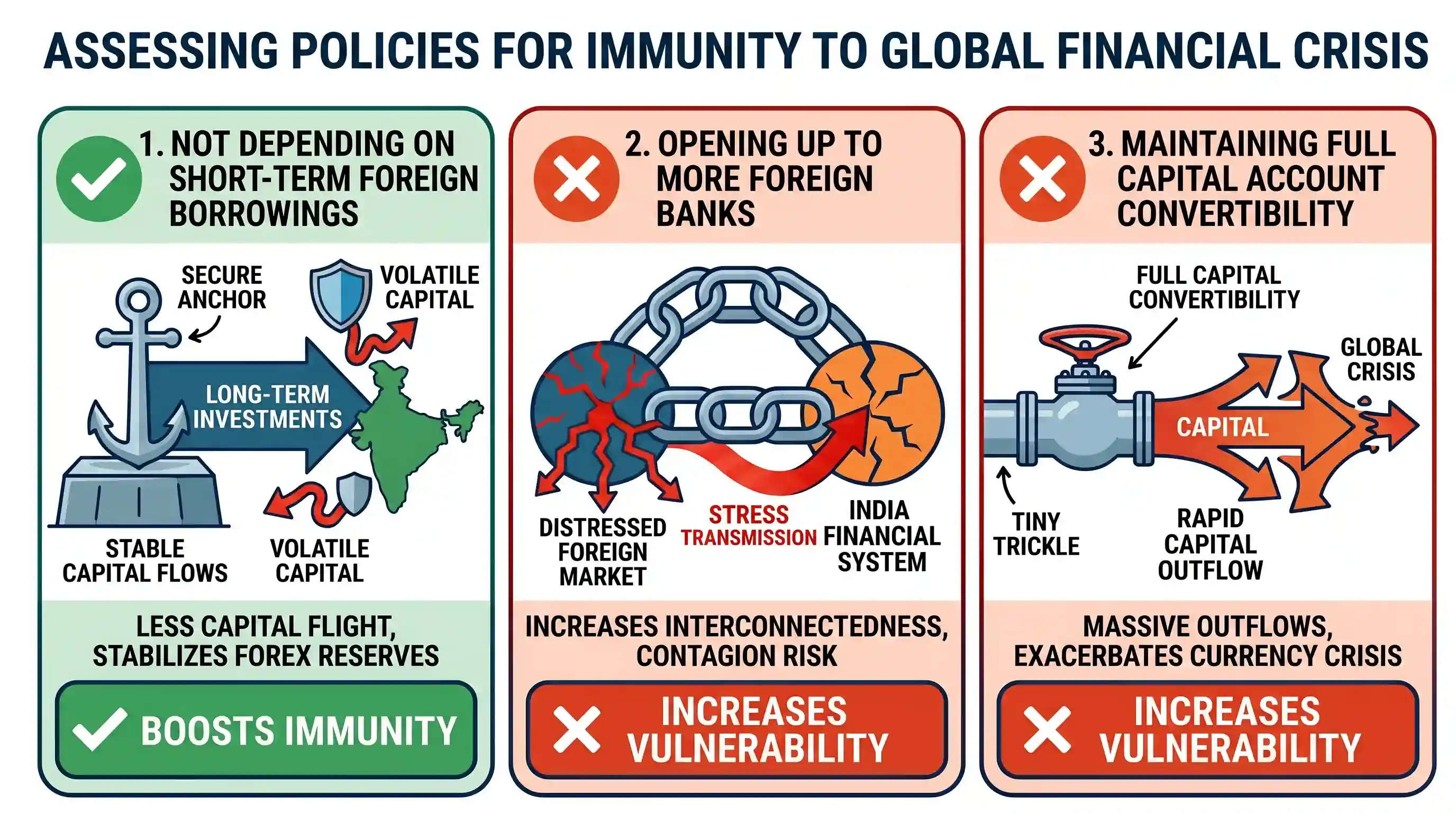
Not depending on short-term foreign borrowings: Correct. Short-term foreign borrowings (e.g., foreign institutional investments in debt, short-term external commercial borrowings) are highly volatile and can be rapidly withdrawn during a global financial crisis or period of uncertainty. This sudden outflow of capital can put immense pressure on a country's currency, lead to a sharp depreciation, deplete foreign exchange reserves, and trigger a liquidity crisis. Reducing reliance on such volatile capital inflows provides significant immunity from external shocks.
-
Opening up to more foreign banks: Incorrect. While foreign banks can bring benefits like increased competition and financial innovation, opening up to more foreign banks could also increase financial interconnectedness and potential contagion from global financial crises. If these foreign banks are heavily exposed to distressed assets or have liquidity issues in their home countries, their presence could transmit the crisis more directly into the domestic financial system.
-
Maintaining full capital account convertibility: Incorrect. Full capital account convertibility means there are no restrictions on the flow of capital (investments, loans, etc.) into and out of a country. While it can promote economic efficiency and attract foreign investment in normal times, in the event of a global financial crisis, it can lead to massive and rapid capital flight, exacerbating the crisis for the domestic economy. Countries often implement capital controls during crises to prevent such outflows. Therefore, maintaining full convertibility would make India more, not less, vulnerable.
Thus, only not depending on short-term foreign borrowings is likely to give some immunity to India during a global financial crisis.
Related questions
More UPSC Prelims practice from the same subject and topic.
- Prelims 2020GS1economy
With reference to Foreign Direct Investment in India, which one of the following is considered its major characteristic?
- Prelims 2020GS1economy
With reference to the international trade of India at present, which of the following statements is/are correct? 1. India's merchandise exports are less than its merchandise imports. 2. India's import…
- Prelims 2020GS1economy
With reference to Trade-Related Investment Measures (TRIMS), which of the following statements is/are correct? 1. Quantitative restrictions on imports by foreign investors are prohibited. 2. They appl…
- Prelims 2020GS1economy
Consider the following statements: 1. The value of Indo-Sri Lanka trade has consistently increased in the last decade. 2. "Textile and textile articles" constitute an important item of trade between I…
- Prelims 2020GS1economy
Along with the Budget, the Finance Minister also places other documents before the Parliament which include 'The Macro Economic Framework Statement'. The aforesaid document is presented because this i…
- Prelims 2020GS1economy
"Gold Tranche" (Reserve Tranche) refers to