If you withdraw ₹ 1,00,000 in cash from your Demand Deposit Account at your bank, the immediate effect on aggregate money supply in the economy will be

- Ato reduce it by ₹ 1,00,000
- Bto increase it by ₹ 1,00,000
- Cto increase it by more than ₹ 1,00,000
- Dto leave it unchangedCorrect
Explanation
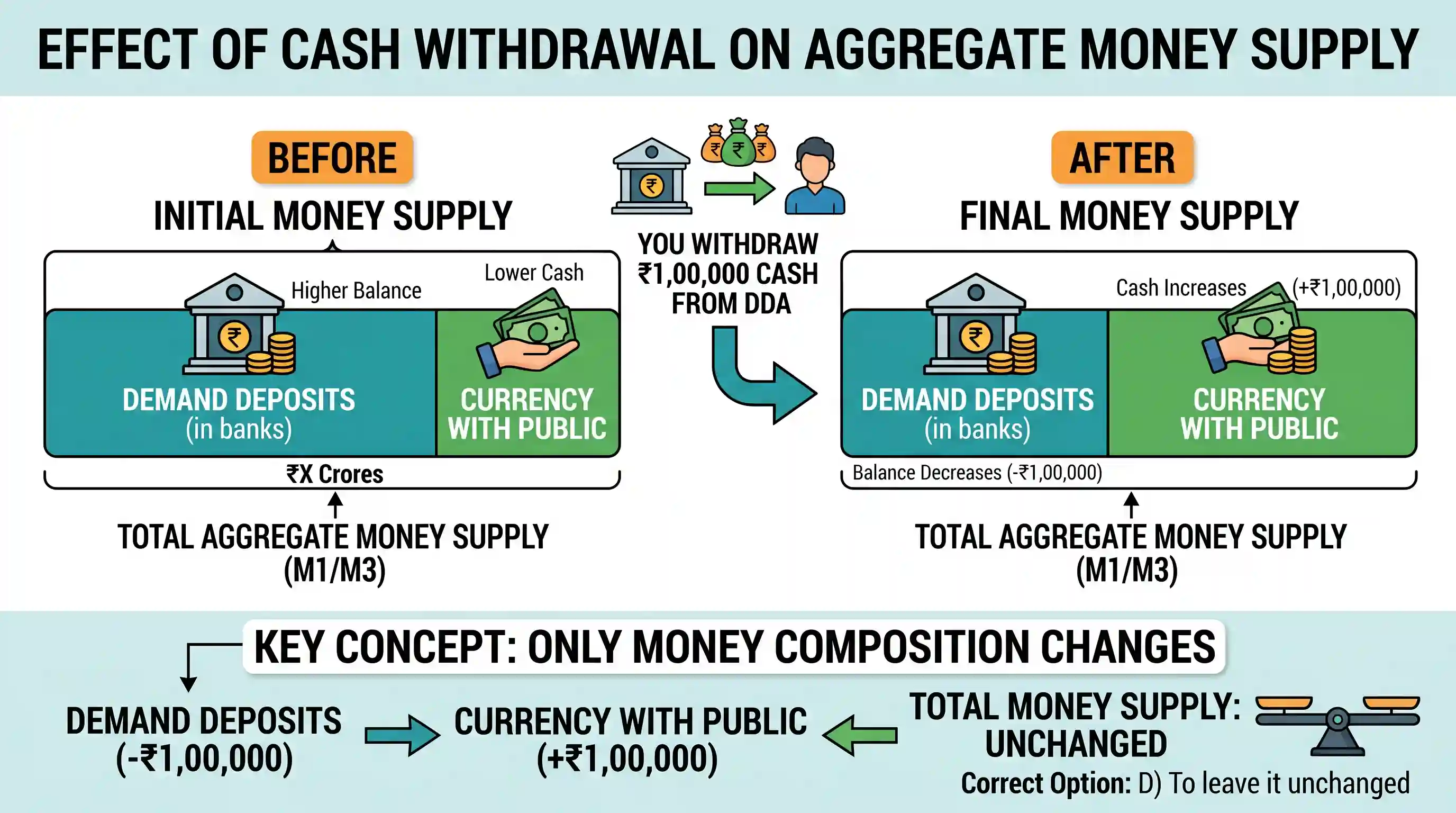
When you withdraw cash (currency in circulation) from your Demand Deposit Account at your bank, the immediate effect on the aggregate money supply in the economy is to leave it unchanged.
Here's why:
Money supply (typically measured as M1 or M3) includes both currency held by the public (cash) and demand deposits (money held in checking or savings accounts that can be readily accessed).
When you withdraw cash:
Your demand deposit balance decreases by ₹ 1,00,000. The amount of currency in circulation increases by ₹ 1,00,000. Essentially, you are converting one component of the money supply (demand deposit) into another component (currency). The total amount of money available in the economy, as defined by the aggregate money supply measures, does not change as a result of this transaction. It's a change in the composition of money, not its total quantity.
Related questions
More UPSC Prelims practice from the same subject and topic.
- Prelims 2020GS1economy
"Gold Tranche" (Reserve Tranche) refers to
- Prelims 2020GS1economy
In the context of the Indian economy, non-financial debt includes which of the following? 1. Housing loans owed by households 2. Amounts outstanding on credit cards 3. Treasury bills Select the correc…
- Prelims 2020GS1economy
If the RBI decides to adopt an expansionist monetary policy, which of the following would it not do ? 1. Cut and optimize the Statutory Liquidity Ratio 2. Increase the Marginal Standing Facility Rate …
- Prelims 2020GS1economy
With reference to the Indian economy, consider the following statements: 1. 'Commercial Paper' is a short-term unsecured promissory note. 2. 'Certificate of Deposit' is a long-term instrument issued b…
- Prelims 2020GS1economy
Along with the Budget, the Finance Minister also places other documents before the Parliament which include 'The Macro Economic Framework Statement'. The aforesaid document is presented because this i…
- Prelims 2020GS1economy
Which of the following phrases defines the nature of the 'Hundi' generally referred to in the sources of the post-Harsha period?