With reference to the Indian economy, consider the following statements: 1. 'Commercial Paper' is a short-term unsecured promissory note. 2. 'Certificate of Deposit' is a long-term instrument issued by the Reserve Bank of India to a corporation. 3. 'Call Money' is a short-term finance used for interbank transactions. 4. 'Zero-Coupon Bonds' are the interest bearing short-term bonds issued by the Scheduled Commercial Banks to corporations. Which of the statements given above is/are correct?

- A1 and 2 only
- B4 only
- C1 and 3 onlyCorrect
- D2, 3 and 4 only
Explanation
Let's analyze each statement regarding financial market instruments in India:
-
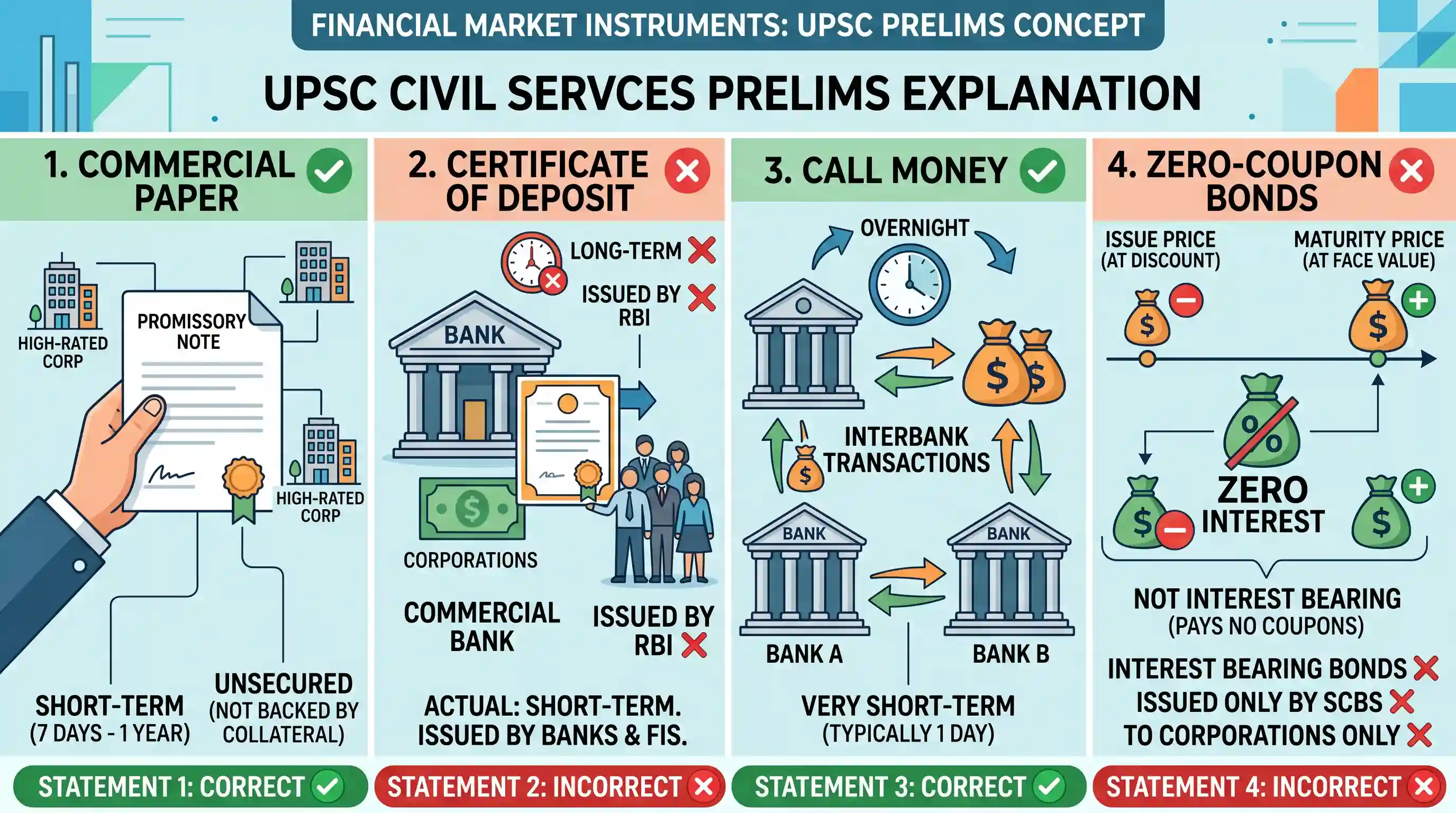
'Commercial Paper' is a short-term unsecured promissory note. This statement is correct. Commercial Paper (CP) is indeed a short-term (typically 7 days to 1 year) money market instrument issued by highly-rated corporate borrowers and primary dealers. It is unsecured, meaning it is not backed by collateral, and is issued in the form of a promissory note.
-
'Certificate of Deposit' is a long-term instrument issued by the Reserve Bank of India to a corporation. This statement is incorrect. A Certificate of Deposit (CD) is a short-term (generally 7 days to 1 year for banks; 3 months to 1 year for financial institutions) money market instrument. It is issued by commercial banks and financial institutions, not typically by the Reserve Bank of India, and can be issued to individuals, corporations, or funds. It is not a long-term instrument.
-
'Call Money' is a short-term finance used for interbank transactions. This statement is correct. Call money refers to overnight lending and borrowing between banks to manage their day-to-day liquidity positions. It is a very short-term (typically one day) money market instrument primarily used for interbank transactions.
-
'Zero-Coupon Bonds' are the interest bearing short-term bonds issued by the Scheduled Commercial Banks to corporations. This statement is incorrect. Zero-Coupon Bonds (ZCBs) are bonds that do not pay periodic interest (coupons). Instead, they are issued at a discount to their face value and redeemed at face value upon maturity, with the difference constituting the investor's return. They are not 'interest bearing' in the traditional sense, can be short or long-term, and are issued by various entities (governments, corporations), not exclusively by Scheduled Commercial Banks to corporations.
Therefore, statements 1 and 3 are correct.
Related questions
More UPSC Prelims practice from the same subject and topic.
- Prelims 2020GS1economy
"Gold Tranche" (Reserve Tranche) refers to
- Prelims 2020GS1economy
If you withdraw ₹ 1,00,000 in cash from your Demand Deposit Account at your bank, the immediate effect on aggregate money supply in the economy will be
- Prelims 2020GS1economy
In the context of the Indian economy, non-financial debt includes which of the following? 1. Housing loans owed by households 2. Amounts outstanding on credit cards 3. Treasury bills Select the correc…
- Prelims 2020GS1economy
If the RBI decides to adopt an expansionist monetary policy, which of the following would it not do ? 1. Cut and optimize the Statutory Liquidity Ratio 2. Increase the Marginal Standing Facility Rate …
- Prelims 2020GS1economy
Along with the Budget, the Finance Minister also places other documents before the Parliament which include 'The Macro Economic Framework Statement'. The aforesaid document is presented because this i…
- Prelims 2020GS1economy
Which of the following phrases defines the nature of the 'Hundi' generally referred to in the sources of the post-Harsha period?