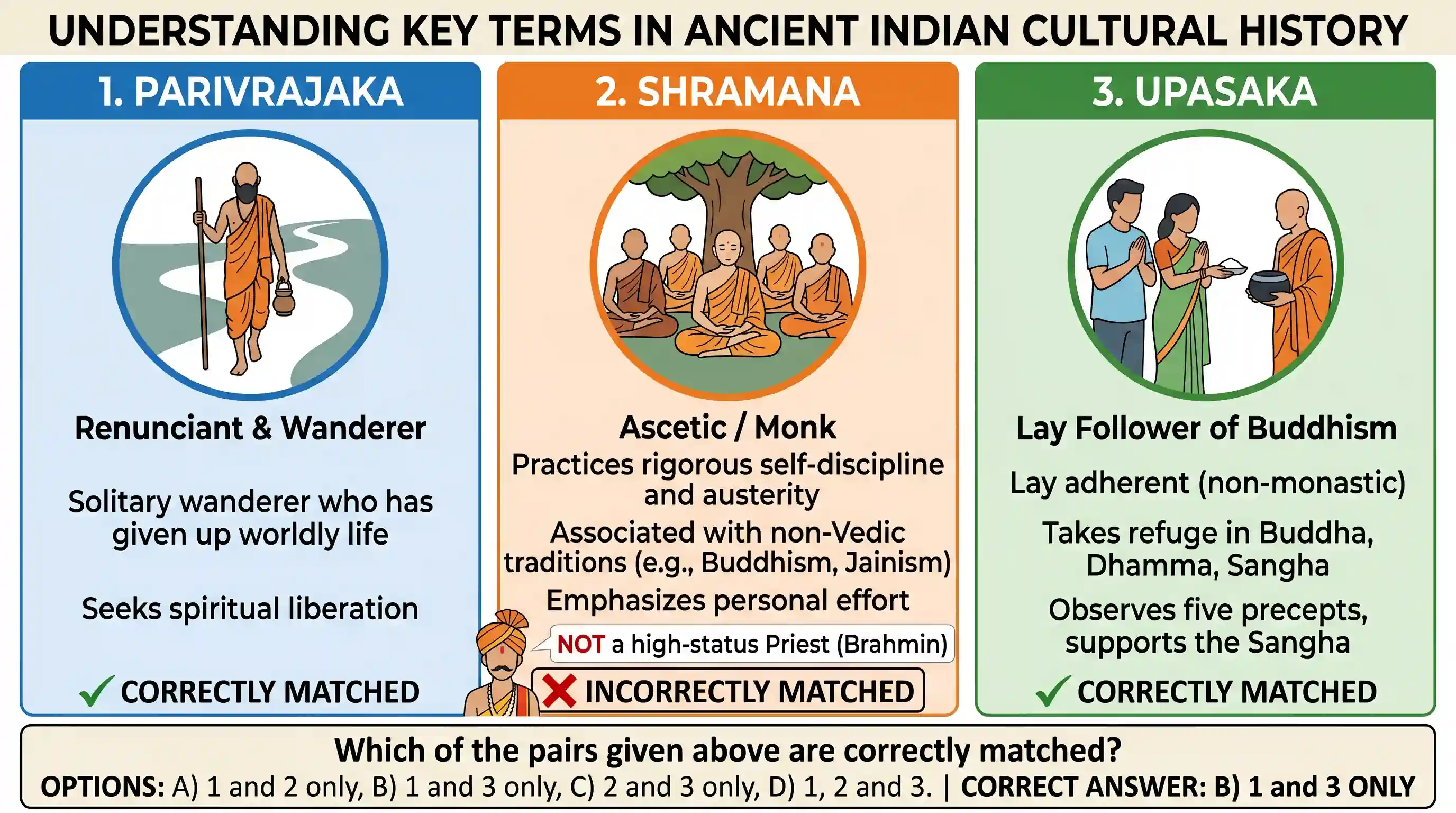
With reference to the cultural history of India, consider the following pairs: 1. Parivrajaka : Renunciant and Wanderer 2. Shramana : Priest with a high status 3. Upasaka : Lay follower of Buddhism Which of the pairs given above are correctly matched?

- A1 and 2 only
- B1 and 3 onlyCorrect
- C2 and 3 only
- D1, 2 and 3
Explanation
Let's examine the terms from the cultural history of India:
-
Parivrajaka : Renunciant and Wanderer: This pair is correctly matched. 'Parivrajaka' literally means 'one who wanders about' and refers to an ascetic or renunciant who has given up worldly attachments and leads a wandering life without a fixed abode, seeking spiritual liberation. This term is common in ancient Indian religious traditions, including Brahmanical, Buddhist, and Jain.
-
Shramana : Priest with a high status: This pair is incorrectly matched. 'Shramana' refers to ascetics, renunciants, or monks who practiced self-mortification and rigorous discipline to attain spiritual goals. They were often associated with non-Vedic traditions like Buddhism and Jainism. Shramanas were distinct from Vedic priests (Brahmins) and did not typically hold the status of priests in the traditional sense of performing rituals for others. They emphasized personal effort and inner transformation.
-
Upasaka : Lay follower of Buddhism: This pair is correctly matched. An 'Upasaka' (and Upasika for female) is a lay adherent or follower of Buddhism. They are individuals who take refuge in the Triple Gem (Buddha, Dhamma, Sangha) and observe the five precepts but do not join the monastic order (Sangha). They contribute to the Sangha's sustenance and uphold Buddhist principles in their daily lives.
Therefore, statements 1 and 3 are correctly matched.
Related questions
More UPSC Prelims practice from the same subject and topic.
- Prelims 2020GS1history
Consider the following events in the history of India: 1. Rise of Pratiharas under King Bhoja 2. Establishment of Pallava power under Mahendravarman - I 3. Establishment of Chola power by Parantaka - …
- Prelims 2020GS1history
With reference to the history of India, the terms "kulyavapa" and "dronavapa" denote
- Prelims 2020GS1history
Who among the following rulers advised his subjects through this inscription ? "Whosoever praises his religious sect or blames other sects out of excessive devotion to his own sect, with the view of g…
- Prelims 2020GS1history
With reference to the scholars/litterateurs of ancient India, consider the following statements: 1. Panini is associated with Pushyamitra Shunga. 2. Amarasimha is associated with Harshavardhana. 3. Ka…
- Prelims 2020GS1history
With reference to the period of Gupta dynasty in ancient India, the towns Ghantasala, Kadura and Chaul were well known as
- Prelims 2020GS1history
With reference to the history of India, consider the following pairs: Famous Place Present State 1. Bhilsa : Madhya Pradesh 2. Dwarasamudra : Maharashtra 3. Girinagar : Gujarat 4. Sthanesvara : Uttar …