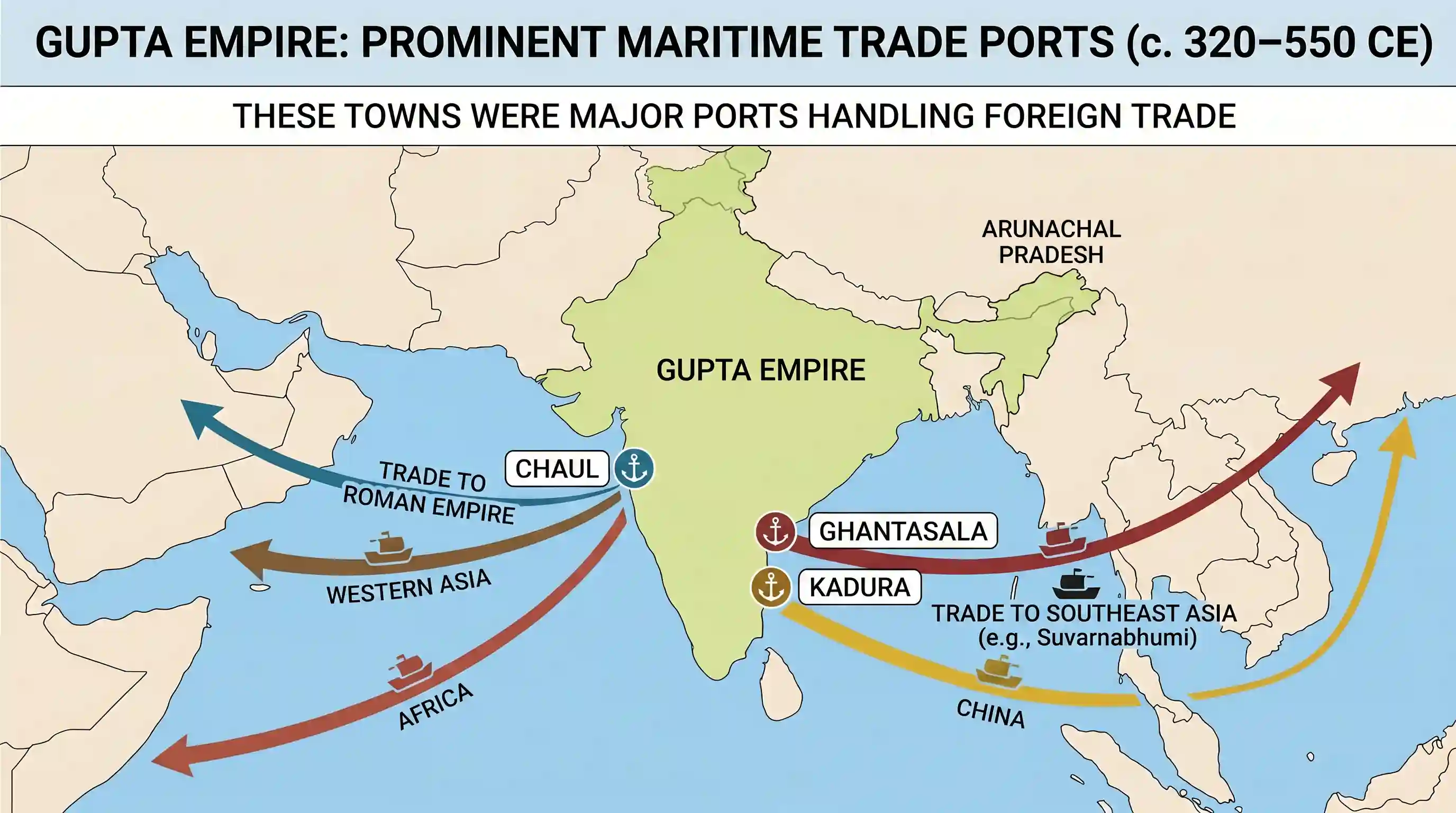
With reference to the period of Gupta dynasty in ancient India, the towns Ghantasala, Kadura and Chaul were well known as

- Aports handling foreign tradeCorrect
- Bcapitals of powerful kingdoms
- Cplaces of exquisite stone art and architecture
- Dimportant Buddhist pilgrimage centres
Explanation
During the period of the Gupta dynasty (circa 320 to 550 CE), ancient India had flourishing trade relations, both inland and overseas, with regions as far as the Roman Empire, Southeast Asia, and China. Maritime trade played a significant role in the economic prosperity of the empire.
Ghantasala, Kadura (also referred to as Kudura), and Chaul were well-known port towns that facilitated this extensive foreign trade:
Ghantasala and Kadura: These were important ports located on the eastern coast of India, primarily in the Andhra Pradesh region. They served as crucial hubs for maritime trade with Southeast Asian countries (like Suvarnabhumi, or present-day Southeast Asia) and potentially with the Roman Empire via sea routes. Chaul: Located on the western coast of India (near present-day Mumbai in Maharashtra), Chaul was a significant port that handled trade with the Western world, including the Roman Empire and later, Arab traders. These towns were vital centers for the import and export of a variety of goods, including spices, textiles, precious stones, metals, and luxury items, contributing significantly to the economy of the Gupta Empire. While some of these places might have had cultural or religious significance, their primary renown during the Gupta period, in the context of foreign interactions, was as bustling trading ports.
Related questions
More UPSC Prelims practice from the same subject and topic.
- Prelims 2020GS1history
Consider the following events in the history of India: 1. Rise of Pratiharas under King Bhoja 2. Establishment of Pallava power under Mahendravarman - I 3. Establishment of Chola power by Parantaka - …
- Prelims 2020GS1history
With reference to the history of India, the terms "kulyavapa" and "dronavapa" denote
- Prelims 2020GS1history
Who among the following rulers advised his subjects through this inscription ? "Whosoever praises his religious sect or blames other sects out of excessive devotion to his own sect, with the view of g…
- Prelims 2020GS1history
With reference to the scholars/litterateurs of ancient India, consider the following statements: 1. Panini is associated with Pushyamitra Shunga. 2. Amarasimha is associated with Harshavardhana. 3. Ka…
- Prelims 2020GS1history
With reference to the cultural history of India, consider the following pairs: 1. Parivrajaka : Renunciant and Wanderer 2. Shramana : Priest with a high status 3. Upasaka : Lay follower of Buddhism Wh…
- Prelims 2020GS1history
With reference to the history of India, consider the following pairs: Famous Place Present State 1. Bhilsa : Madhya Pradesh 2. Dwarasamudra : Maharashtra 3. Girinagar : Gujarat 4. Sthanesvara : Uttar …