What is/are the advantage/advantages of zero tillage in agriculture ? 1. Sowing of wheat is possible without burning the residue of previous crop. 2. Without the need for nursery of rice saplings, direct planting of paddy seeds in the wet soil is possible. 3. Carbon sequestration in the soil is possible. Select the correct answer using the code given below:

- A1 and 2 only
- B2 and 3 only
- C3 only
- D1, 2 and 3Correct
Explanation
Zero tillage, also known as no-till farming, is an agricultural practice where crops are grown without disturbing the soil through tilling or ploughing. It is a key component of conservation agriculture and offers multiple advantages for environmental sustainability and agricultural productivity. All three statements are correct:
-
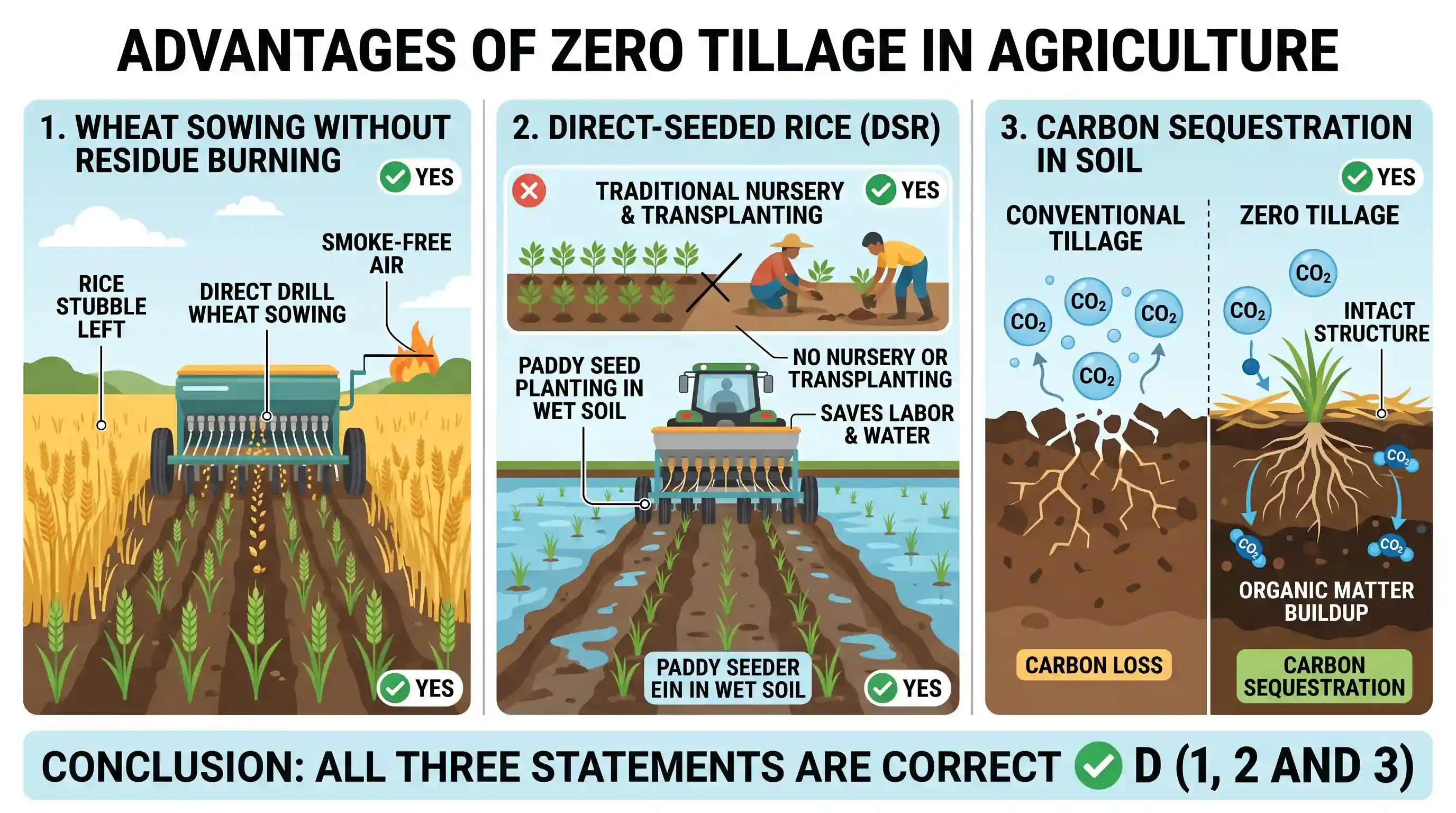
Sowing of wheat is possible without burning the residue of previous crop: Zero tillage systems allow for direct sowing of the next crop (e.g., wheat) into the soil, leaving the residues of the previous crop (e.g., rice stubble) on the surface. This eliminates the need for stubble burning, a common practice that causes severe air pollution, loss of soil organic matter, and destruction of beneficial microorganisms.
-
Without the need for nursery of rice saplings, direct planting of paddy seeds in the wet soil is possible: Zero tillage facilitates direct-seeded rice (DSR) cultivation. In DSR, paddy seeds are directly sown into the wet field, bypassing the traditional method of raising seedlings in a nursery and then transplanting them. This saves significant labor, water, and time, aligning perfectly with zero tillage principles.
-
Carbon sequestration in the soil is possible: By minimizing soil disturbance, zero tillage promotes the accumulation of organic matter in the soil. This leads to an increase in soil carbon content over time, effectively sequestering atmospheric carbon dioxide into the soil. This practice helps mitigate climate change by reducing greenhouse gas emissions and enhancing soil health.
Therefore, zero tillage is a comprehensive approach offering benefits across environmental and agricultural dimensions.
Related questions
More UPSC Prelims practice from the same subject and topic.
- Prelims 2020GS1geography
Which of the following are the reasons/factors for exposure to benzene pollution? 1. Automobile exhaust 2. Tobacco smoke 3. Wood burning 4. Using varnished wooden furniture 5. Using products made of p…
- Prelims 2020GS1geography
With reference to Indian elephants, consider the following statements: 1. The leader of an elephant group is a female. 2. The maximum gestation period can be 22 months. 3. An elephant can normally go …
- Prelims 2020GS1geography
With reference to India's biodiversity, Ceylon frogmouth, Coppersmith barbet, Gray-chinned minivet and White-throated redstart are
- Prelims 2020GS1geography
Which one of the following protected areas is well-known for the conservation of a sub-species of the Indian swamp deer (Barasingha) that thrives well on hard ground and is exclusively graminivorous?
- Prelims 2020GS1geography
Which of the following are the most likely places to find the musk deer in its natural habitat? 1. Askot Wildlife Sanctuary 2. Gangotri National Park 3. Kishanpur Wildlife Sanctuary 4. Manas National …
- Prelims 2020GS1geography
In rural road construction, the use of which of the following is preferred for ensuring environmental sustainability or to reduce carbon footprint? 1. Copper slag 2. Cold mix asphalt technology 3. Geo…