Which one of the following protected areas is well-known for the conservation of a sub-species of the Indian swamp deer (Barasingha) that thrives well on hard ground and is exclusively graminivorous?

- AKanha National ParkCorrect
- BManas National Park
- CMudumalai Wildlife Sanctuary
- DTal Chhapar Wildlife Sanctuary
Explanation
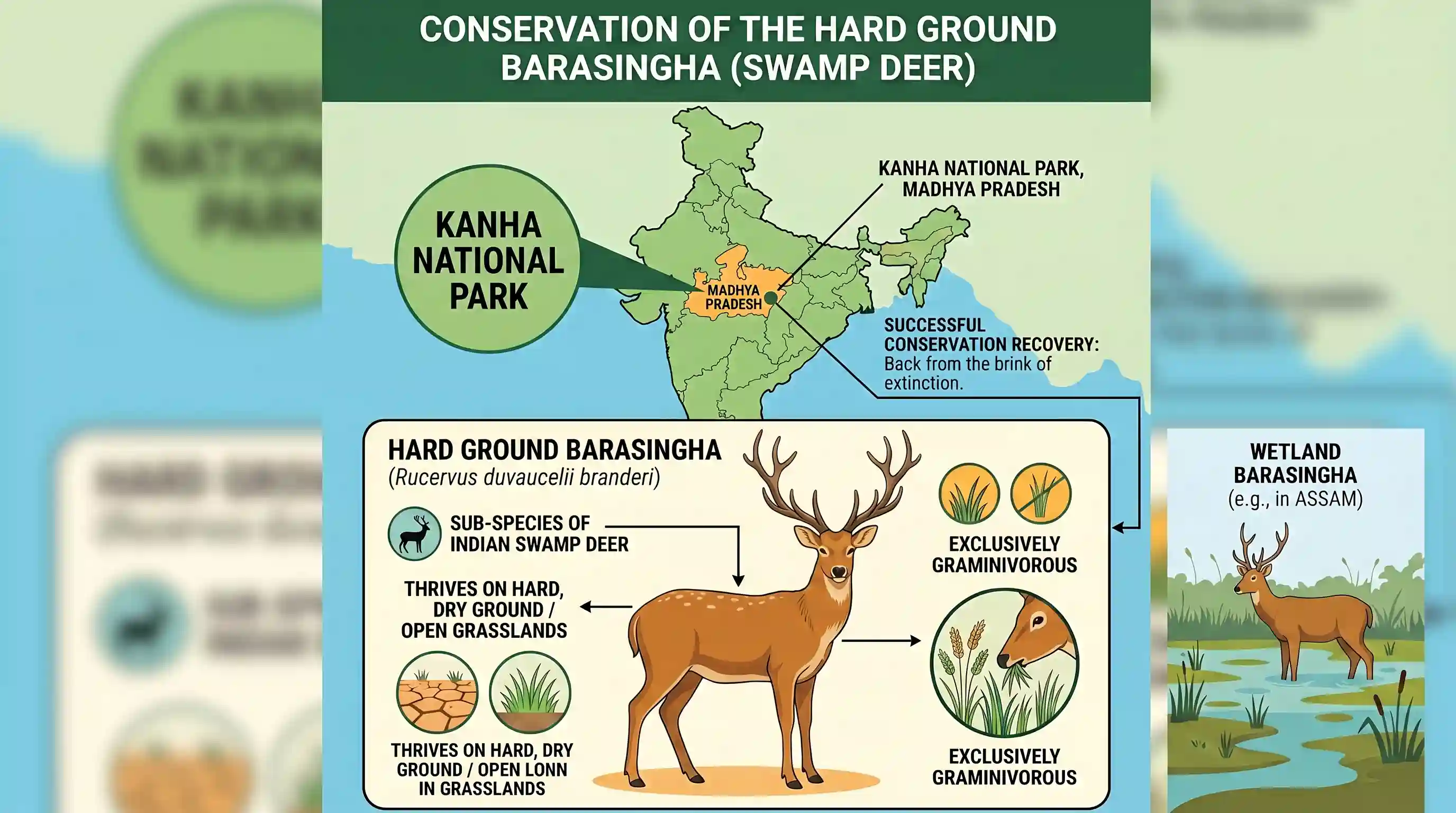
Kanha National Park, located in Madhya Pradesh, is widely recognized for its significant role in the conservation of the hard ground Barasingha (Rucervus duvaucelii branderi), a distinct sub-species of the Indian swamp deer. Unlike its counterparts that prefer swampy grasslands, the hard ground Barasingha thrives in the dry, open grasslands typical of Kanha. It is also exclusively graminivorous, meaning it feeds solely on grasses.
Kanha National Park successfully brought this sub-species back from the brink of extinction through dedicated conservation efforts, making it a prime example of successful wildlife management.
Manas National Park (Assam): Known for its tigers, rhinos, and wild buffalo, but not specifically for hard ground Barasingha.
Mudumalai Wildlife Sanctuary (Tamil Nadu): Part of the Nilgiri Biosphere Reserve, known for elephants, tigers, and a wide variety of other fauna, but not the hard ground Barasingha.
Tal Chhapar Wildlife Sanctuary (Rajasthan): Known for its Blackbucks.
Related questions
More UPSC Prelims practice from the same subject and topic.
- Prelims 2020GS1geography
Which of the following are the reasons/factors for exposure to benzene pollution? 1. Automobile exhaust 2. Tobacco smoke 3. Wood burning 4. Using varnished wooden furniture 5. Using products made of p…
- Prelims 2020GS1geography
With reference to Indian elephants, consider the following statements: 1. The leader of an elephant group is a female. 2. The maximum gestation period can be 22 months. 3. An elephant can normally go …
- Prelims 2020GS1geography
With reference to India's biodiversity, Ceylon frogmouth, Coppersmith barbet, Gray-chinned minivet and White-throated redstart are
- Prelims 2020GS1geography
Which of the following are the most likely places to find the musk deer in its natural habitat? 1. Askot Wildlife Sanctuary 2. Gangotri National Park 3. Kishanpur Wildlife Sanctuary 4. Manas National …
- Prelims 2020GS1geography
In rural road construction, the use of which of the following is preferred for ensuring environmental sustainability or to reduce carbon footprint? 1. Copper slag 2. Cold mix asphalt technology 3. Geo…
- Prelims 2020GS1geography
Consider the following statements: 1. Coal ash contains arsenic, lead and mercury. 2. Coal-fired power plants release sulphur dioxide and oxides of nitrogen into the environment. 3. High ash content i…