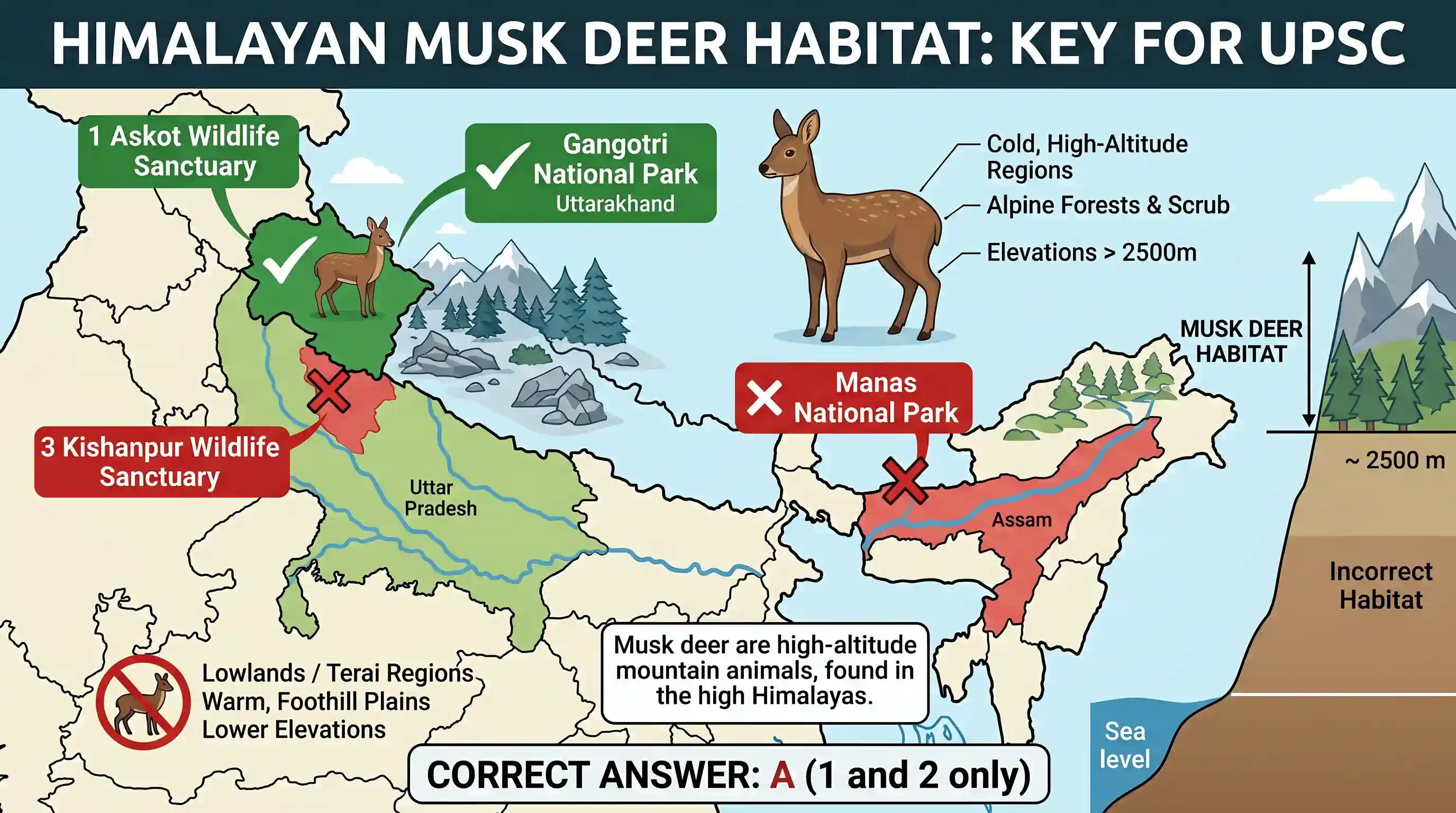
Which of the following are the most likely places to find the musk deer in its natural habitat? 1. Askot Wildlife Sanctuary 2. Gangotri National Park 3. Kishanpur Wildlife Sanctuary 4. Manas National Park Select the correct answer using the code given below:

- A1 and 2 onlyCorrect
- B2 and 3 only
- C3 and 4 only
- D1 and 4 only
Explanation
The musk deer (specifically the Himalayan Musk Deer, Moschus chrysogaster) is a species typically found in the high-altitude, cold environments of the Himalayan region. Its natural habitat includes alpine forests, scrublands, and rocky areas at elevations generally above 2,500 meters.
-
Askot Wildlife Sanctuary: Located in Uttarakhand, Askot Wildlife Sanctuary is a renowned habitat for musk deer. It encompasses diverse Himalayan ecosystems, providing the necessary high-altitude forests and challenging terrains that musk deer prefer.
-
Gangotri National Park: Situated in Uttarakhand, Gangotri National Park is another key protected area within the high Himalayas. Its alpine meadows, coniferous forests, and rocky terrains offer ideal conditions for musk deer, and it is a known stronghold for the species.
-
Kishanpur Wildlife Sanctuary: Located in the Terai region of Uttar Pradesh, Kishanpur Wildlife Sanctuary is primarily a habitat for swamp deer and other lowland species. Its geographical location and elevation are not suitable for musk deer, which are mountain-dwelling animals.
-
Manas National Park: Situated in Assam, Manas National Park is part of the Eastern Himalayan foothills and plains, known for its rich biodiversity including tigers, elephants, and pygmy hogs. While it is in a different part of the Himalayas, its lower altitude and distinct ecosystem do not typically support the Himalayan Musk Deer as a primary habitat.
Therefore, only Askot Wildlife Sanctuary and Gangotri National Park are highly likely places to find the musk deer in its natural habitat among the given options.
Related questions
More UPSC Prelims practice from the same subject and topic.
- Prelims 2020GS1geography
Which of the following are the reasons/factors for exposure to benzene pollution? 1. Automobile exhaust 2. Tobacco smoke 3. Wood burning 4. Using varnished wooden furniture 5. Using products made of p…
- Prelims 2020GS1geography
With reference to Indian elephants, consider the following statements: 1. The leader of an elephant group is a female. 2. The maximum gestation period can be 22 months. 3. An elephant can normally go …
- Prelims 2020GS1geography
With reference to India's biodiversity, Ceylon frogmouth, Coppersmith barbet, Gray-chinned minivet and White-throated redstart are
- Prelims 2020GS1geography
Which one of the following protected areas is well-known for the conservation of a sub-species of the Indian swamp deer (Barasingha) that thrives well on hard ground and is exclusively graminivorous?
- Prelims 2020GS1geography
In rural road construction, the use of which of the following is preferred for ensuring environmental sustainability or to reduce carbon footprint? 1. Copper slag 2. Cold mix asphalt technology 3. Geo…
- Prelims 2020GS1geography
Consider the following statements: 1. Coal ash contains arsenic, lead and mercury. 2. Coal-fired power plants release sulphur dioxide and oxides of nitrogen into the environment. 3. High ash content i…