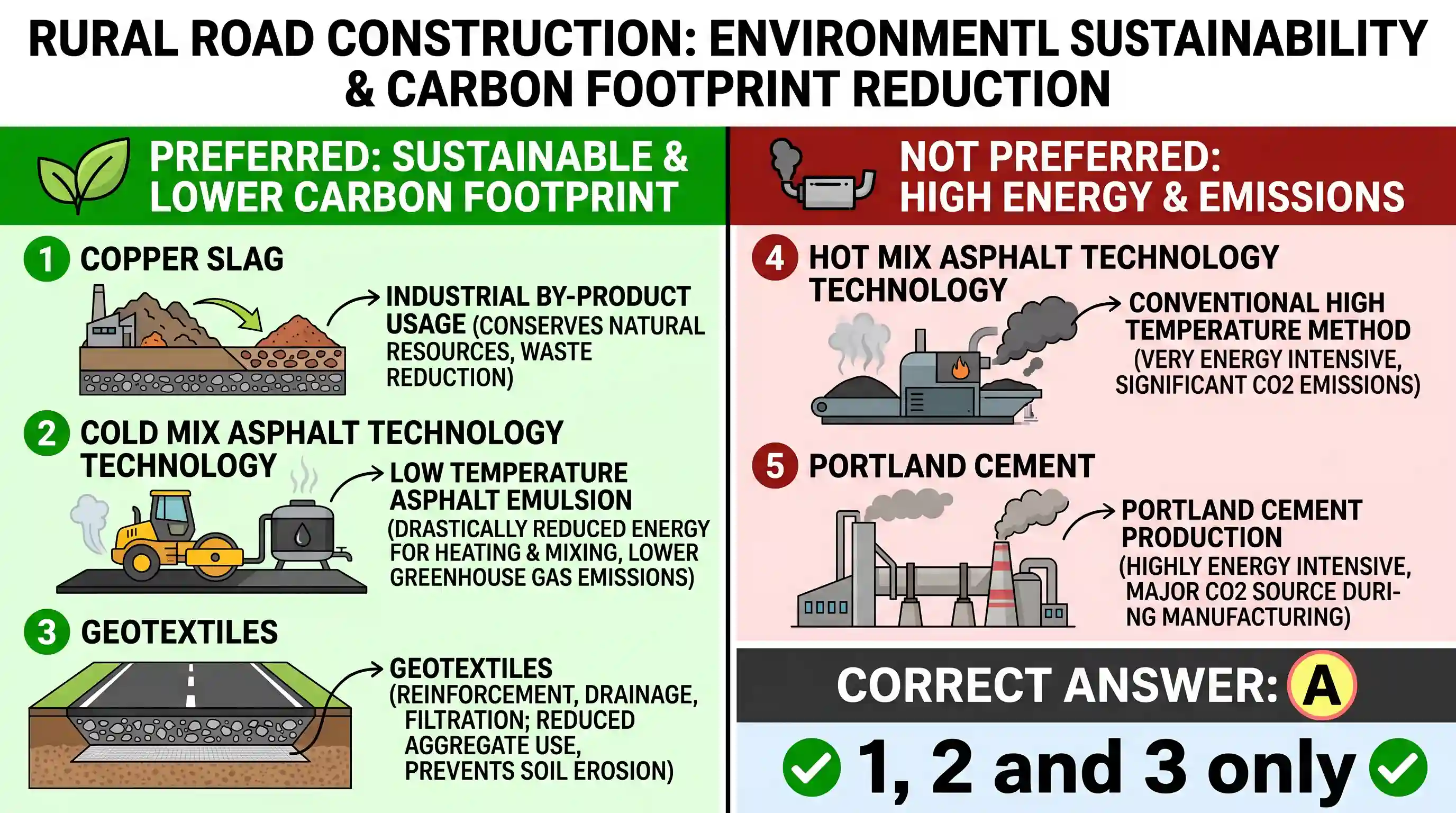
In rural road construction, the use of which of the following is preferred for ensuring environmental sustainability or to reduce carbon footprint? 1. Copper slag 2. Cold mix asphalt technology 3. Geotextiles 4. Hot mix asphalt technology 5. Portland cement Select the correct answer using the code given below:

- A1, 2 and 3 onlyCorrect
- B2, 3 and 4 only
- C4 and 5 only
- D1 and 5 only
Explanation
To ensure environmental sustainability and reduce carbon footprint in rural road construction, the following options are preferred:
-
Copper slag: Copper slag is an industrial by-product that can be effectively used as a substitute for natural aggregates in road construction. Its utilization helps reduce the demand for virgin materials, conserves natural resources, and provides a sustainable way to manage industrial waste, thus contributing to a lower environmental impact.
-
Cold mix asphalt technology: Unlike traditional hot mix asphalt, cold mix asphalt technology uses asphalt emulsions at ambient or significantly lower temperatures. This drastically reduces the energy required for heating and mixing, leading to lower fuel consumption and a substantial reduction in greenhouse gas emissions (carbon footprint) during construction. It is a highly preferred sustainable technology.
-
Geotextiles: Geotextiles are permeable fabrics used in various civil engineering applications, including road construction, for separation, reinforcement, filtration, and drainage. Their use can improve the structural integrity and longevity of roads, reduce the need for excessive aggregate layers, minimize soil erosion, and enhance the overall sustainability of the construction project by optimizing material use and reducing maintenance cycles.
-
Hot mix asphalt technology: This is the conventional method that requires heating asphalt and aggregates to very high temperatures (typically 150-180°C). This process is highly energy-intensive and results in significant greenhouse gas emissions and release of volatile organic compounds, making it less preferred for environmental sustainability compared to cold mix technology.
-
Portland cement: While Portland cement is a fundamental component in many construction activities, including some road applications (e.g., concrete roads, soil stabilization), its production is known to be highly energy-intensive and a major source of carbon dioxide emissions. While necessary for certain applications, its widespread use is generally associated with a higher carbon footprint compared to other more sustainable alternatives or practices in road construction. The question asks for preferences specifically for environmental sustainability or reducing carbon footprint.
Therefore, options 1, 2, and 3 are preferred for ensuring environmental sustainability and reducing carbon footprint in rural road construction.
Related questions
More UPSC Prelims practice from the same subject and topic.
- Prelims 2020GS1geography
Which of the following are the reasons/factors for exposure to benzene pollution? 1. Automobile exhaust 2. Tobacco smoke 3. Wood burning 4. Using varnished wooden furniture 5. Using products made of p…
- Prelims 2020GS1geography
With reference to Indian elephants, consider the following statements: 1. The leader of an elephant group is a female. 2. The maximum gestation period can be 22 months. 3. An elephant can normally go …
- Prelims 2020GS1geography
With reference to India's biodiversity, Ceylon frogmouth, Coppersmith barbet, Gray-chinned minivet and White-throated redstart are
- Prelims 2020GS1geography
Which one of the following protected areas is well-known for the conservation of a sub-species of the Indian swamp deer (Barasingha) that thrives well on hard ground and is exclusively graminivorous?
- Prelims 2020GS1geography
Which of the following are the most likely places to find the musk deer in its natural habitat? 1. Askot Wildlife Sanctuary 2. Gangotri National Park 3. Kishanpur Wildlife Sanctuary 4. Manas National …
- Prelims 2020GS1geography
Consider the following statements: 1. Coal ash contains arsenic, lead and mercury. 2. Coal-fired power plants release sulphur dioxide and oxides of nitrogen into the environment. 3. High ash content i…