If a particular plant species is placed under Schedule VI of The Wildlife Protection Act, 1972, what is the implication?

- AA licence is required to cultivate that plant.Correct
- BSuch a plant cannot be cultivated under any circumstances.
- CIt is a Genetically Modified crop plant.
- DSuch a plant is invasive and harmful to the ecosystem.
Explanation
The Wildlife (Protection) Act, 1972, provides for the protection of wild animals and plants. It categorizes species into various schedules based on their conservation status and the level of protection afforded to them.
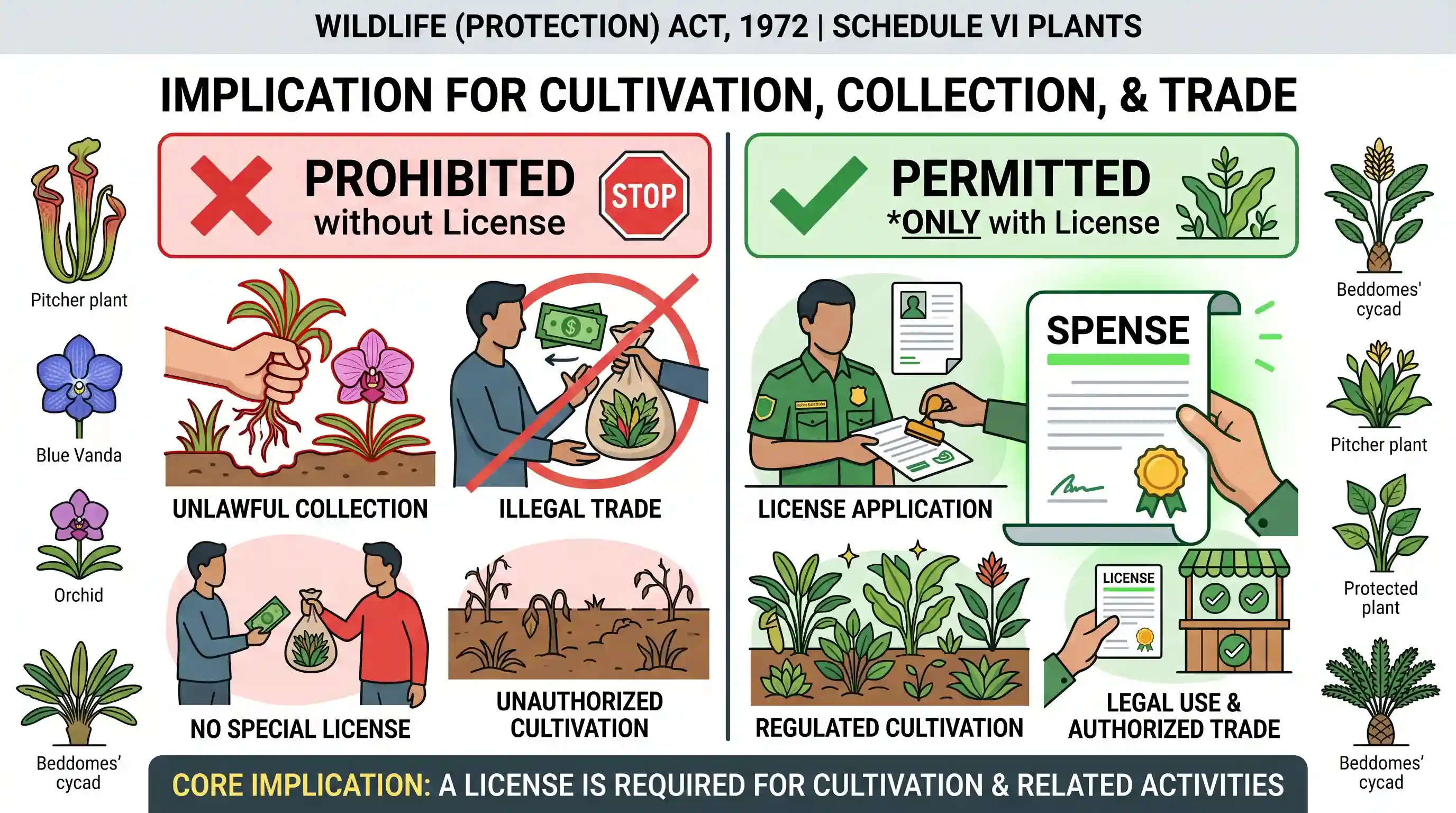
Schedule VI of the Wildlife (Protection) Act, 1972, lists specific plant species that are under special protection. For these plants, any cultivation, collection, extraction, transport, or trade requires a special license from the Chief Wildlife Warden or an authorized officer. This provision is primarily aimed at preventing the unregulated exploitation and trade of certain rare, endangered, or otherwise protected plant species.
Therefore, the implication of a plant species being placed under Schedule VI is that a license is required to cultivate that plant. It does not mean it cannot be cultivated under any circumstances (as a license is possible), nor does it imply that it is a Genetically Modified crop plant or an invasive and harmful species (though some invasive species might be regulated under other provisions, this is not the direct implication of Schedule VI).
Related questions
More UPSC Prelims practice from the same subject and topic.
- Prelims 2020GS1geography
Which of the following are the reasons/factors for exposure to benzene pollution? 1. Automobile exhaust 2. Tobacco smoke 3. Wood burning 4. Using varnished wooden furniture 5. Using products made of p…
- Prelims 2020GS1geography
With reference to Indian elephants, consider the following statements: 1. The leader of an elephant group is a female. 2. The maximum gestation period can be 22 months. 3. An elephant can normally go …
- Prelims 2020GS1geography
With reference to India's biodiversity, Ceylon frogmouth, Coppersmith barbet, Gray-chinned minivet and White-throated redstart are
- Prelims 2020GS1geography
Which one of the following protected areas is well-known for the conservation of a sub-species of the Indian swamp deer (Barasingha) that thrives well on hard ground and is exclusively graminivorous?
- Prelims 2020GS1geography
Which of the following are the most likely places to find the musk deer in its natural habitat? 1. Askot Wildlife Sanctuary 2. Gangotri National Park 3. Kishanpur Wildlife Sanctuary 4. Manas National …
- Prelims 2020GS1geography
In rural road construction, the use of which of the following is preferred for ensuring environmental sustainability or to reduce carbon footprint? 1. Copper slag 2. Cold mix asphalt technology 3. Geo…