In the context of the Indian economy, non-financial debt includes which of the following? 1. Housing loans owed by households 2. Amounts outstanding on credit cards 3. Treasury bills Select the correct answer using the code given below:

- A1 only
- B1 and 2 only
- C3 only
- D1, 2 and 3Correct
Explanation
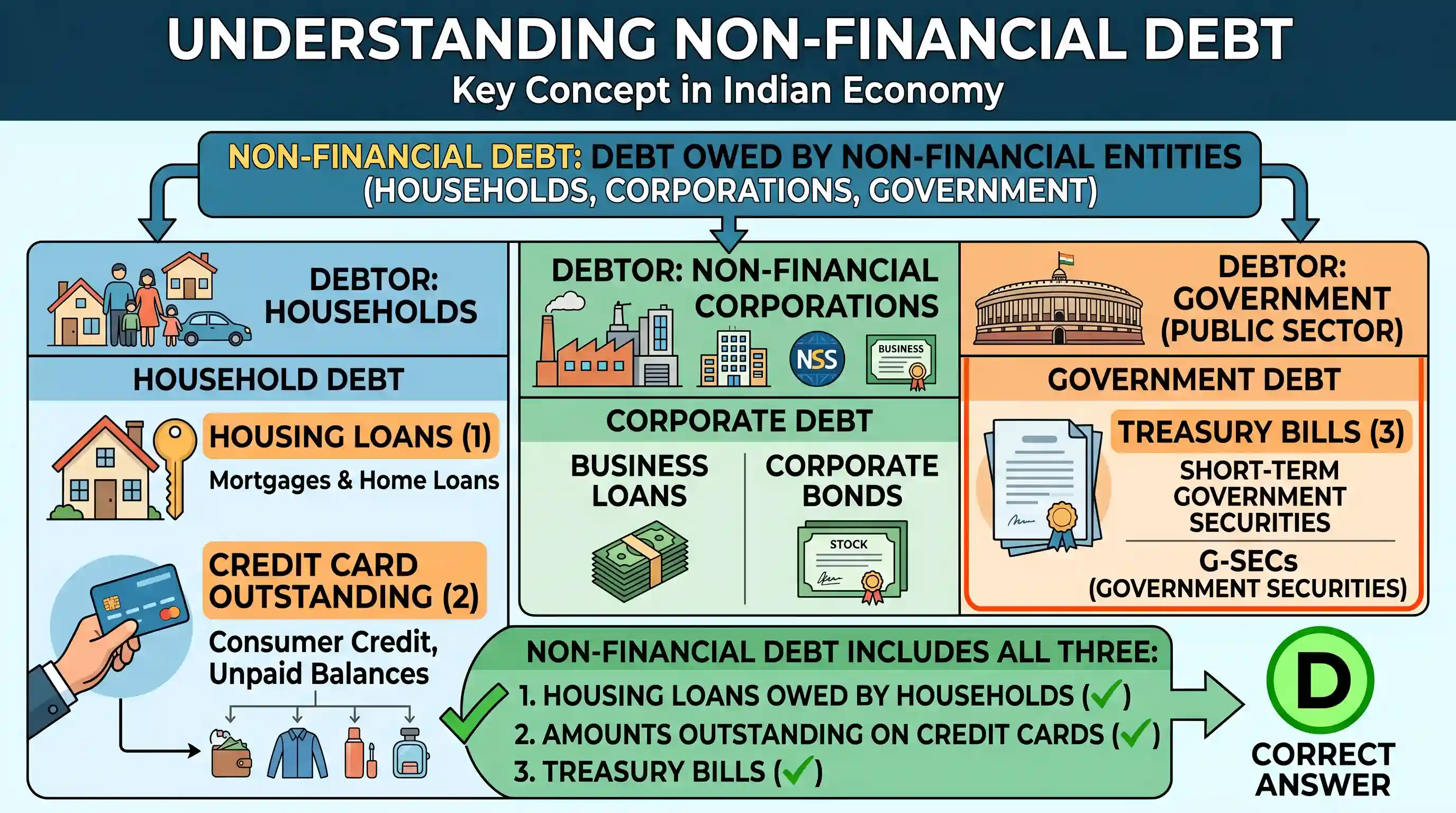
Non-financial debt refers to debt held by non-financial entities — households, non-financial corporations, and the government (as opposed to debt held by banks and financial institutions).
-
Housing loans owed by households: Households are non-financial entities. Their borrowings (mortgages, home loans) form a core part of non-financial debt. ✓
-
Amounts outstanding on credit cards: Credit card balances are consumer debt owed by households — a non-financial sector entity. ✓
-
Treasury bills: T-bills are debt instruments issued by the government. The government is a non-financial entity, and its borrowings are counted as non-financial debt (specifically, government/public debt — a sub-category of total non-financial debt). ✓
All three — household debt, consumer credit, and government securities — are classified as non-financial debt. The correct answer is 1, 2 and 3.
Related questions
More UPSC Prelims practice from the same subject and topic.
- Prelims 2020GS1economy
"Gold Tranche" (Reserve Tranche) refers to
- Prelims 2020GS1economy
If you withdraw ₹ 1,00,000 in cash from your Demand Deposit Account at your bank, the immediate effect on aggregate money supply in the economy will be
- Prelims 2020GS1economy
If the RBI decides to adopt an expansionist monetary policy, which of the following would it not do ? 1. Cut and optimize the Statutory Liquidity Ratio 2. Increase the Marginal Standing Facility Rate …
- Prelims 2020GS1economy
With reference to the Indian economy, consider the following statements: 1. 'Commercial Paper' is a short-term unsecured promissory note. 2. 'Certificate of Deposit' is a long-term instrument issued b…
- Prelims 2020GS1economy
Along with the Budget, the Finance Minister also places other documents before the Parliament which include 'The Macro Economic Framework Statement'. The aforesaid document is presented because this i…
- Prelims 2020GS1economy
Which of the following phrases defines the nature of the 'Hundi' generally referred to in the sources of the post-Harsha period?