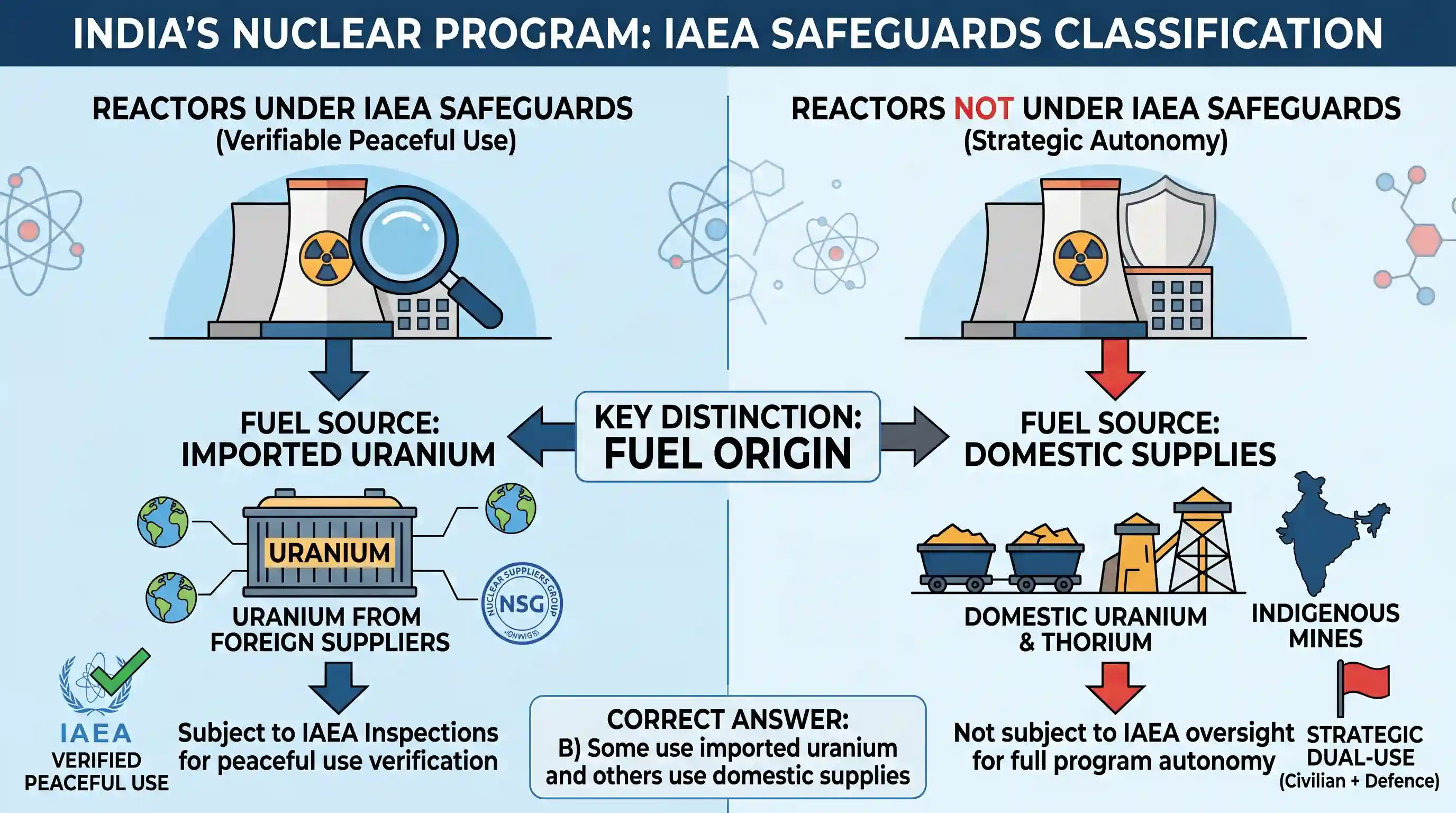
In India, why are some nuclear reactors kept under "IAEA Safeguards" while others are not?

- ASome use uranium and others use thorium
- BSome use imported uranium and others use domestic suppliesCorrect
- CSome are operated by foreign enterprises and others are operated by domestic enterprises
- DSome are State-owned and others are privately-owned
Explanation
India has a unique nuclear program with a distinction between its civilian and strategic nuclear facilities. The reason some nuclear reactors in India are under "IAEA Safeguards" while others are not stems from the source of the nuclear fuel:
Reactors using imported uranium: These reactors are subject to IAEA (International Atomic Energy Agency) safeguards. This arrangement is part of India's commitment under its various bilateral and multilateral agreements with nuclear suppliers, allowing it to engage in international nuclear commerce despite not being a signatory to the Nuclear Non-Proliferation Treaty (NPT) as a nuclear-weapon state. The safeguards ensure that imported nuclear material is used only for peaceful purposes.
Reactors using domestic uranium: These reactors are not under IAEA safeguards. They are part of India's indigenous three-stage nuclear power program and are used for both civilian and strategic purposes. India maintains the right to use these facilities and the indigenously produced nuclear material for its strategic autonomy.
This dual arrangement allows India to benefit from international nuclear cooperation while preserving the confidentiality of its strategic program.
Related questions
More UPSC Prelims practice from the same subject and topic.
- Prelims 2020GS1science-and-technology
In the context of recent advances in human reproductive technology, "Pronuclear Transfer" is used for
- Prelims 2020GS1science-and-technology
With the present state of development, Artificial Intelligence can effectively do which of the following? 1. Bring down electricity consumption in industrial units 2. Create meaningful short stories a…
- Prelims 2020GS1science-and-technology
With reference to Visible Light Communication (VLC) technology, which of the following statements are correct? 1. VLC uses electromagnetic spectrum wavelengths 375 to 780 nm. 2. VLC is known as long-r…
- Prelims 2020GS1science-and-technology
With reference to "Blockchain Technology", consider the following statements: 1. It is a public ledger that everyone can inspect, but which no single user controls. 2. The structure and design of bloc…
- Prelims 2020GS1science-and-technology
With reference to carbon nanotubes, consider the following statements: 1. They can be used as carriers of drugs and antigens in the human body. 2. They can be made into artificial blood capillaries fo…
- Prelims 2020GS1science-and-technology
Consider the following activities : 1. Spraying pesticides on a crop field 2. Inspecting the craters of active volcanoes 3. Collecting breath samples from spouting whales for DNA analysis At the prese…