Which of the following phrases defines the nature of the 'Hundi' generally referred to in the sources of the post-Harsha period?

- AAn advisory issued by the king to his subordinates
- BA diary to be maintained for daily accounts
- CA bill of exchangeCorrect
- DAn order from the feudal lord to his subordinates
Explanation
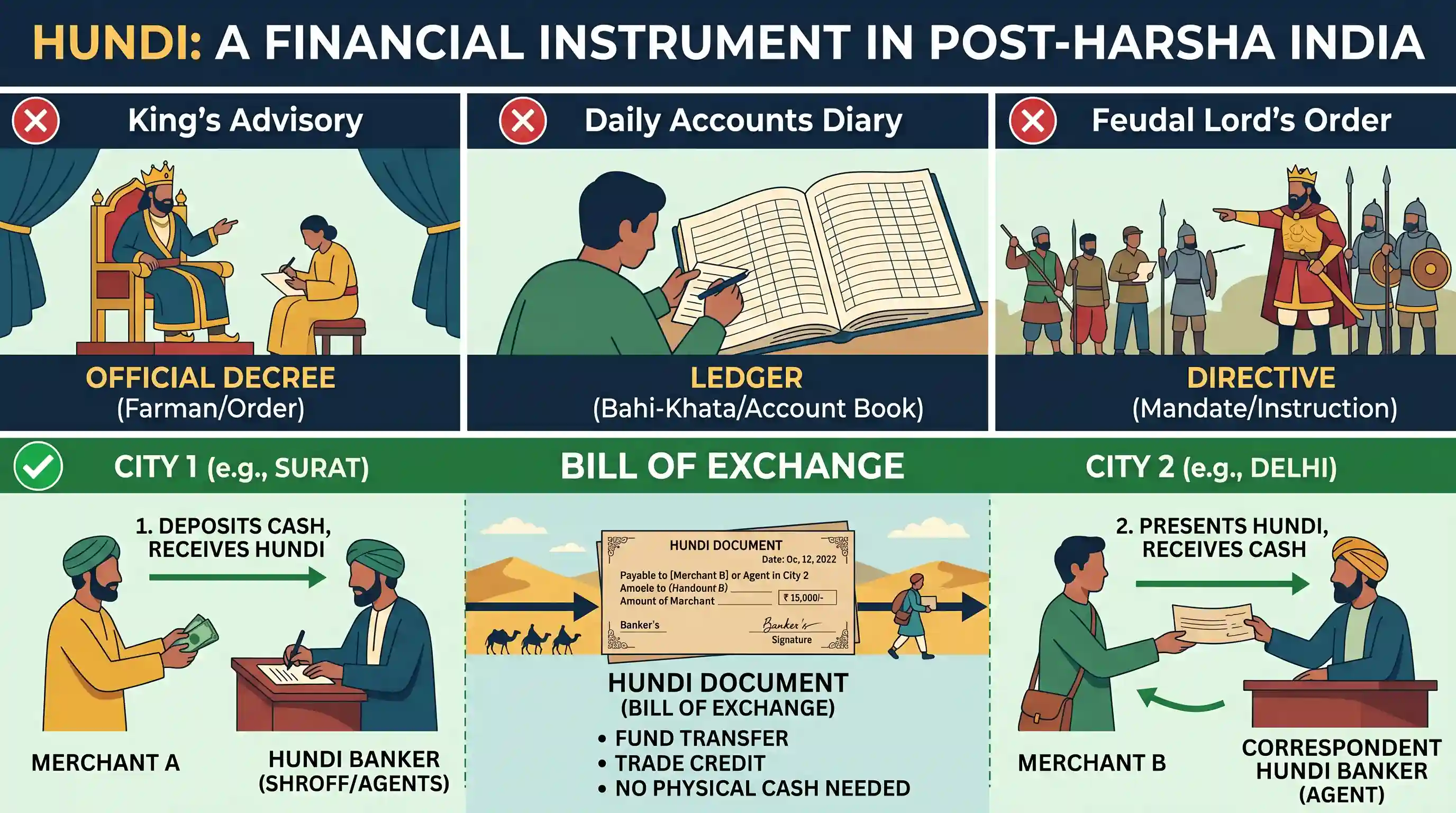
In the context of the history of India, particularly from the post-Harsha period onwards (which spans medieval and early modern times), a 'Hundi' (also spelled 'Hundee' or 'Hundi') refers to a bill of exchange.
Functionality: Hundis were indigenous financial instruments used for various purposes, primarily facilitating trade and credit. They allowed merchants to transfer funds from one place to another without physically carrying cash. A merchant could deposit money with a Hundi banker in one city and receive a Hundi, which could then be presented to another Hundi banker (or agent) in a different city to receive the equivalent amount. Types: Hundis could function as bills of exchange, promissory notes, or simply as informal credit notes. They were crucial in enabling long-distance trade and commerce across different regions of India and even internationally. Historical Significance: The Hundi system was a sophisticated indigenous banking practice that predated and continued to operate alongside modern banking systems. It demonstrated a well-developed financial infrastructure in pre-colonial and early colonial India. Let's look at why other options are incorrect:
A) An advisory issued by the king to his subordinates: This would be more akin to a 'farman' or an official decree, not a Hundi. B) A diary to be maintained for daily accounts: This describes a ledger or an account book, not a Hundi. D) An order from the feudal lord to his subordinates: This would be a directive or an instruction, not a financial instrument like a Hundi. Therefore, a 'Hundi' is best defined as a bill of exchange.
Related questions
More UPSC Prelims practice from the same subject and topic.
- Prelims 2020GS1economy
In India, under cyber insurance for individuals, which of the following benefits are generally covered, in addition to payment for the loss of funds and other benefits? 1. Cost of restoration of the c…
- Prelims 2020GS1economy
What is the importance of the term "Interest Coverage Ratio" of a firm in India? 1. It helps in understanding the present risk of a firm that a bank is going to give loan to. 2. It helps in evaluating…
- Prelims 2020GS1economy
Consider the following statements: 1. The weightage of food in Consumer Price Index (CPI) is higher than that in Wholesale Price Index (WPI). 2. The WPI does not capture changes in the prices of servi…
- Prelims 2020GS1economy
Along with the Budget, the Finance Minister also places other documents before the Parliament which include 'The Macro Economic Framework Statement'. The aforesaid document is presented because this i…
- Prelims 2020GS1economy
"Gold Tranche" (Reserve Tranche) refers to
- Prelims 2020GS1economy
If another global financial crisis happens in the near future, which of the following actions/policies are most likely to give some immunity to India? 1. Not depending on short-term foreign borrowings…