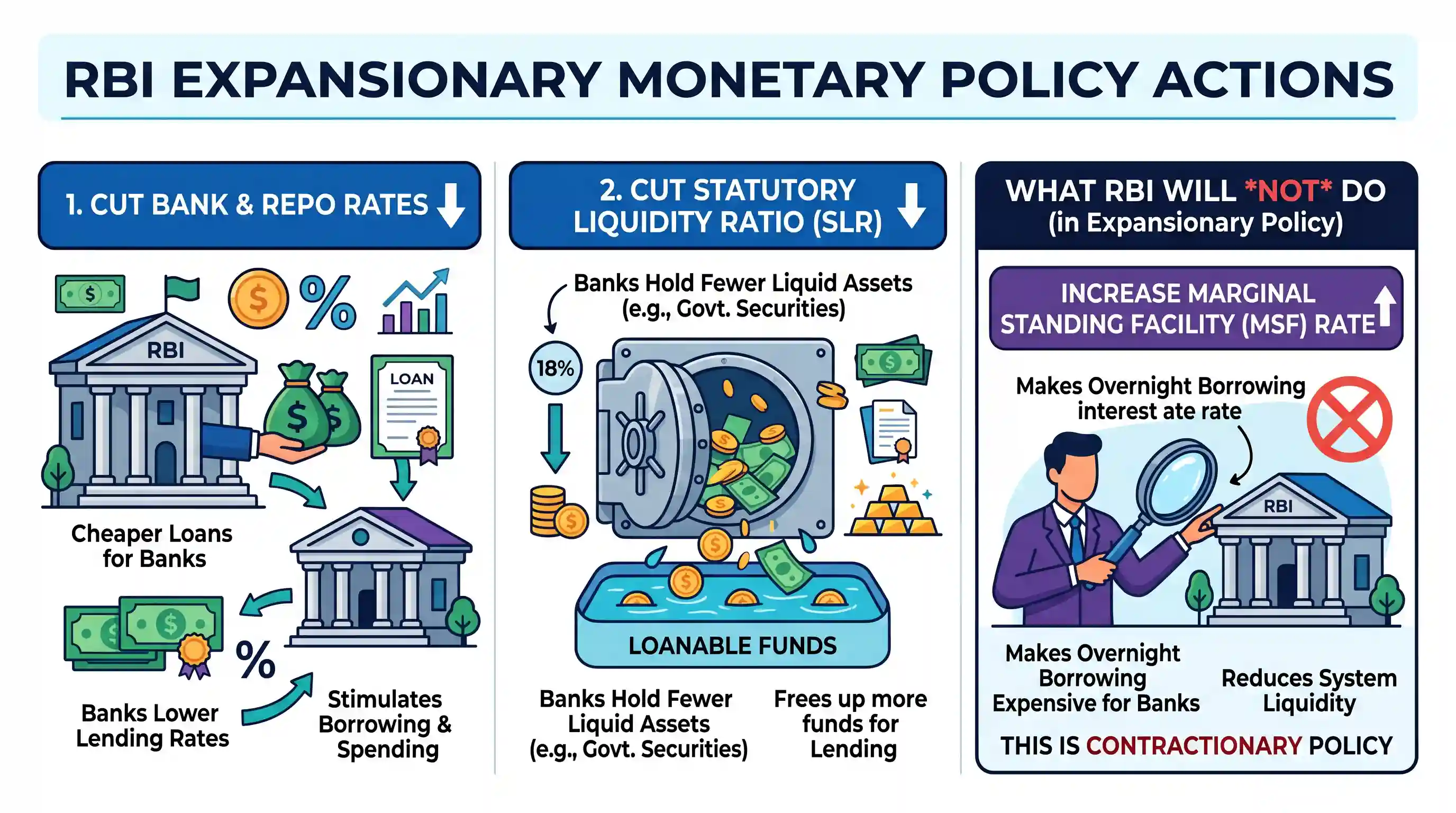
If the RBI decides to adopt an expansionist monetary policy, which of the following would it not do ? 1. Cut and optimize the Statutory Liquidity Ratio 2. Increase the Marginal Standing Facility Rate 3. Cut the Bank Rate and Repo Rate Select the correct answer using the code given below:

- A1 and 2 only
- B2 onlyCorrect
- C1 and 3 only
- D1, 2 and 3
Explanation
An expansionist monetary policy aims to increase the money supply in the economy, lower interest rates, and stimulate economic growth. The Reserve Bank of India (RBI) uses various tools to achieve this:
-
Cut and optimize the Statutory Liquidity Ratio (SLR): Cutting the SLR reduces the proportion of deposits that commercial banks must hold in the form of liquid assets (like government securities). This frees up more funds for banks to lend, thereby increasing credit availability and money supply. This is an expansionist measure.
-
Increase the Marginal Standing Facility (MSF) Rate: The MSF rate is the rate at which banks can borrow overnight funds from the RBI against approved government securities, in an emergency. Increasing the MSF rate makes such borrowing more expensive for banks, which discourages them from borrowing and reduces liquidity in the system. This is a contractionary monetary policy measure. Therefore, the RBI would not do this in an expansionist policy.
-
Cut the Bank Rate and Repo Rate: The Bank Rate is the rate at which the RBI lends money to commercial banks without any security. The Repo Rate is the rate at which banks borrow money from the RBI by selling securities with an agreement to repurchase them. Cutting these rates makes borrowing cheaper for commercial banks, which in turn encourages them to reduce their lending rates, leading to increased borrowing by businesses and individuals, thereby stimulating economic activity. These are expansionist measures.
The question asks what the RBI would not do as part of an expansionist monetary policy. Based on the analysis, increasing the MSF rate is a contractionary measure.
Related questions
More UPSC Prelims practice from the same subject and topic.
- Prelims 2020GS1economy
"Gold Tranche" (Reserve Tranche) refers to
- Prelims 2020GS1economy
If you withdraw ₹ 1,00,000 in cash from your Demand Deposit Account at your bank, the immediate effect on aggregate money supply in the economy will be
- Prelims 2020GS1economy
In the context of the Indian economy, non-financial debt includes which of the following? 1. Housing loans owed by households 2. Amounts outstanding on credit cards 3. Treasury bills Select the correc…
- Prelims 2020GS1economy
With reference to the Indian economy, consider the following statements: 1. 'Commercial Paper' is a short-term unsecured promissory note. 2. 'Certificate of Deposit' is a long-term instrument issued b…
- Prelims 2020GS1economy
Along with the Budget, the Finance Minister also places other documents before the Parliament which include 'The Macro Economic Framework Statement'. The aforesaid document is presented because this i…
- Prelims 2020GS1economy
Which of the following phrases defines the nature of the 'Hundi' generally referred to in the sources of the post-Harsha period?