With reference to the Indian economy after the 1991 economic liberalization, consider the following statements: 1. Worker productivity (₹ per worker at 2004-05 prices) increased in urban areas while it decreased in rural areas. 2. The percentage share of rural areas in the workforce steadily increased. 3. In rural areas, the growth in non-farm economy increased. 4. The growth rate in rural employment decreased. Which of the statements given above is/are correct?

- A1 and 2 only
- B3 and 4 onlyCorrect
- C3 only
- D1, 2 and 4 only
Explanation
Let's analyze the statements regarding the Indian economy after the 1991 economic liberalization:
-
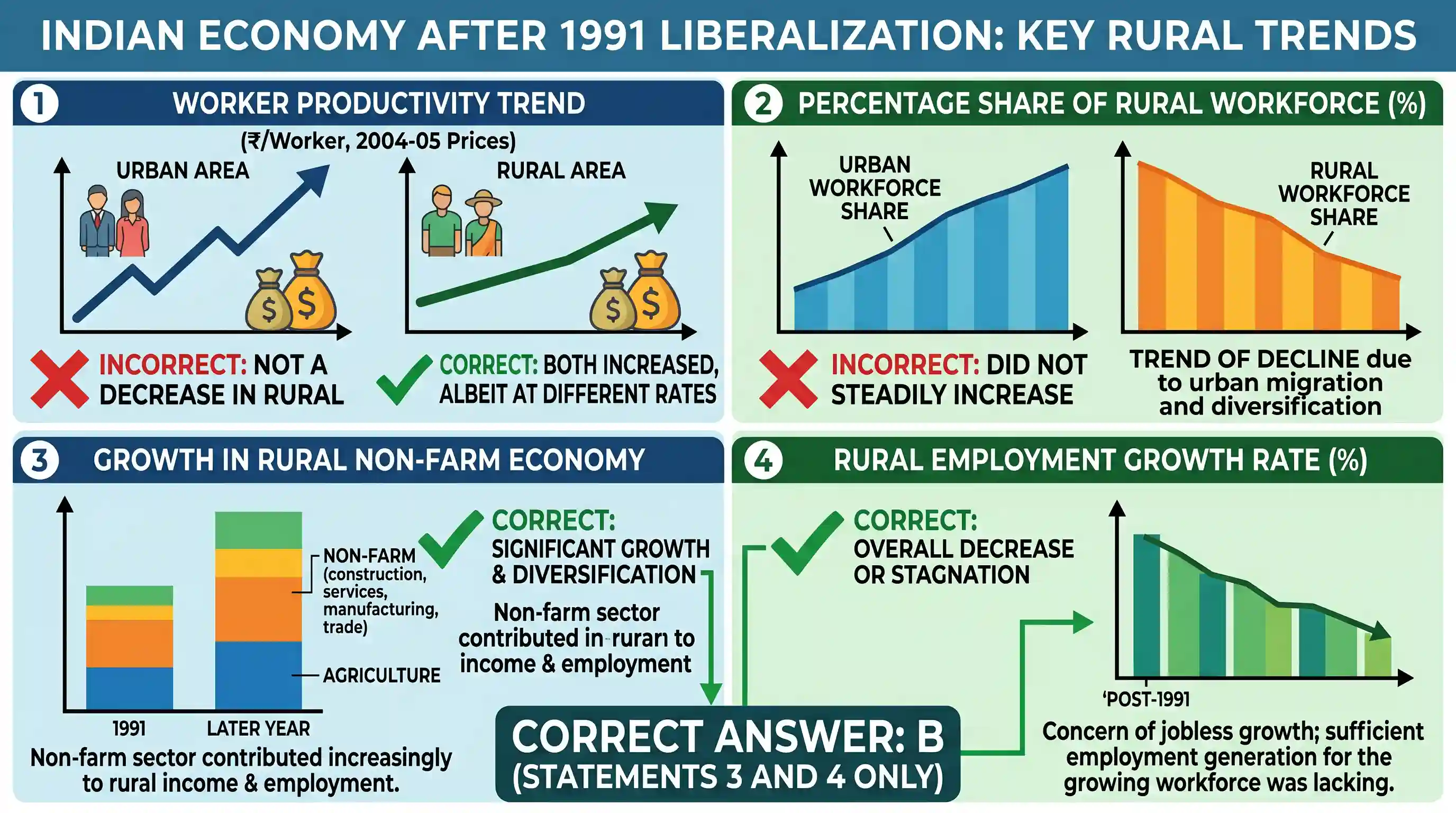
Worker productivity (₹ per worker at 2004-05 prices) increased in urban areas while it decreased in rural areas. This statement is generally incorrect. Post-1991, economic reforms and technological advancements led to overall productivity improvements. While urban areas might have seen more rapid productivity growth in organized sectors, it's not accurate to state a decrease in rural areas. Productivity improvements, albeit at varying rates, could be observed in some rural non-farm sectors as well.
-
The percentage share of rural areas in the workforce steadily increased. This statement is incorrect. With economic growth and urbanization, there has been a long-term trend of a decline in the percentage share of the rural workforce in the total workforce, as people migrate to urban areas and the economy diversifies away from agriculture.
-
In rural areas, the growth in non-farm economy increased. This statement is correct. Post-1991, there was a significant diversification of rural livelihoods. The non-farm sector (e.g., construction, manufacturing, rural services, trade) witnessed substantial growth, contributing increasingly to rural incomes and employment as agriculture's share of GDP declined.
-
The growth rate in rural employment decreased. This statement is correct. Despite growth in the non-farm sector, the overall growth rate of rural employment has often stagnated or declined in certain periods post-1991, leading to concerns about 'jobless growth' or insufficient employment generation to absorb the growing rural workforce, particularly in agriculture.
Therefore, statements 3 and 4 are correct.
Related questions
More UPSC Prelims practice from the same subject and topic.
- Prelims 2020GS1economy
The term 'West Texas Intermediate', sometimes found in news, refers to a grade of
- Prelims 2020GS1economy
Consider the following statements: 1. In terms of short-term credit delivery to the agriculture sector, District Central Cooperative Banks (DCCBs) deliver more credit in comparison to Scheduled Commer…
- Prelims 2020GS1economy
In India, which of the following can be considered as public investment in agriculture? 1. Fixing Minimum Support Price for agricultural produce of all crops 2. Computerization of Primary Agricultural…
- Prelims 2020GS1economy
Which of the following factors/policies were affecting the price of rice in India in the recent past? 1. Minimum Support Price 2. Government's trading 3. Government's stockpiling 4. Consumer subsidies…
- Prelims 2020GS1economy
In which one of the following groups are all the four countries members of G20?
- Prelims 2020GS1economy
Under the Kisan Credit Card scheme, short-term credit support is given to farmers for which of the following purposes ? 1. Working capital for maintenance of farm assets 2. Purchase of combine harvest…