In India, which of the following can be considered as public investment in agriculture? 1. Fixing Minimum Support Price for agricultural produce of all crops 2. Computerization of Primary Agricultural Credit Societies 3. Social Capital development 4. Free electricity supply to farmers 5. Waiver of agricultural loans by the banking system 6. Setting up of cold storage facilities by the governments Select the correct answer using the code given below:

- A1, 2 and 5 only
- B1, 3, 4 and 5 only
- C2, 3 and 6 onlyCorrect
- D1, 2, 3, 4, 5 and 6
Explanation
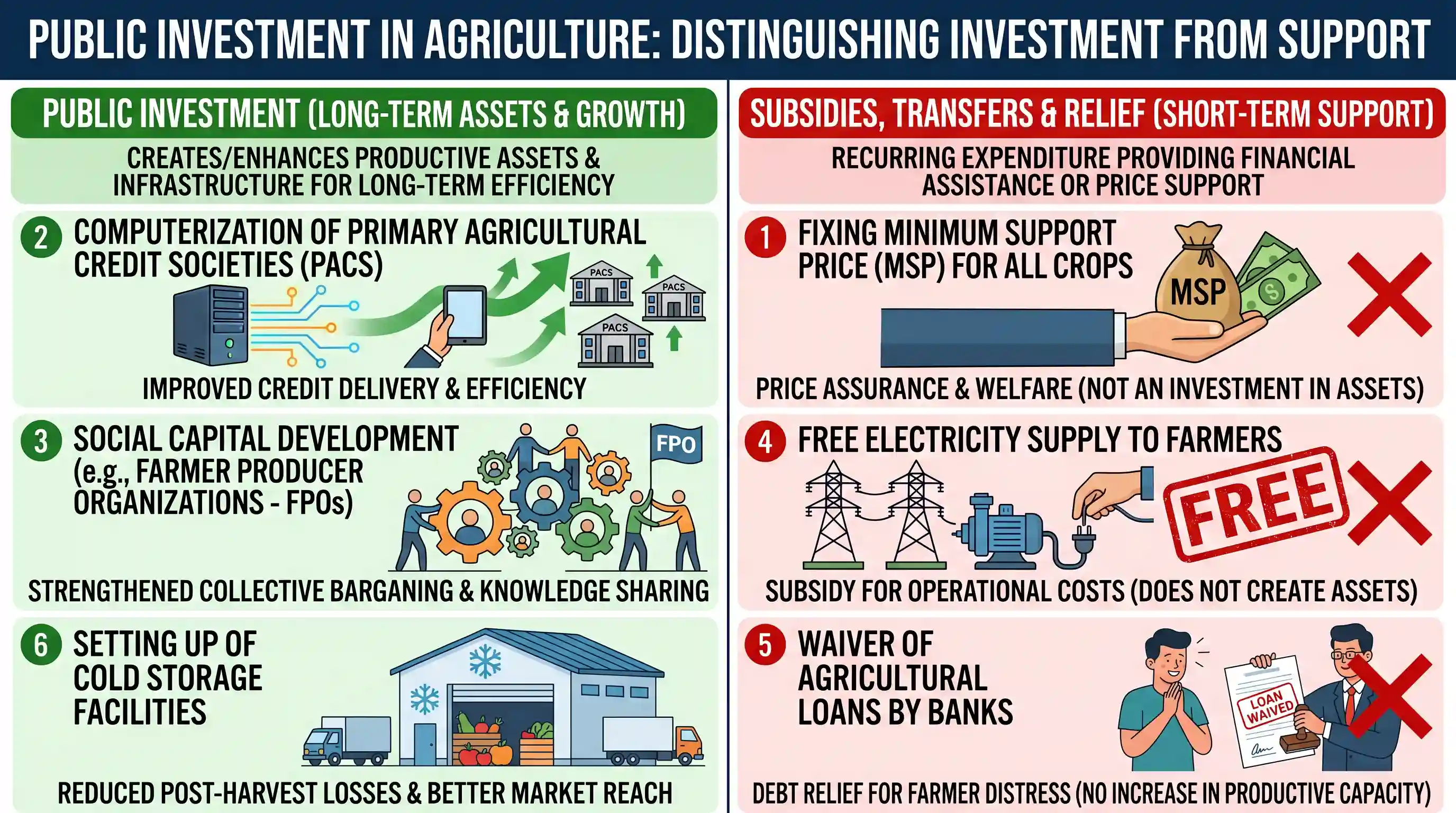
Public investment in agriculture refers to government spending that creates or enhances productive assets and infrastructure, leading to long-term growth and efficiency in the agricultural sector. Let's examine the given options:
-
Fixing Minimum Support Price for agricultural produce of all crops: MSP is a price support mechanism and a welfare measure for farmers, but it is not a direct investment that creates physical or social capital. It's a transfer payment or a market intervention.
-
Computerization of Primary Agricultural Credit Societies: This is an investment in institutional and technological infrastructure. It aims to improve the efficiency, transparency, and reach of agricultural credit delivery, thus contributing to agricultural development. This is public investment.
-
Social Capital development: Investments in building social capital, such as promoting farmer producer organizations (FPOs), community self-help groups, and farmer education programs, can enhance collective action, knowledge sharing, and rural livelihoods, indirectly boosting agricultural productivity and efficiency. This is a form of public investment.
-
Free electricity supply to farmers: This is a subsidy or a consumption support measure. While it helps farmers by reducing input costs, it does not directly create new productive assets or infrastructure. It's a recurring expenditure, not an investment.
-
Waiver of agricultural loans by the banking system: Loan waivers are a form of debt relief or a fiscal measure, aimed at alleviating farmer distress. They do not directly lead to the creation of new productive assets or increase the productive capacity of agriculture in the long run. They can even have negative implications for credit discipline.
-
Setting up of cold storage facilities by the governments: Cold storage facilities are critical infrastructure for reducing post-harvest losses, improving supply chain efficiency, and enabling farmers to store produce for better market prices. This is a direct public investment that creates physical assets essential for agricultural value chains.
Therefore, statements 2, 3, and 6 can be considered public investment in agriculture.
Related questions
More UPSC Prelims practice from the same subject and topic.
- Prelims 2020GS1economy
The term 'West Texas Intermediate', sometimes found in news, refers to a grade of
- Prelims 2020GS1economy
With reference to the Indian economy after the 1991 economic liberalization, consider the following statements: 1. Worker productivity (₹ per worker at 2004-05 prices) increased in urban areas while i…
- Prelims 2020GS1economy
Consider the following statements: 1. In terms of short-term credit delivery to the agriculture sector, District Central Cooperative Banks (DCCBs) deliver more credit in comparison to Scheduled Commer…
- Prelims 2020GS1economy
Which of the following factors/policies were affecting the price of rice in India in the recent past? 1. Minimum Support Price 2. Government's trading 3. Government's stockpiling 4. Consumer subsidies…
- Prelims 2020GS1economy
In which one of the following groups are all the four countries members of G20?
- Prelims 2020GS1economy
Under the Kisan Credit Card scheme, short-term credit support is given to farmers for which of the following purposes ? 1. Working capital for maintenance of farm assets 2. Purchase of combine harvest…