Which of the following factors/policies were affecting the price of rice in India in the recent past? 1. Minimum Support Price 2. Government's trading 3. Government's stockpiling 4. Consumer subsidies Select the correct answer using the code given below:

- A1, 2 and 4 only
- B1, 3 and 4 only
- C2 and 3 only
- D1, 2, 3 and 4Correct
Explanation
All the listed factors significantly influence the price of rice in India:
-
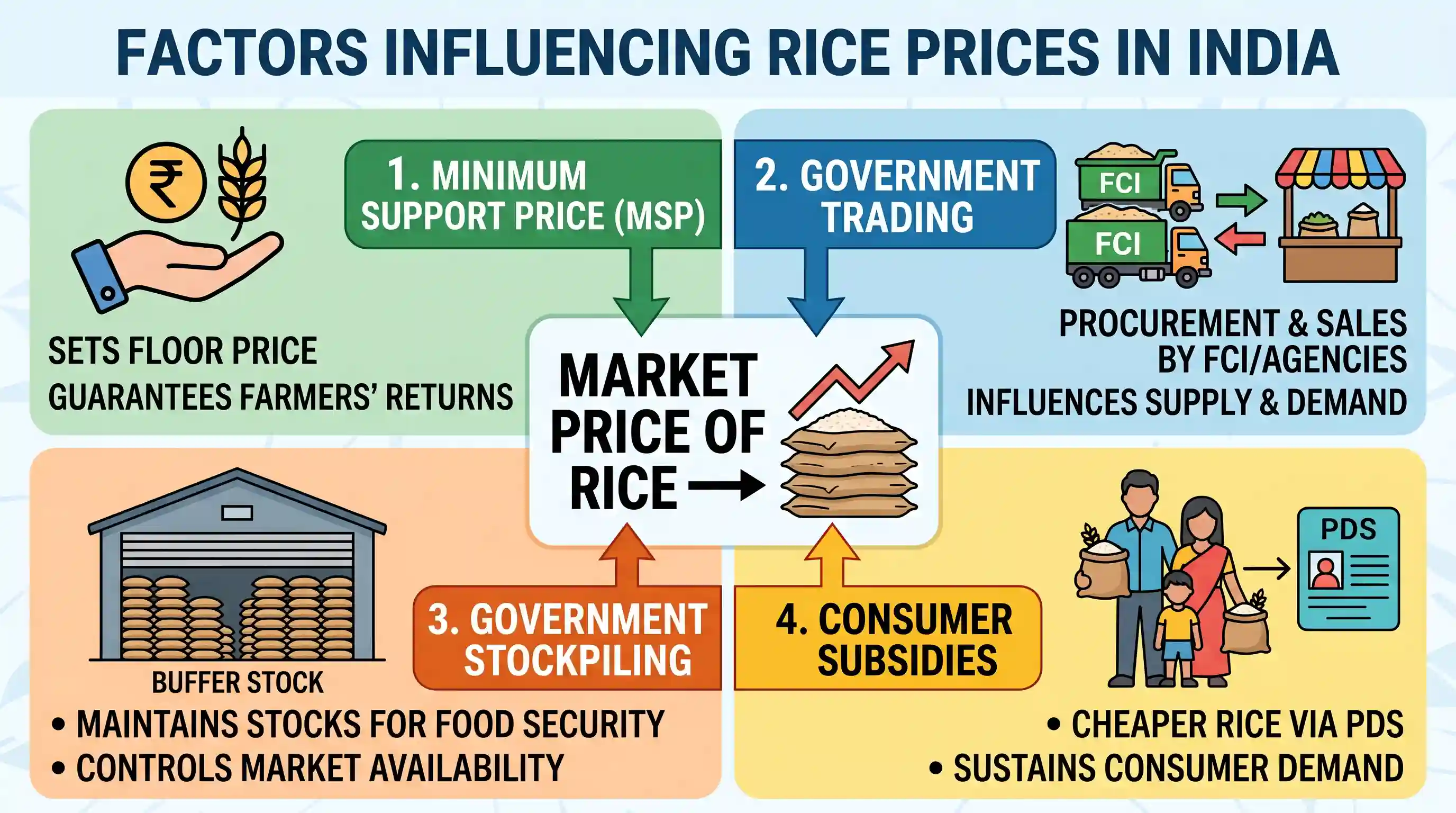
Minimum Support Price (MSP): MSP acts as a floor price for rice. Government procurement at MSP ensures that farmers receive a minimum price, which supports market prices and influences farmers' planting decisions, thereby impacting supply and overall market dynamics.
-
Government's trading: Government agencies, like the Food Corporation of India (FCI), engage in large-scale procurement and distribution of rice. Their buying and selling activities, including open market sales and releases under public distribution systems, directly affect market supply and, consequently, prices.
-
Government's stockpiling: The government maintains buffer stocks of rice for food security and price stabilization. Decisions to build up or release these stocks have a direct impact on the availability of rice in the market and influence price movements.
-
Consumer subsidies: Subsidies on rice (e.g., through the Public Distribution System - PDS) make it affordable for a large section of the population, thereby sustaining demand. Changes in subsidy policies or the effectiveness of PDS can significantly influence market demand for rice and its pricing.
All these factors are direct or indirect mechanisms through which government policies and market interventions affect the price of rice in India.
Related questions
More UPSC Prelims practice from the same subject and topic.
- Prelims 2020GS1economy
The term 'West Texas Intermediate', sometimes found in news, refers to a grade of
- Prelims 2020GS1economy
With reference to the Indian economy after the 1991 economic liberalization, consider the following statements: 1. Worker productivity (₹ per worker at 2004-05 prices) increased in urban areas while i…
- Prelims 2020GS1economy
Consider the following statements: 1. In terms of short-term credit delivery to the agriculture sector, District Central Cooperative Banks (DCCBs) deliver more credit in comparison to Scheduled Commer…
- Prelims 2020GS1economy
In India, which of the following can be considered as public investment in agriculture? 1. Fixing Minimum Support Price for agricultural produce of all crops 2. Computerization of Primary Agricultural…
- Prelims 2020GS1economy
In which one of the following groups are all the four countries members of G20?
- Prelims 2020GS1economy
Under the Kisan Credit Card scheme, short-term credit support is given to farmers for which of the following purposes ? 1. Working capital for maintenance of farm assets 2. Purchase of combine harvest…