Consider the following statements: 1. In the case of all cereals, pulses and oil-seeds, the procurement at Minimum Support Price (MSP) is unlimited in any State/UT of India. 2. In the case of cereals and pulses, the MSP is fixed in any State/UT at a level to which the market price will never rise. Which of the statements given above is/are correct?

- A1 only
- B2 only
- CBoth 1 and 2
- DNeither 1 nor 2Correct
Explanation
Let's examine the statements concerning Minimum Support Price (MSP) procurement in India:
-
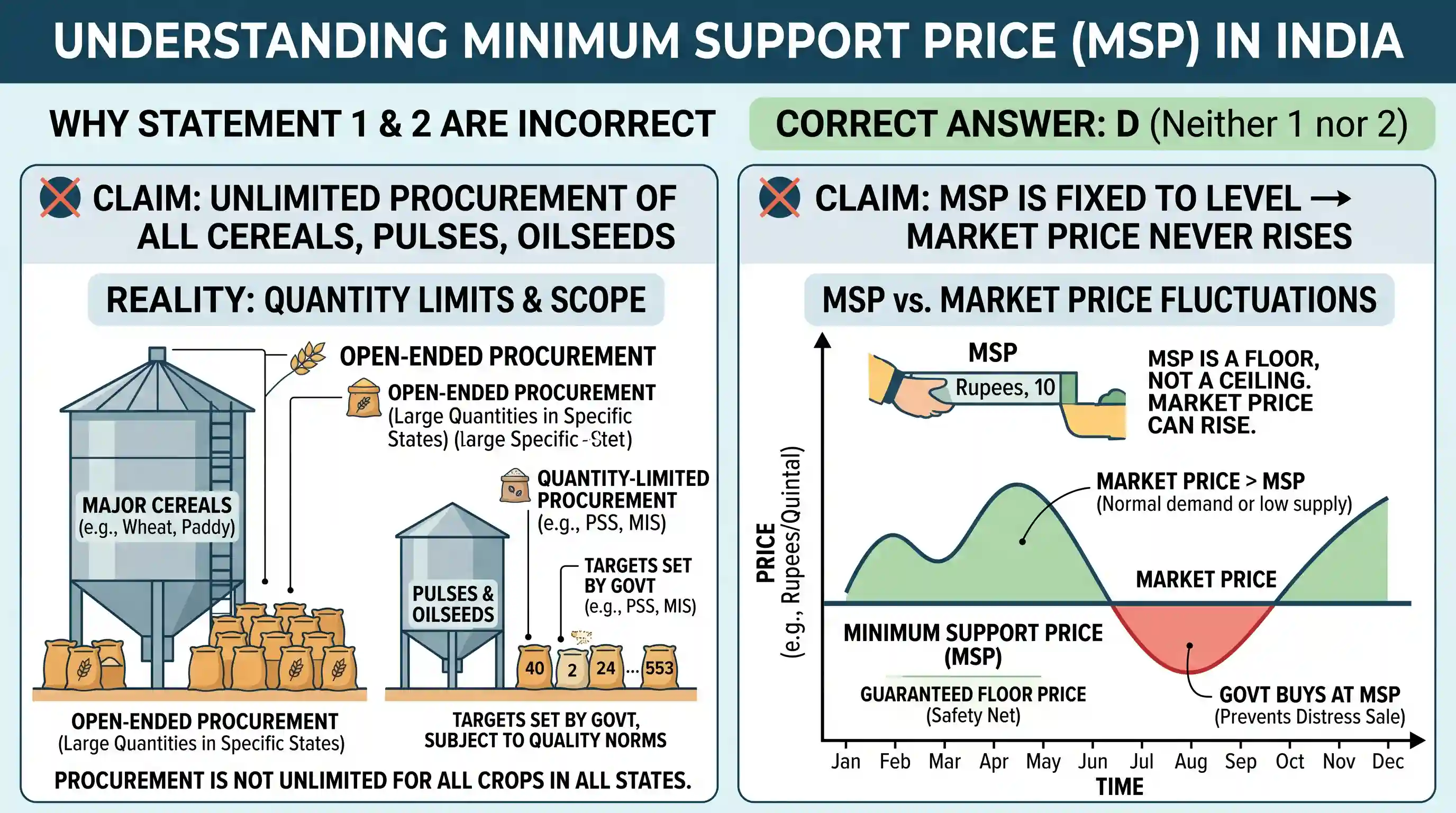
In the case of all cereals, pulses and oil-seeds, the procurement at Minimum Support Price (MSP) is unlimited in any State/UT of India. This statement is incorrect. While procurement of certain cereals (like wheat and paddy) is significant and often referred to as open-ended in major producing states, it is not truly 'unlimited' for all crops (including pulses and oilseeds) or in all states/UTs. For pulses and oilseeds, procurement under schemes like Price Support Scheme (PSS) is quantity-limited and often undertaken when market prices fall below MSP. Operational limitations, quality specifications, and logistical challenges also mean that procurement is not universally unlimited.
-
In the case of cereals and pulses, the MSP is fixed in any State/UT at a level to which the market price will never rise. This statement is incorrect. The Minimum Support Price (MSP) is a floor price, a minimum guaranteed price for farmers. Its purpose is to provide a safety net and protect farmers from distress sales during times of abundant harvest or price crashes. Market prices can, and often do, rise above the MSP, especially during periods of high demand, lean supply, or when global prices are high. MSP is a 'minimum' support, not a price ceiling.
Therefore, neither statement 1 nor statement 2 is correct.
Related questions
More UPSC Prelims practice from the same subject and topic.
- Prelims 2020GS1economy
The term 'West Texas Intermediate', sometimes found in news, refers to a grade of
- Prelims 2020GS1economy
With reference to the Indian economy after the 1991 economic liberalization, consider the following statements: 1. Worker productivity (₹ per worker at 2004-05 prices) increased in urban areas while i…
- Prelims 2020GS1economy
Consider the following statements: 1. In terms of short-term credit delivery to the agriculture sector, District Central Cooperative Banks (DCCBs) deliver more credit in comparison to Scheduled Commer…
- Prelims 2020GS1economy
In India, which of the following can be considered as public investment in agriculture? 1. Fixing Minimum Support Price for agricultural produce of all crops 2. Computerization of Primary Agricultural…
- Prelims 2020GS1economy
Which of the following factors/policies were affecting the price of rice in India in the recent past? 1. Minimum Support Price 2. Government's trading 3. Government's stockpiling 4. Consumer subsidies…
- Prelims 2020GS1economy
In which one of the following groups are all the four countries members of G20?