Consider the following statements : 1. St. Francis Xavier was one of the founding members of the Jesuit Order. 2. St. Francis Xavier died in Goa and a church is dedicated to him there. 3. The Feast of St. Francis Xavier is celebrated in Goa each year. Which of the statements given above are correct?

- A1 and 2 only
- B2 and 3 only
- C1 and 3 only
- D1, 2 and 3Correct
Explanation
Let's analyze each statement regarding St. Francis Xavier:
-
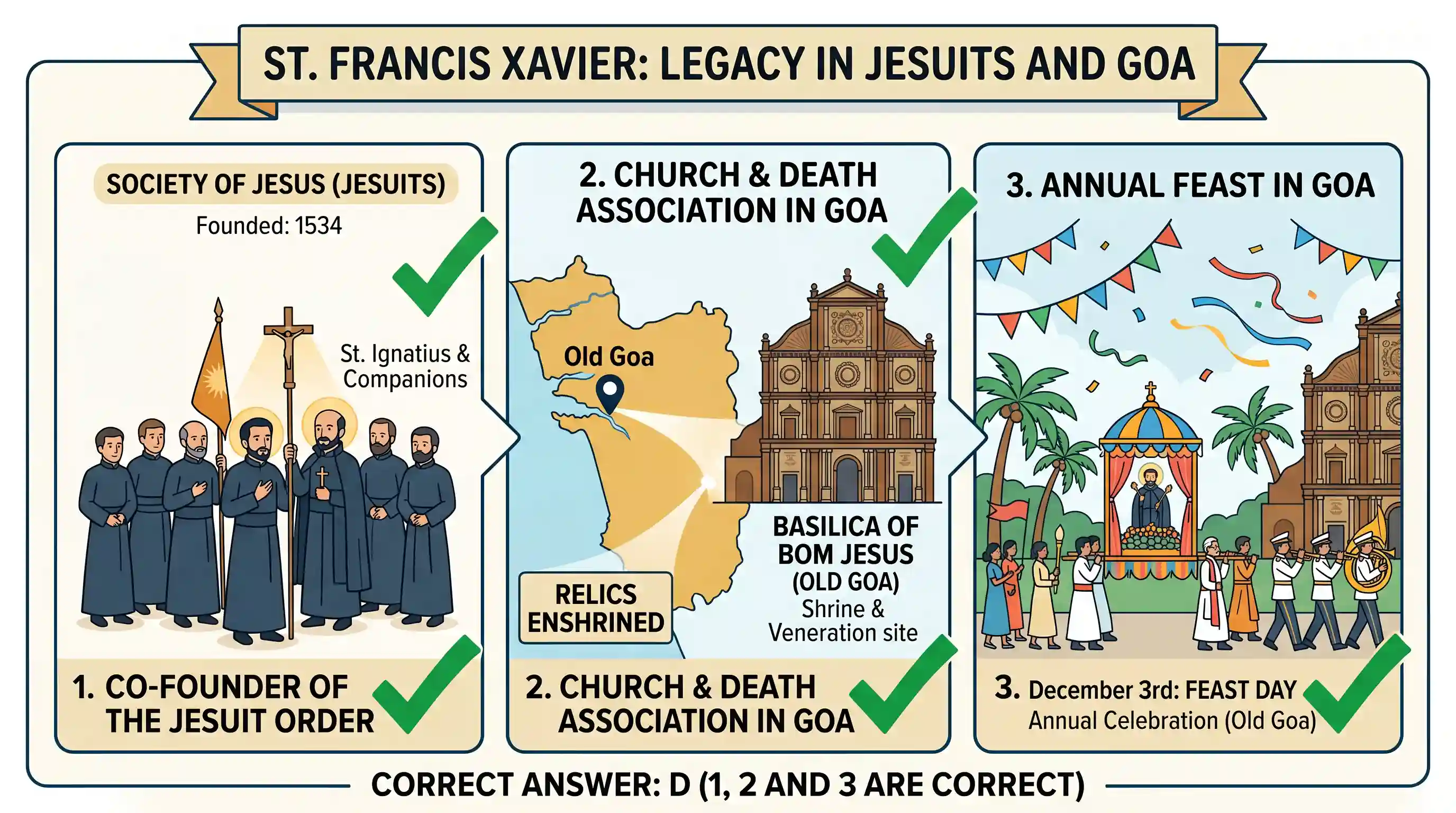
St. Francis Xavier was one of the founding members of the Jesuit Order: This statement is correct. St. Francis Xavier was indeed one of the original seven companions who, alongside Ignatius of Loyola, founded the Society of Jesus (Jesuit Order) in 1534.
-
St. Francis Xavier died in Goa and a church is dedicated to him there: This statement requires clarification but is considered correct in the context of the options. St. Francis Xavier actually died on Sancian Island, China, in 1552. However, his body was later brought to Goa, and his relics are enshrined in the Basilica of Bom Jesus in Old Goa. While he didn't die in Goa, this Basilica is widely associated with him and serves as a major site of veneration and pilgrimage, effectively a church dedicated to his memory and legacy.
-
The Feast of St. Francis Xavier is celebrated in Goa each year: This statement is correct. The Feast of St. Francis Xavier is celebrated annually on December 3rd in Goa, marking his death anniversary and drawing a large number of devotees and pilgrims.
Considering the prominent association of his relics and annual feast with Goa, and the common understanding of his presence there, all three statements are considered correct.
Related questions
More UPSC Prelims practice from the same subject and topic.
- Prelims 2021GS1art-and-culture
Who among the following is associated with 'Songs from Prison', a translation of ancient Indian religious lyrics in English?
- Prelims 2021GS1art-and-culture
With reference to India, the terms 'Halbi, Ho and Kui' pertain to
- Prelims 2021GS1art-and-culture
With reference to Chausath Yogini Temple situated near Morena, consider the following statements : 1. It is a circular temple built during the reign of Kachchhapaghata Dynasty. 2. It is the only circu…
- Prelims 2021GS1art-and-culture
With reference to the history of ancient India, Bhavabhuti, Hastimalla and Kshemeshvara were famous
- Prelims 2021GS1art-and-culture
Which one of the following statements is correct?
- Prelims 2021GS1art-and-culture
Consider the following statements in respect of the Laureus World Sports Award which was instituted in the year 2000 : 1. American golfer Tiger Woods was the first winner of this award. 2. The award w…