With reference to the history of ancient India, which of the following statements is/are correct? 1. Mitakshara was the civil law for upper castes and Dayabhaga was the civil law for lower castes. 2. In the Mitakshara system, the sons can claim right to the property during the lifetime of the father, whereas in the Dayabhaga system, it is only after the death of the father that the sons can claim right to the property. 3. The Mitakshara system deals with the matters related to the property held by male members only of a family, whereas the Dayabhaga system deals with the matters related to the property held by both male and female members of a family. Select the correct answer using the code given below.

- A1 and 2
- B2 onlyCorrect
- C1 and 3
- D3 only
Explanation
Let's analyze each statement regarding Mitakshara and Dayabhaga systems of law:
-
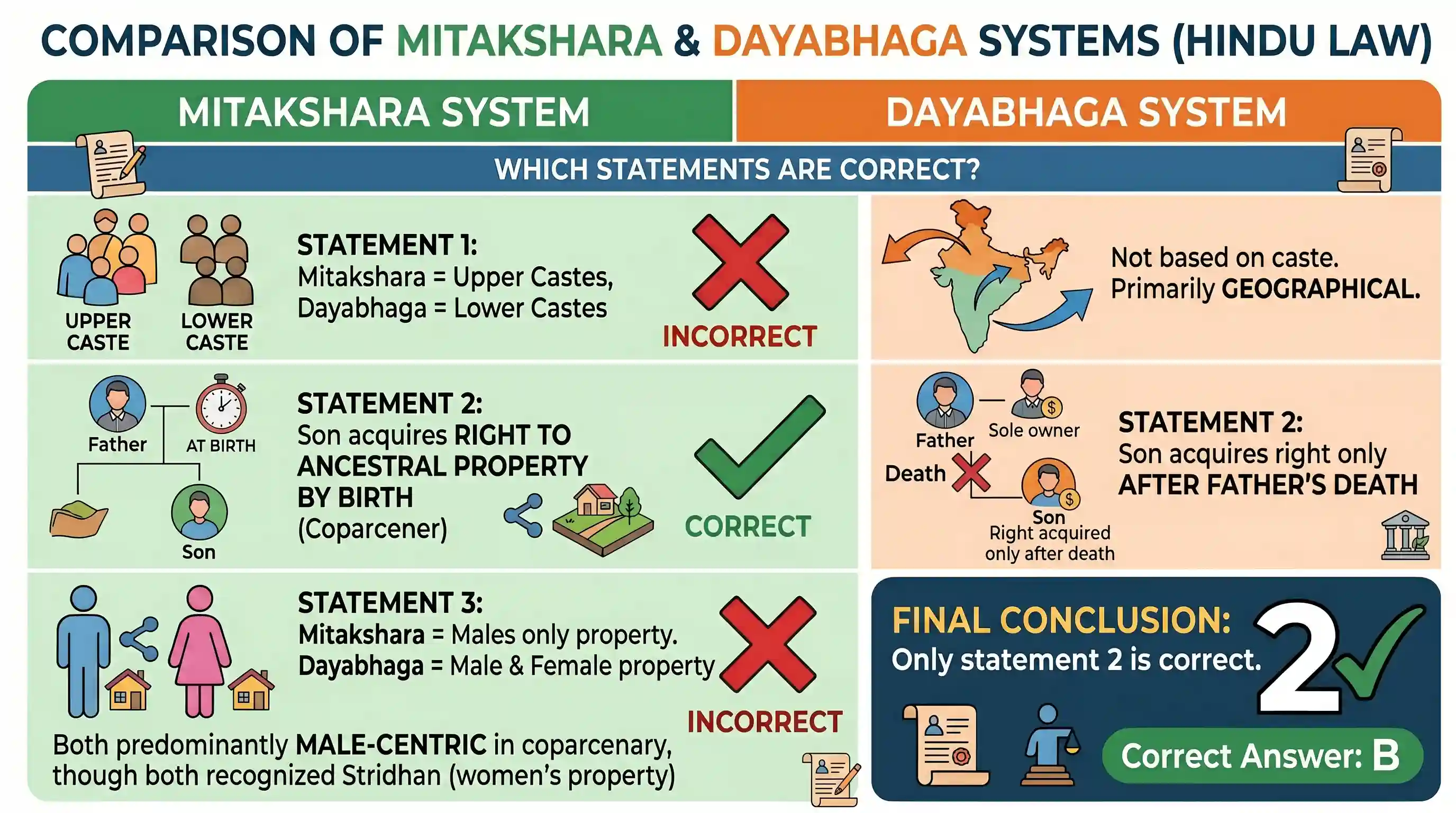
Mitakshara was the civil law for upper castes and Dayabhaga was the civil law for lower castes: This statement is incorrect. Both Mitakshara and Dayabhaga were schools of Hindu law governing property, inheritance, and family matters. Their distinction was primarily geographical, not caste-based. Mitakshara prevailed over most of India, while Dayabhaga was prevalent mainly in Bengal and Assam.
-
In the Mitakshara system, the sons can claim right to the property during the lifetime of the father, whereas in the Dayabhaga system, it is only after the death of the father that the sons can claim right to the property: This statement is correct. This is the fundamental and most significant difference between the two systems. In Mitakshara, a son acquires a right by birth in the ancestral property, making him a coparcener with his father. In Dayabhaga, the father is the sole owner of the property during his lifetime, and sons acquire rights only upon his death.
-
The Mitakshara system deals with the matters related to the property held by male members only of a family, whereas the Dayabhaga system deals with the matters related to the property held by both male and female members of a family: This statement is incorrect. Both systems primarily dealt with coparcenary property, which was traditionally dominated by male members. While both recognized 'Stridhan' (women's property) to some extent, the core principles of inheritance and coparcenary in both systems largely revolved around male lineal descendants. Neither system was exclusively or broadly for female members in the way implied.
Therefore, only statement 2 is correct.
Related questions
More UPSC Prelims practice from the same subject and topic.
- Prelims 2021GS1history
Which one of the following ancient towns is well-known for its elaborate system of water harvesting and management by building a series of dams and channelizing water into connected reservoirs?
- Prelims 2021GS1history
From the decline of Guptas until the rise of Harshavardhana in the early seventh century, which of the following kingdoms were holding power in Northern India? 1. The Guptas of Magadha 2. The Paramara…
- Prelims 2021GS1history
Consider the following pairs : Historical place : Well-known for 1. Burzahom : Rock-cut shrines 2. Chandra-ketugarh : Terracotta art 3. Ganeshwar : Copper artefacts Which of the pairs given above is/a…
- Prelims 2021GS1history
In the first quarter of seventeenth century, in which of the following was/were the factory/factories of the English East India Company located? 1. Broach 2. Chicacole 3. Trichinopoly Select the corre…
- Prelims 2021GS1history
According to Portuguese writer Nuniz, the women in Vijayanagara Empire were expert in which of the following areas? 1. Wrestling 2. Astrology 3. Accounting 4. Soothsaying Select the correct answer usi…
- Prelims 2021GS1history
With reference to Madanapalle of Andhra Pradesh, which one of the following statements is correct?