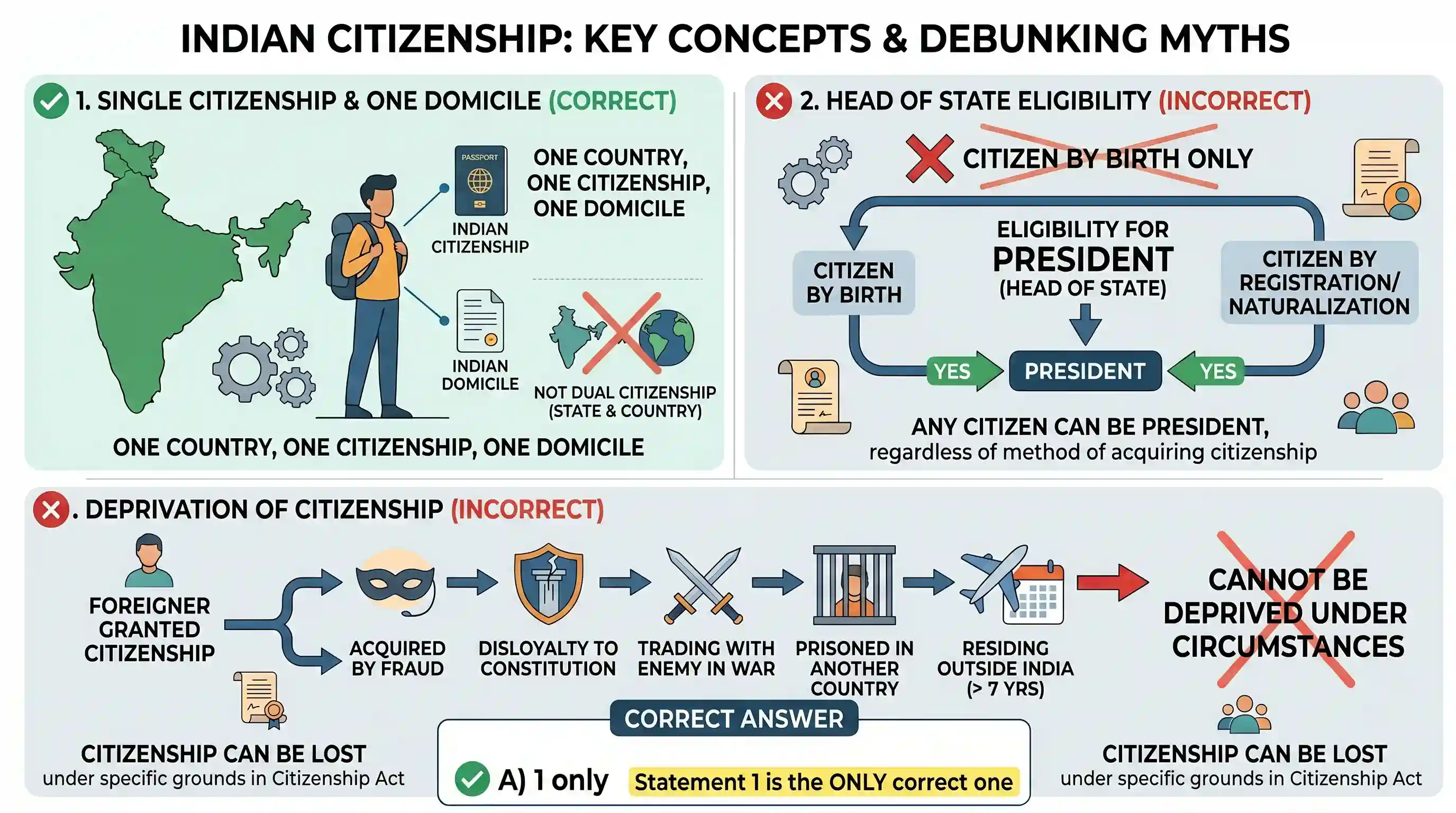
With reference to India, consider the following statements : 1. There is only one citizenship and one domicile. 2. A citizen by birth only can become the Head of State. 3. A foreigner once granted the citizenship cannot be deprived of it under any circumstances. Which of the statements given above is/are correct?

- A1 onlyCorrect
- B2 only
- C1 and 3
- D2 and 3
Explanation
Statement 1 is correct. India adopts the system of single citizenship, meaning a person is a citizen of the entire country (India) and not of any particular state within India. Similarly, there is one domicile for the entire country.
Statement 2 is incorrect. In India, a person who acquires citizenship by naturalization or registration can also become the Head of State (President). There is no constitutional requirement that the President must be a citizen by birth, unlike in some countries (e.g., the USA).
Statement 3 is incorrect. A foreigner once granted Indian citizenship can indeed be deprived of it under certain circumstances, as laid down in the Citizenship Act, 1955. Grounds for deprivation include acquiring citizenship by fraud, disloyalty to the Constitution, or continuous residence outside India for a specified period.
Related questions
More UPSC Prelims practice from the same subject and topic.
- Prelims 2021GS1polity-and-governance
'Right to Privacy' is protected under which Article of the Constitution of India?
- Prelims 2021GS1polity-and-governance
A legislation which confers on the executive or administrative authority an unguided and uncontrolled discretionary power in the matter of application of law violates which one of the following Articl…
- Prelims 2021GS1polity-and-governance
Which one of the following best defines the term 'State'?
- Prelims 2021GS1polity-and-governance
What is the position of the Right to Property in India?
- Prelims 2021GS1polity-and-governance
What was the exact constitutional status of India on 26th January, 1950?
- Prelims 2021GS1polity-and-governance
Constitutional government means