What is the position of the Right to Property in India?

- ALegal right available to citizens only
- BLegal right available to any personCorrect
- CFundamental Right available to citizens only
- DNeither Fundamental Right nor legal right
Explanation
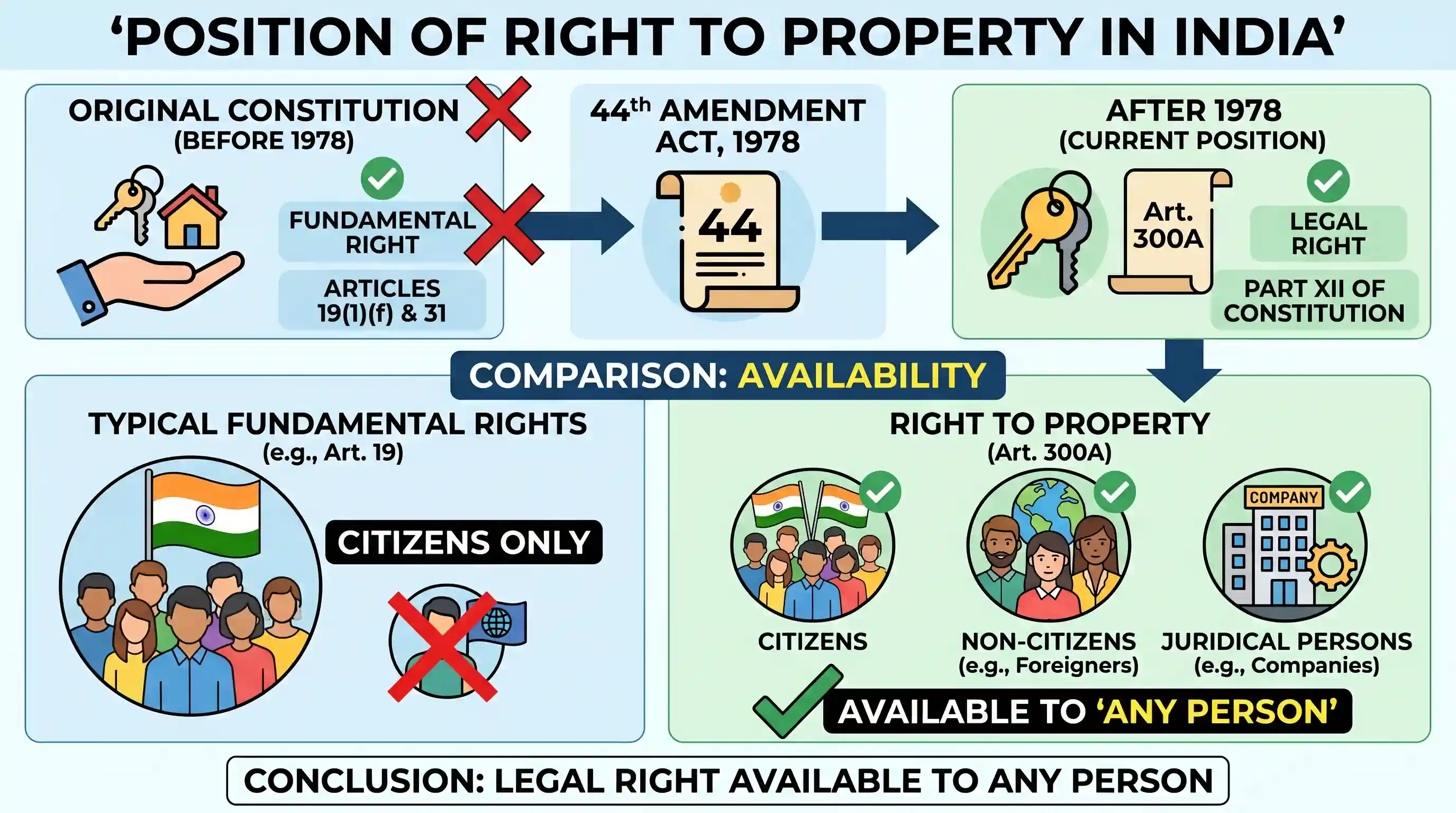
Originally, the Right to Property was a Fundamental Right under Article 31 and Article 19(1)(f). However, it was removed from the list of Fundamental Rights by the 44th Amendment Act of 1978. It was then shifted to Part XII of the Constitution and made a legal right under Article 300A. As a legal right under Article 300A, it is available to 'any person', meaning both citizens and non-citizens (juridical persons like companies) can exercise this right, though it can be regulated by ordinary law and does not automatically lead to compensation upon deprivation unless explicitly provided by law.
Related questions
More UPSC Prelims practice from the same subject and topic.
- Prelims 2021GS1polity-and-governance
'Right to Privacy' is protected under which Article of the Constitution of India?
- Prelims 2021GS1polity-and-governance
A legislation which confers on the executive or administrative authority an unguided and uncontrolled discretionary power in the matter of application of law violates which one of the following Articl…
- Prelims 2021GS1polity-and-governance
Which one of the following best defines the term 'State'?
- Prelims 2021GS1polity-and-governance
With reference to India, consider the following statements : 1. There is only one citizenship and one domicile. 2. A citizen by birth only can become the Head of State. 3. A foreigner once granted the…
- Prelims 2021GS1polity-and-governance
What was the exact constitutional status of India on 26th January, 1950?
- Prelims 2021GS1polity-and-governance
Constitutional government means