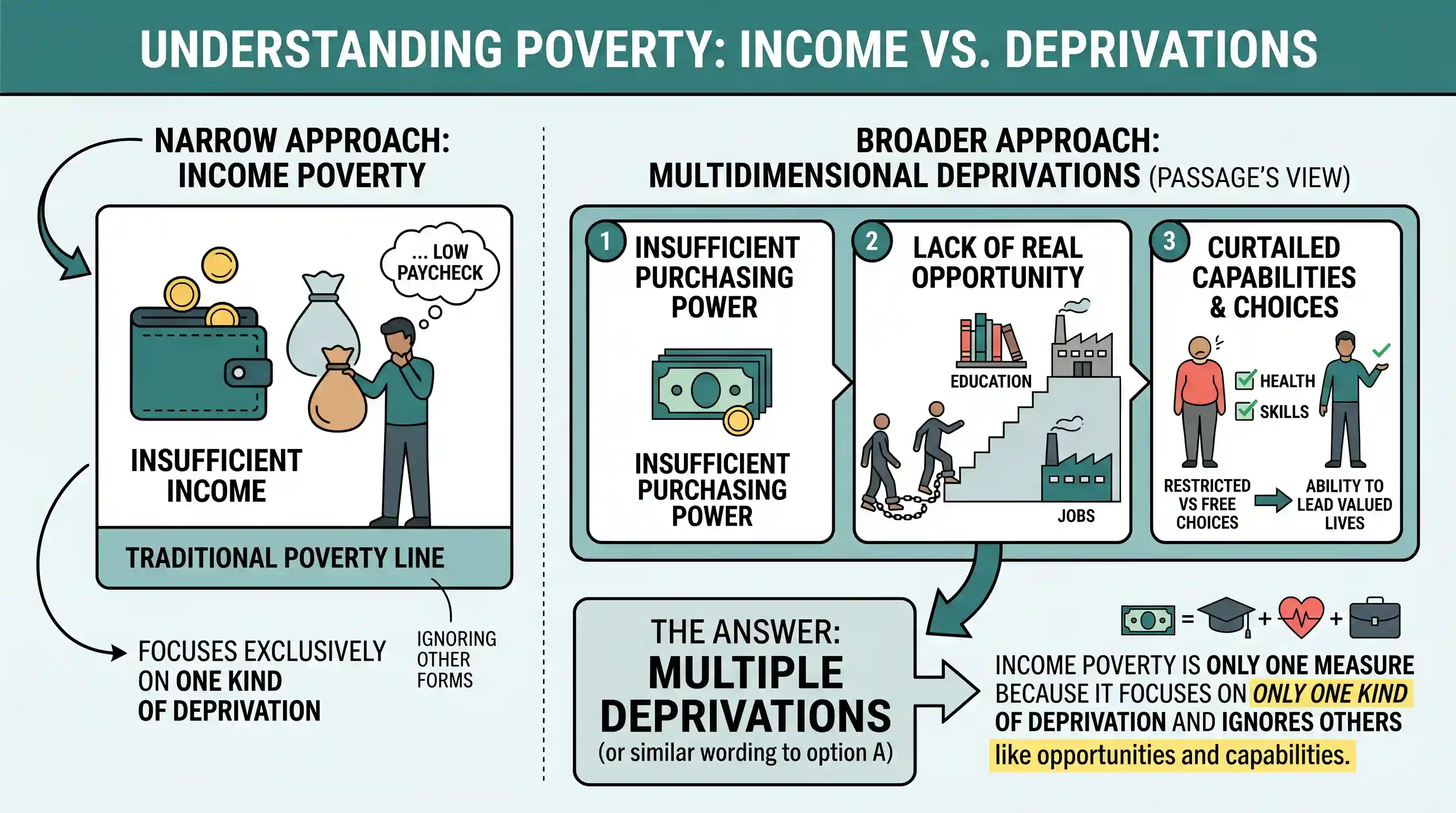
The poverty line is quite unsatisfactory when it comes to grasping the extent of poverty in India. It is not only because of its extremely narrow definition of 'who is poor' and the debatable methodology used to count the poor, but also because of a more fundamental assumption underlying it. It exclusively relies on the notion of poverty as insufficient income or insufficient purchasing power. One can better categorize it by calling it income poverty. If poverty is ultimately about deprivations affecting human well- being, then income poverty is only one aspect of it. Poverty of a life, in our view, lies not merely in the impoverished state in which the person actually lives, but also in the lack of real opportunity given by social constraints as well as personal circumstances- to choose other types of living. Even the relevance of low incomes, meagre possessions, and other aspects of what are standardly seen as economic poverty relate ultimately to their role in curtailing capabilities, i.e., their role in severely restricting the choices people have to lead variable and valued lives. Why is income poverty only one measure of counting the 'poor'?

- AIt talks of only one kind of deprivation ignoring all othersCorrect
- BOther deprivations in a human life have nothing to do with lack of purchasing power
- CIncome poverty is not a permanent condition, it changes from time to time
- DIncome poverty restricts human choices only at a point of time.
Explanation
The passage explicitly states that the poverty line "exclusively relies on the notion of poverty as insufficient income or insufficient purchasing power," and then clarifies, "If poverty is ultimately about deprivations affecting human well-being, then income poverty is only one aspect of it." It further explains that poverty also involves "lack of real opportunity" and "curtailing capabilities," which are other forms of deprivation. Therefore, income poverty is only one measure because it focuses on a single type of deprivation (income/purchasing power) while neglecting others.
Analyzing the options: A) It talks of only one kind of deprivation ignoring all others. This directly aligns with the passage's argument that income poverty is "only one aspect" of poverty and that poverty encompasses other deprivations like lack of opportunity and curtailed capabilities. B) Other deprivations in a human life have nothing to do with lack of purchasing power. The passage suggests a connection, stating that low incomes "relate ultimately to their role in curtailing capabilities," implying they can influence other deprivations. This option is too strong and contradictory to the text's nuance. C) Income poverty is not a permanent condition, it changes from time to time. The passage discusses the definition and scope of income poverty, not its temporal nature or permanence. This is outside the scope of the provided text's argument. D) Income poverty restricts human choices only at a point of time. The passage focuses on the nature of the restriction (curtailing capabilities, restricting choices) as a consequence of low income, but not whether this restriction is momentary or enduring. This option introduces a temporal aspect not discussed as the primary reason for income poverty being only one measure.
The final answer is A.
Related questions
More UPSC Prelims practice from the same subject and topic.
- Prelims 2022CSATReading Comprehension
The main threat to maintaining progress in human development comes from the increasingly evident unsustainability of production and consumption patterns. Current production models rely heavily on foss…
- Prelims 2022CSATReading Comprehension
The main threat to maintaining progress in human development comes from the increasingly evident unsustainability of production and consumption patterns. Current production models rely heavily on foss…
- Prelims 2022CSATReading Comprehension
Unless the forces and tendencies which are responsible for destroying the country's environment are checked in the near future and afforestation of denuded areas is taken up on a massive scale, the ha…
- Prelims 2022CSATReading Comprehension
"In simple matters like shoe- making, we think only a specially trained person will serve our purpose, but in politics, we presume that everyone who knows how to get votes knows how to administer a St…
- Prelims 2022CSATReading Comprehension
The poverty line is quite unsatisfactory when it comes to grasping the extent of poverty in India. It is not only because of its extremely narrow definition of 'who is poor' and the debatable methodol…
- Prelims 2022CSATReading Comprehension
The poverty line is quite unsatisfactory when it comes to grasping the extent of poverty in India. It is not only because of its extremely narrow definition of 'who is poor' and the debatable methodol…