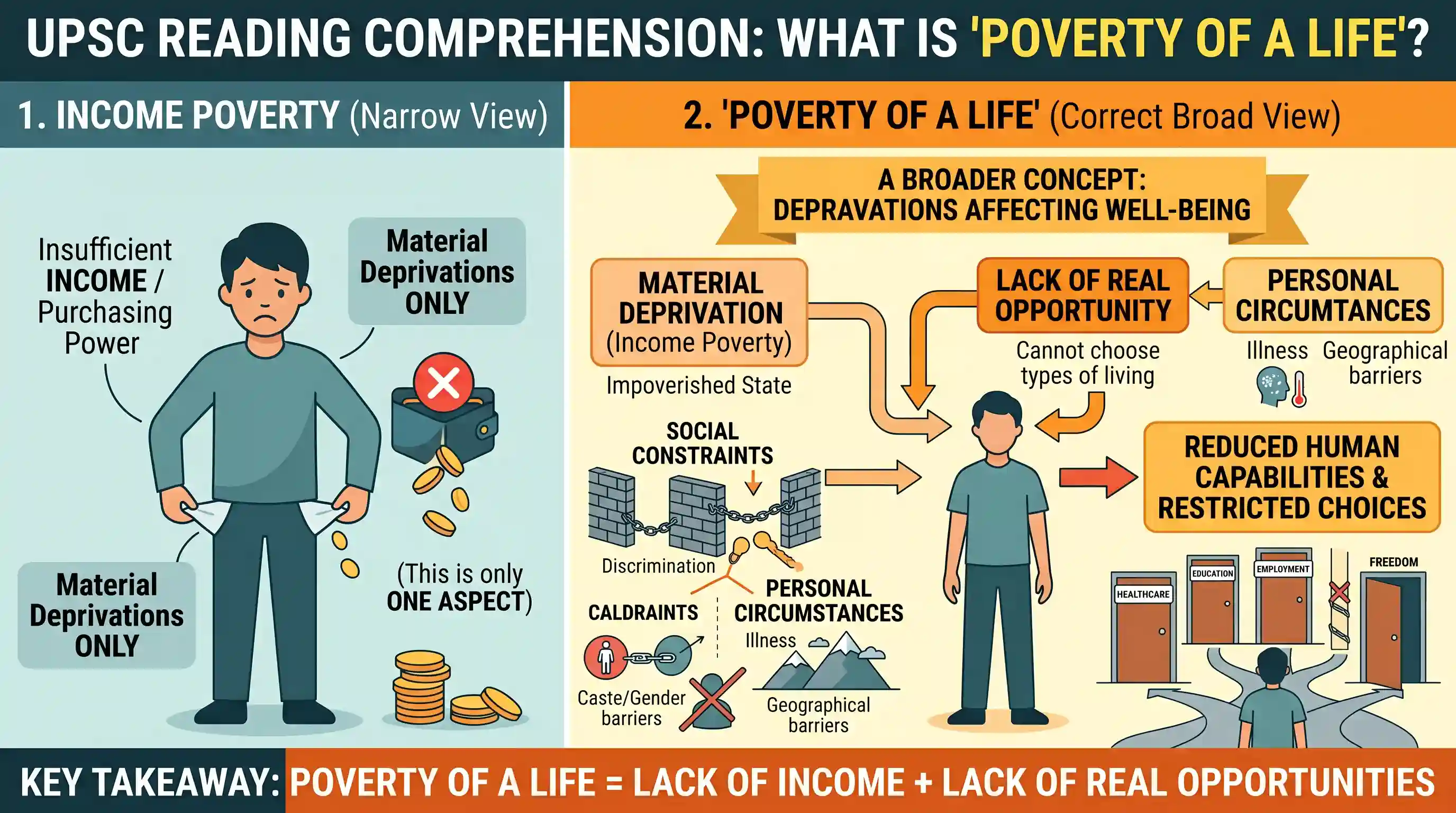
The poverty line is quite unsatisfactory when it comes to grasping the extent of poverty in India. It is not only because of its extremely narrow definition of 'who is poor' and the debatable methodology used to count the poor, but also because of a more fundamental assumption underlying it. It exclusively relies on the notion of poverty as insufficient income or insufficient purchasing power. One can better categorize it by calling it income poverty. If poverty is ultimately about deprivations affecting human well- being, then income poverty is only one aspect of it. Poverty of a life, in our view, lies not merely in the impoverished state in which the person actually lives, but also in the lack of real opportunity given by social constraints as well as personal circumstances- to choose other types of living. Even the relevance of low incomes, meagre possessions, and other aspects of what are standardly seen as economic poverty relate ultimately to their role in curtailing capabilities, i.e., their role in severely restricting the choices people have to lead variable and valued lives. What does the author mean by 'poverty of a life'?

- AAll deprivations in a human life which stem not only from lack of income but lack of real opportunitiesCorrect
- BImpoverished state of poor people in rural and urban areas
- CMissed opportunities in diverse personal circumstances
- DMaterial as well as non-material deprivations in a human life which restrict human choices permanently
Explanation
The author defines 'poverty of a life' as a broader concept than mere 'income poverty'.
Analysis of Options:
A) All deprivations in a human life which stem not only from lack of income but lack of real opportunities. This option perfectly captures the author's meaning. The passage states, "If poverty is ultimately about deprivations affecting human well-being, then income poverty is only one aspect of it." It then elaborates that 'poverty of a life' lies "not merely in the impoverished state... but also in the lack of real opportunity given by social constraints as well as personal circumstances- to choose other types of living." This directly links deprivations to both lack of income (impoverished state) and lack of real opportunities.
B) Impoverished state of poor people in rural and urban areas. The passage explicitly states that 'poverty of a life' is "not merely in the impoverished state," indicating that this option is too narrow and misses the core argument about lack of opportunities and choices.
C) Missed opportunities in diverse personal circumstances. While lack of opportunity is crucial, this option is too narrow as it omits the role of social constraints and the broader concept of "deprivations," of which income is one aspect. It also doesn't fully encompass the idea of restricted choices.
D) Material as well as non-material deprivations in a human life which restrict human choices permanently. This option is largely correct in identifying material and non-material deprivations that restrict choices. However, the word "permanently" is not supported by the text. The author speaks of "curtailing capabilities" and "severely restricting choices," but does not imply these restrictions are permanent.
Therefore, Option A is the most accurate and comprehensive explanation of what the author means by 'poverty of a life'.
Related questions
More UPSC Prelims practice from the same subject and topic.
- Prelims 2022CSATReading Comprehension
The main threat to maintaining progress in human development comes from the increasingly evident unsustainability of production and consumption patterns. Current production models rely heavily on foss…
- Prelims 2022CSATReading Comprehension
The main threat to maintaining progress in human development comes from the increasingly evident unsustainability of production and consumption patterns. Current production models rely heavily on foss…
- Prelims 2022CSATReading Comprehension
Unless the forces and tendencies which are responsible for destroying the country's environment are checked in the near future and afforestation of denuded areas is taken up on a massive scale, the ha…
- Prelims 2022CSATReading Comprehension
"In simple matters like shoe- making, we think only a specially trained person will serve our purpose, but in politics, we presume that everyone who knows how to get votes knows how to administer a St…
- Prelims 2022CSATReading Comprehension
The poverty line is quite unsatisfactory when it comes to grasping the extent of poverty in India. It is not only because of its extremely narrow definition of 'who is poor' and the debatable methodol…
- Prelims 2022CSATReading Comprehension
The poverty line is quite unsatisfactory when it comes to grasping the extent of poverty in India. It is not only because of its extremely narrow definition of 'who is poor' and the debatable methodol…