X and Y run a 3 km race along a circular course of length 300 m. Their speeds are in the ratio 3:2 . If they start together in the same direction, how many times would the first one pass the other (the start-off is not counted as passing)?

- A2
- B3Correct
- C4
- D5
Explanation
To determine how many times the first runner (X) passes the other (Y), we need to consider their relative speed and the total distance covered.
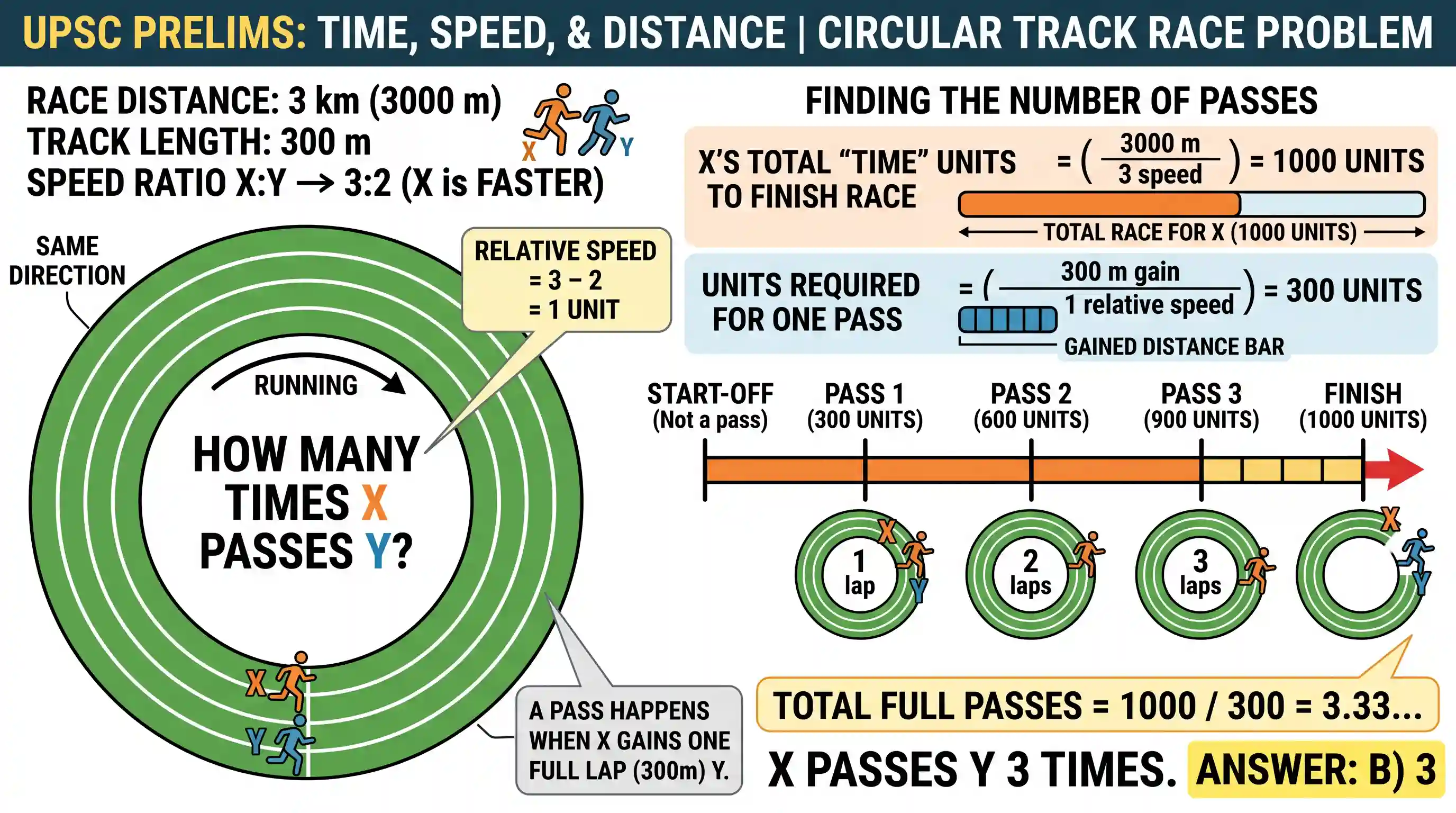
- Relative Speed: X's speed is 3 units, Y's speed is 2 units. Since they run in the same direction, X gains on Y at a relative speed of (3 - 2) = 1 unit.
- Distance for one pass: X passes Y when X gains one full lap on Y. The length of one lap is 300 m.
- Total race distance: The race is 3 km = 3000 m.
- Time for X to finish the race: X runs at 3 units of speed. To cover 3000 m, X takes a time proportional to 3000/3 = 1000 units.
- Time for X to gain one lap: X gains one lap (300 m) at a relative speed of 1 unit. This takes a time proportional to 300/1 = 300 units.
- Number of passes: Divide the total "time" X is running by the "time" it takes for X to gain one lap. Number of passes = (Time for X to finish) / (Time for X to gain one lap) Number of passes = 1000 / 300 = 10/3 = 3.33...
Since a pass means completing a full lap ahead, we take the integer part. X passes Y 3 times. The start-off is not counted, and our calculation counts distinct instances of X gaining a full lap.
The final answer is B) 3.
Related questions
More UPSC Prelims practice from the same subject and topic.
- Prelims 2022CSATQuantitative Aptitude
A man started from home at 14:30 hours and drove to village, arriving there when the village clock indicated 15:15 hours. After staying for 25 minutes, he drove back by a different route of length 1:2…
- Prelims 2022CSATQuantitative Aptitude
An Identity Card has the number ABCDEFG, not necessarily in that order, where each letter represents a distinct digit (1, 2, 4, 5, 7, 8, 9 only). The number is divisible by 9. After deleting the first…
- Prelims 2022CSATQuantitative Aptitude
A bill for ₹1,840 is paid in the denominations of ₹50, ₹20 and ₹10 notes. 50 notes in all are used. Consider the following statements: 1. 25 notes of ₹50 are used and the remaining are in the denomina…
- Prelims 2022CSATQuantitative Aptitude
Which number amongst 2⁴⁰, 3²¹, 4¹⁸ and 8¹² is the smallest?
- Prelims 2022CSATQuantitative Aptitude
The digits 1 to 9 are arranged in three rows in such a way that each row contains three digits, and the number formed in the second row is twice the number formed in the first row; and the number form…
- Prelims 2022CSATQuantitative Aptitude
In a tournament of Chess having 150 entrants, a player is eliminated whenever he loses a match. It is given that no match results in a tie/draw. How many matches are played in the entire tournament?