A bill for ₹1,840 is paid in the denominations of ₹50, ₹20 and ₹10 notes. 50 notes in all are used. Consider the following statements: 1. 25 notes of ₹50 are used and the remaining are in the denominations of ₹20 and ₹10. 2. 35 notes of ₹20 are used and the remaining are in the denominations of ₹50 and ₹10. 3. 20 notes of ₹10 are used and the remaining are in the denominations of ₹50 and ₹20. Which of the above statements are not correct?

- A1 and 2 only
- B2 and 3 only
- C1 and 3 only
- D1, 2 and 3Correct
Explanation
Let N50, N20, and N10 be the number of notes of denominations ₹50, ₹20, and ₹10 respectively.
Given: Total amount = 50N50 + 20N20 + 10*N10 = 1840 Total number of notes = N50 + N20 + N10 = 50
Let's analyze each statement:
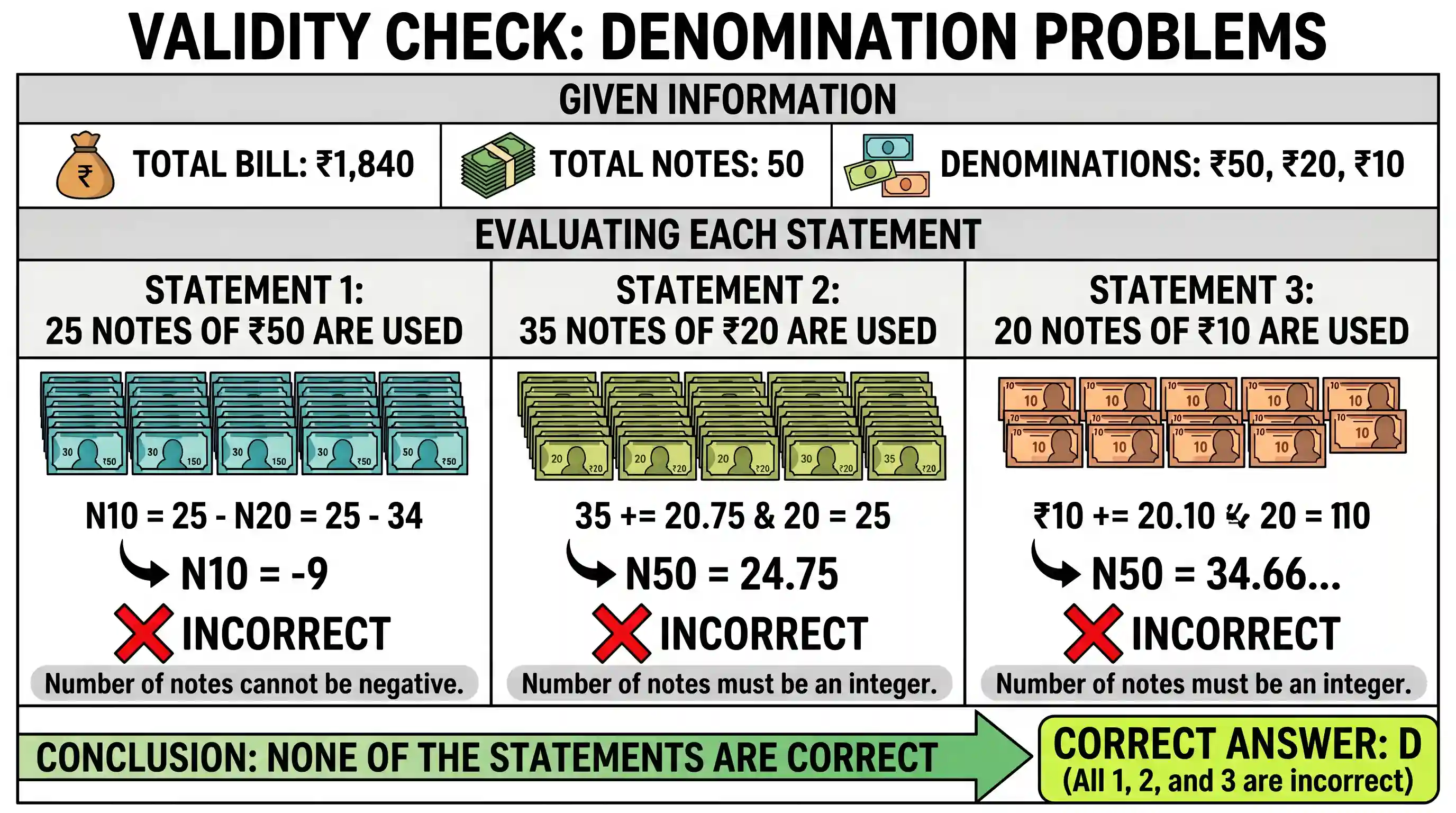
Statement 1: 25 notes of ₹50 are used (N50 = 25). Substitute N50 = 25 into the equations:
- 5025 + 20N20 + 10N10 = 1840 => 1250 + 20N20 + 10N10 = 1840 => 20N20 + 10*N10 = 590
- 25 + N20 + N10 = 50 => N20 + N10 = 25
From the second derived equation, N10 = 25 - N20. Substitute this into the first derived equation: 20N20 + 10(25 - N20) = 590 20N20 + 250 - 10N20 = 590 10*N20 = 340 N20 = 34
Now find N10: N10 = 25 - 34 = -9. Since the number of notes cannot be negative, Statement 1 is incorrect.
Statement 2: 35 notes of ₹20 are used (N20 = 35). Substitute N20 = 35 into the equations:
- 50N50 + 2035 + 10N10 = 1840 => 50N50 + 700 + 10N10 = 1840 => 50N50 + 10*N10 = 1140
- N50 + 35 + N10 = 50 => N50 + N10 = 15
From the second derived equation, N10 = 15 - N50. Substitute this into the first derived equation: 50N50 + 10(15 - N50) = 1140 50N50 + 150 - 10N50 = 1140 40*N50 = 990 N50 = 990 / 40 = 24.75
Since the number of notes must be an integer, Statement 2 is incorrect.
Statement 3: 20 notes of ₹10 are used (N10 = 20). Substitute N10 = 20 into the equations:
- 50N50 + 20N20 + 1020 = 1840 => 50N50 + 20N20 + 200 = 1840 => 50N50 + 20*N20 = 1640
- N50 + N20 + 20 = 50 => N50 + N20 = 30
From the second derived equation, N20 = 30 - N50. Substitute this into the first derived equation: 50N50 + 20(30 - N50) = 1640 50N50 + 600 - 20N50 = 1640 30*N50 = 1040 N50 = 1040 / 30 = 104 / 3 = 34.66...
Since the number of notes must be an integer, Statement 3 is incorrect.
Since all three statements (1, 2, and 3) are incorrect, the correct option is D.
The final answer is D
Related questions
More UPSC Prelims practice from the same subject and topic.
- Prelims 2022CSATQuantitative Aptitude
In a tournament of Chess having 150 entrants, a player is eliminated whenever he loses a match. It is given that no match results in a tie/draw. How many matches are played in the entire tournament?
- Prelims 2022CSATQuantitative Aptitude
The increase in the price of a certain item was 25% . Then the price was decreased by 20% and then again increased by 10% . What is the resultant increase in the price?
- Prelims 2022CSATQuantitative Aptitude
On one side of a 1.01 km long road, 101 plants are planted at equal distance from each other. What is the total distance between 5 consecutive plants?
- Prelims 2022CSATQuantitative Aptitude
Consider the Question and two Statements given below in respect of three cities P , Q and R in a State: Question: How far is city P from city Q ? Statement - 1: City Q is 18 km from city R . Statement…
- Prelims 2022CSATQuantitative Aptitude
Five friends P , Q , X , Y and Z purchased some notebooks. The relevant information is given below: 1. Z Purchased 8 notebooks more than X did. 2. P and Q Together purchased 21 notebooks. 3. Q purchas…
- Prelims 2022CSATQuantitative Aptitude
Consider the Question and two Statements given below: Question: What is the age of Manisha? Statement- 1: Manisha is 24 years younger than her mother. Statement- 2: 5 years later, the ages of Manisha …