Consider the Question and two Statements given below in respect of three cities P , Q and R in a State: Question: How far is city P from city Q ? Statement - 1: City Q is 18 km from city R . Statement - 2: City P is 43 km from city R . Which one of the following is correct in respect of the Question and the Statements?

- AStatement-1 alone is sufficient to answer the Question
- BStatement - 2 alone is sufficient to answer the Question
- CBoth Statement - 1 and Statement-2 are sufficient to answer the Question
- DBoth Statement - 1 and Statement - 2 are not sufficient to answer the QuestionCorrect
Explanation
The question asks for the distance between city P and city Q (PQ).
Statement 1: "City Q is 18 km from city R." This tells us the distance QR = 18 km. This statement alone does not provide any information about city P, so it is not sufficient to find the distance PQ.
Statement 2: "City P is 43 km from city R." This tells us the distance PR = 43 km. This statement alone does not provide any information about city Q, so it is not sufficient to find the distance PQ.
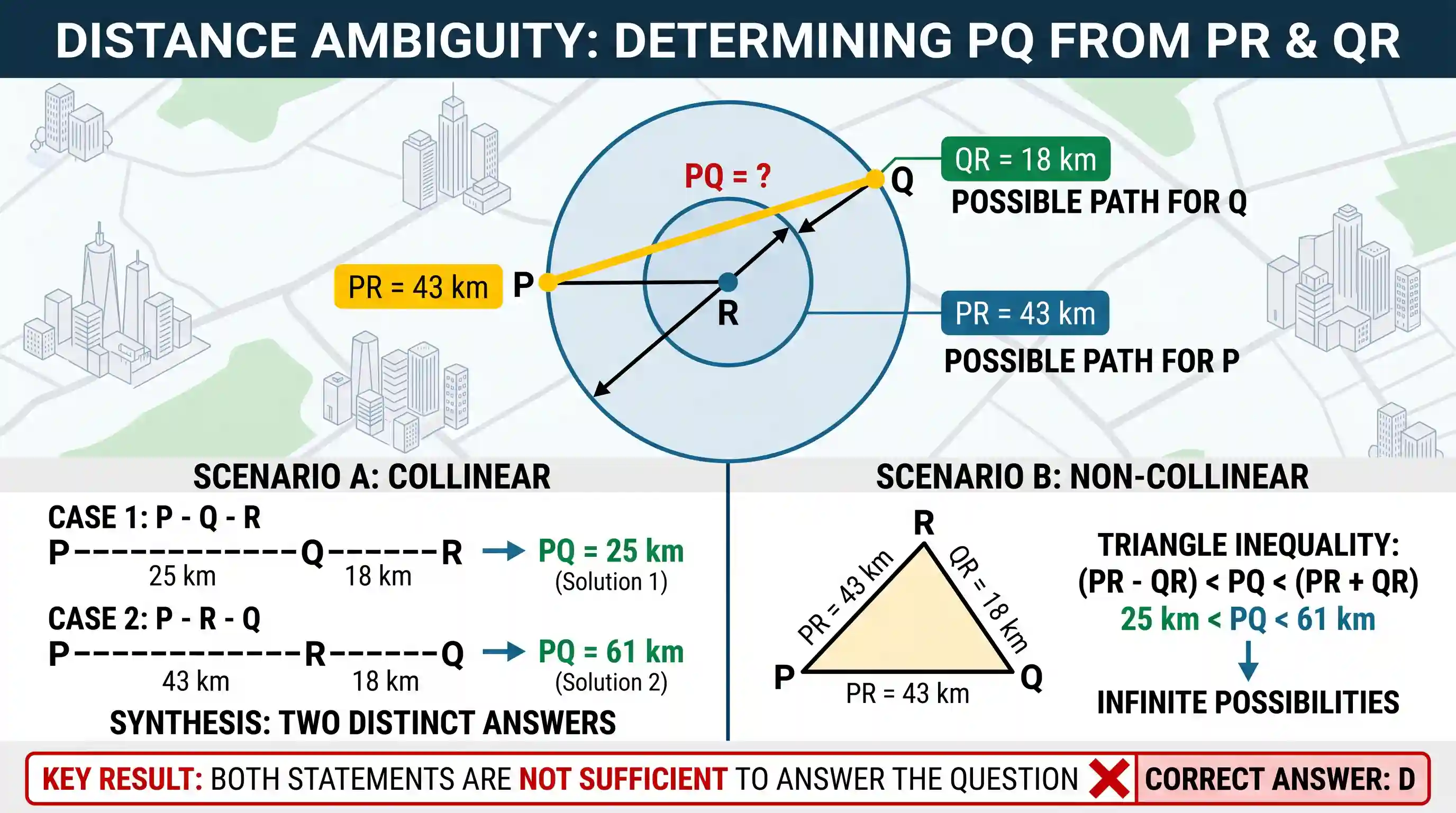
Combining both Statement 1 and Statement 2: We know QR = 18 km and PR = 43 km. The relative positions of P, Q, and R are not specified (e.g., whether they are collinear or form a triangle).
Case 1: The cities are collinear (lie on a straight line). a) If Q is between P and R (P - Q - R): Then PR = PQ + QR 43 = PQ + 18 PQ = 43 - 18 = 25 km.
b) If R is between P and Q (P - R - Q): Then PQ = PR + RQ PQ = 43 + 18 = 61 km.
c) If P is between Q and R (Q - P - R): Then QR = QP + PR 18 = QP + 43 QP = 18 - 43 = -25 km, which is impossible as distance cannot be negative. This arrangement is not valid.
Since there are two distinct possible distances (25 km or 61 km) even if the cities are collinear, the information is not sufficient to give a unique answer.
Case 2: The cities are not collinear (they form a triangle PQR). In a triangle, the length of one side must be greater than the absolute difference of the other two sides and less than their sum. So, |PR - QR| < PQ < (PR + QR) |43 - 18| < PQ < (43 + 18) 25 km < PQ < 61 km. In this case, PQ could be any distance between 25 km and 61 km (e.g., 30 km, 45 km, 50 km, etc.), which means there are infinite possibilities.
Since neither statement alone nor both statements together provide a unique distance for PQ, both statements are not sufficient to answer the question.
The final answer is D
Related questions
More UPSC Prelims practice from the same subject and topic.
- Prelims 2022CSATQuantitative Aptitude
A bill for ₹1,840 is paid in the denominations of ₹50, ₹20 and ₹10 notes. 50 notes in all are used. Consider the following statements: 1. 25 notes of ₹50 are used and the remaining are in the denomina…
- Prelims 2022CSATQuantitative Aptitude
In a tournament of Chess having 150 entrants, a player is eliminated whenever he loses a match. It is given that no match results in a tie/draw. How many matches are played in the entire tournament?
- Prelims 2022CSATQuantitative Aptitude
The increase in the price of a certain item was 25% . Then the price was decreased by 20% and then again increased by 10% . What is the resultant increase in the price?
- Prelims 2022CSATQuantitative Aptitude
On one side of a 1.01 km long road, 101 plants are planted at equal distance from each other. What is the total distance between 5 consecutive plants?
- Prelims 2022CSATQuantitative Aptitude
Five friends P , Q , X , Y and Z purchased some notebooks. The relevant information is given below: 1. Z Purchased 8 notebooks more than X did. 2. P and Q Together purchased 21 notebooks. 3. Q purchas…
- Prelims 2022CSATQuantitative Aptitude
Consider the Question and two Statements given below: Question: What is the age of Manisha? Statement- 1: Manisha is 24 years younger than her mother. Statement- 2: 5 years later, the ages of Manisha …