A man started from home at 14:30 hours and drove to village, arriving there when the village clock indicated 15:15 hours. After staying for 25 minutes, he drove back by a different route of length 1:25 times the first route at a rate twice as fast reaching home at 16:00 hours. As compared to the clock at home, the village clock is

- A10 minutes slow
- B5 minutes slow
- C10 minutes fast
- D5 minutes fastCorrect
Explanation
Here's a step-by-step breakdown:
-
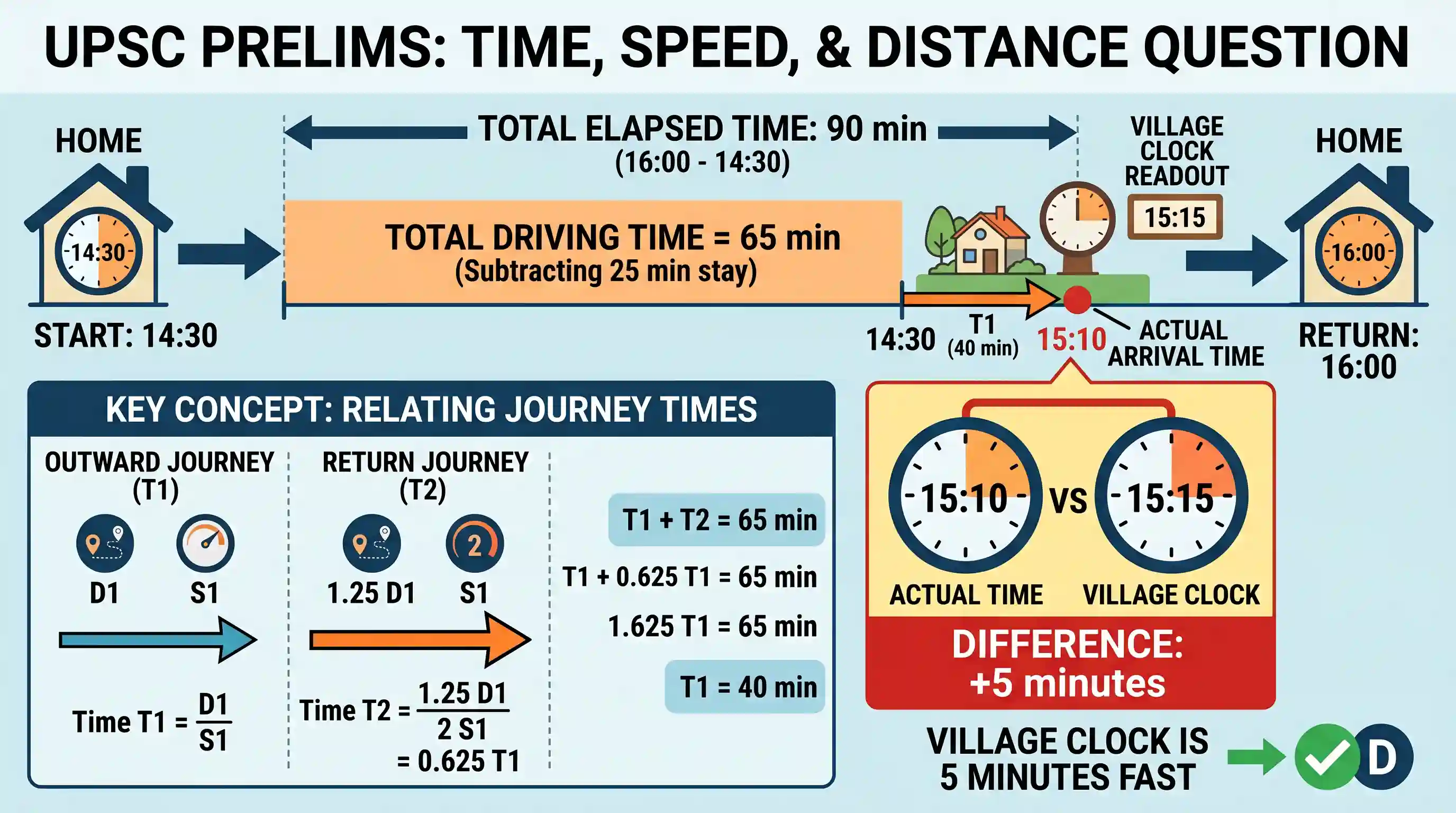
Calculate total time elapsed by home clock: The man started at 14:30 and returned at 16:00. Total time = 16:00 - 14:30 = 1 hour 30 minutes = 90 minutes.
-
Calculate total driving time: He stayed for 25 minutes in the village. So, the total time spent driving = Total time - Stay time = 90 minutes - 25 minutes = 65 minutes.
-
Relate outward and return journey times:
- Let the distance to the village be D1 and speed be S1. Time for outward journey (T1) = D1/S1.
- For the return journey, distance D2 = 1.25 * D1 and speed S2 = 2 * S1.
- Time for return journey (T2) = D2/S2 = (1.25 * D1) / (2 * S1) = (1.25/2) * (D1/S1) = 0.625 * T1.
-
Calculate outward journey time (T1):
- Total driving time = T1 + T2 = T1 + 0.625 * T1 = 1.625 * T1.
- We know total driving time is 65 minutes. So, 1.625 * T1 = 65 minutes.
- T1 = 65 / 1.625 = 65 / (13/8) = 65 * 8 / 13 = 5 * 8 = 40 minutes.
-
Determine actual arrival time at the village: The man started at 14:30 and drove for 40 minutes. So, he actually arrived at the village at 14:30 + 40 minutes = 15:10 (according to an accurate clock, like his home clock).
-
Compare with village clock: When he arrived, the village clock indicated 15:15. His actual arrival time was 15:10.
- Village clock reading (15:15) - Actual time (15:10) = 5 minutes.
- Since the village clock showed a later time, it is 5 minutes fast.
The final answer is D) 5 minutes fast.
Related questions
More UPSC Prelims practice from the same subject and topic.
- Prelims 2022CSATQuantitative Aptitude
X and Y run a 3 km race along a circular course of length 300 m. Their speeds are in the ratio 3:2 . If they start together in the same direction, how many times would the first one pass the other (th…
- Prelims 2022CSATQuantitative Aptitude
An Identity Card has the number ABCDEFG, not necessarily in that order, where each letter represents a distinct digit (1, 2, 4, 5, 7, 8, 9 only). The number is divisible by 9. After deleting the first…
- Prelims 2022CSATQuantitative Aptitude
A bill for ₹1,840 is paid in the denominations of ₹50, ₹20 and ₹10 notes. 50 notes in all are used. Consider the following statements: 1. 25 notes of ₹50 are used and the remaining are in the denomina…
- Prelims 2022CSATQuantitative Aptitude
Which number amongst 2⁴⁰, 3²¹, 4¹⁸ and 8¹² is the smallest?
- Prelims 2022CSATQuantitative Aptitude
The digits 1 to 9 are arranged in three rows in such a way that each row contains three digits, and the number formed in the second row is twice the number formed in the first row; and the number form…
- Prelims 2022CSATQuantitative Aptitude
In a tournament of Chess having 150 entrants, a player is eliminated whenever he loses a match. It is given that no match results in a tie/draw. How many matches are played in the entire tournament?