Three persons A, Band C are standing in a queue not necessarily in the same order. There are 4 persons between A and B, and 7 persons between Band C. If there are 11 persons ahead of Cand 13 behind A, what could be the minimum number of persons in the queue?

- A22Correct
- B28
- C32
- D38
Explanation
To find the minimum number of persons in the queue, we need to consider all possible relative orderings of A, B, and C, and calculate the total number of persons (N) for each valid arrangement.
Let's denote the position of a person from the front of the queue.
- "11 persons ahead of C": This means C is at position 11 + 1 = 12.
- "13 persons behind A": If the total number of persons in the queue is N, then A is at position N - 13.
Now let's analyze the relative positions of A, B, and C based on the "between" conditions:
- "4 persons between A and B": This means the number of positions between A and B is 4.
- "7 persons between B and C": This means the number of positions between B and C is 7.
We will examine the valid linear arrangements of A, B, and C:
Case 1: Order C - B - A Arrangement: C (7 persons) B (4 persons) A * C is at position 12. * B is after C with 7 persons between them: Position of B = Position of C + 1 (for C) + 7 = 12 + 1 + 7 = 20. * A is after B with 4 persons between them: Position of A = Position of B + 1 (for B) + 4 = 20 + 1 + 4 = 25. * We know A is at position N-13. So, 25 = N - 13 => N = 38. This arrangement is consistent with all conditions.
Case 2: Order C - A - B Arrangement: C (x persons) A (y persons) B * From "4 persons between A and B", we know y = 4. * From "7 persons between B and C", we know that (persons between C and A) + 1 (for A) + (persons between A and B) = 7. So, x + 1 + y = 7. * Substitute y=4: x + 1 + 4 = 7 => x = 2. * The arrangement is C (2 persons) A (4 persons) B. * C is at position 12. * A is after C with 2 persons between them: Position of A = Position of C + 1 (for C) + 2 = 12 + 1 + 2 = 15. * B is after A with 4 persons between them: Position of B = Position of A + 1 (for A) + 4 = 15 + 1 + 4 = 20. * We know A is at position N-13. So, 15 = N - 13 => N = 28. This arrangement is consistent with all conditions.
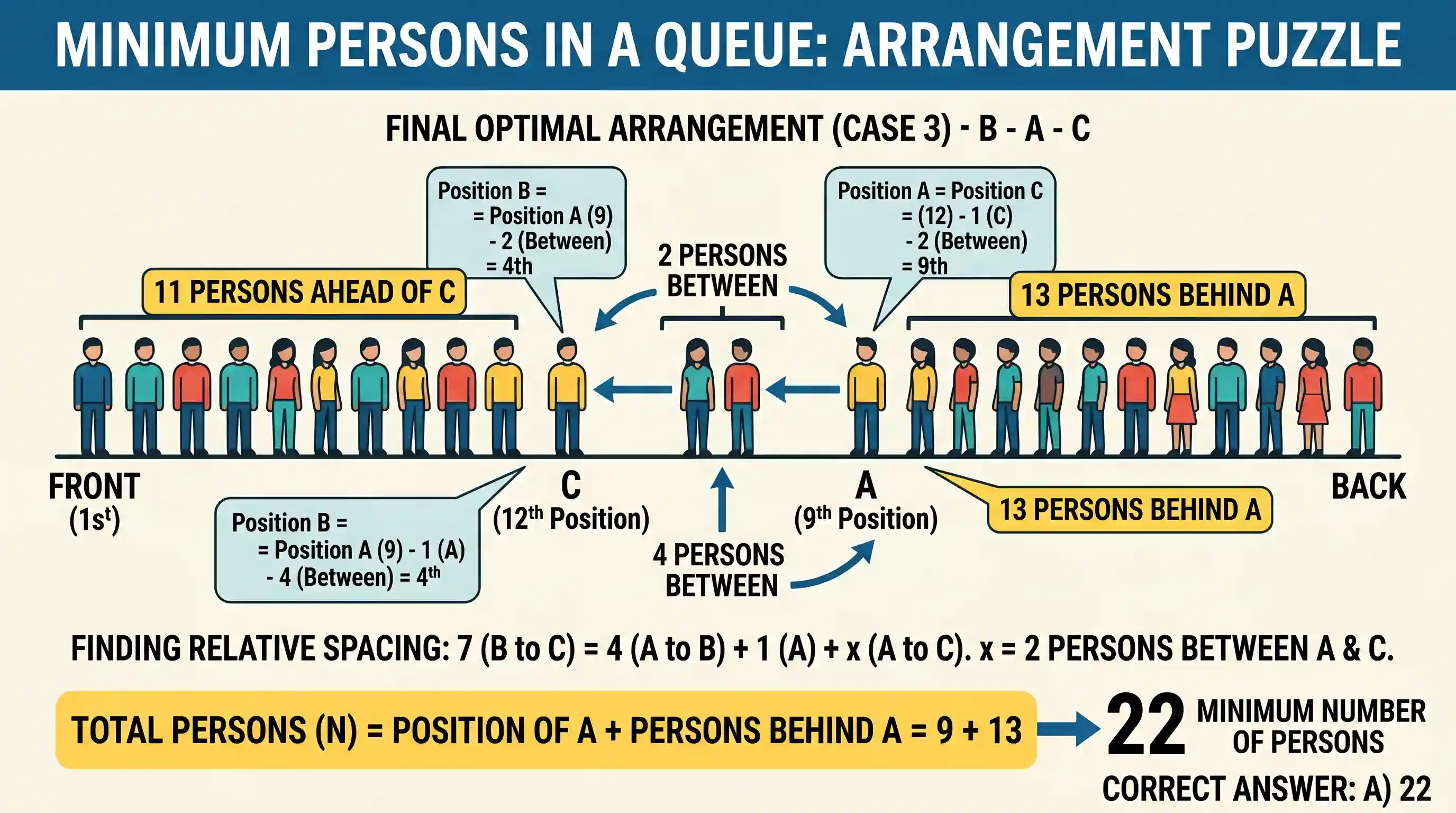
Case 3: Order B - A - C Arrangement: B (x persons) A (y persons) C * From "4 persons between A and B", we know x = 4. * From "7 persons between B and C", we know that (persons between B and A) + 1 (for A) + (persons between A and C) = 7. So, x + 1 + y = 7. * Substitute x=4: 4 + 1 + y = 7 => y = 2. * The arrangement is B (4 persons) A (2 persons) C. * C is at position 12. * A is before C with 2 persons between them: Position of A = Position of C - 1 (for C) - 2 = 12 - 1 - 2 = 9. * B is before A with 4 persons between them: Position of B = Position of A - 1 (for A) - 4 = 9 - 1 - 4 = 4. * We know A is at position N-13. So, 9 = N - 13 => N = 22. This arrangement is consistent with all conditions.
Other possible orders (A-B-C, A-C-B, B-C-A) lead to contradictions (e.g., negative number of persons between, or A's position being less than 1). For example:
- A-B-C: A (4) B (7) C. If C is at 12, A would be at 12 - 1 - 7 - 1 - 4 = -1, which is impossible.
- A-C-B: A (x) C (y) B. 4 persons between A and B means x+1+y=4. 7 persons between B and C means y=7. So x+1+7=4 => x=-4, impossible.
- B-C-A: B (x) C (y) A. 7 persons between B and C means x+1+y=7. 4 persons between A and B means y=4. So x+1+4=7 => x=2. This means B(2)C(4)A. A is at N-13. C is at 12. A is after C. So A=12+1+4=17. N-13=17 => N=30. Check between A and B: A is at 17, B is at 12-1-2=9. Persons between A and B = 17-9-1=7. This contradicts the given 4 persons between A and B. So this order is not valid.
Comparing the valid values for N: 38, 28, 22. The minimum number of persons in the queue is 22.
The final answer is A) 22.
Related questions
More UPSC Prelims practice from the same subject and topic.
- Prelims 2022CSATLogical Reasoning
Two friends X and Y start running and they run together for 50 m in the same direction and reach a point. X turns right and runs 60 m, while Y turns left and runs 40 m. Then X turns left and runs 50 m…
- Prelims 2022CSATLogical Reasoning
Eight students A, B, C, D, E, F, G and H sit around a circular table, equidistant from each other, facing the centre of the table, not necessarily in the same order. Band D sit neither adjacent to C n…
- Prelims 2022CSATLogical Reasoning
Six persons A, B, C, D, E and F are sitting equidistant from each other around a circular table (facing the centre of the table). Consider the Question and two Statements given below : Question : Who …
- Prelims 2022CSATLogical Reasoning
Six lectures A, B, C, D, E and F, each of one hour duration, scheduled between 8:00 am and 2:00 pm Consider the following question and two statements: Question: Which lecture is in the third period? S…
- Prelims 2022CSATLogical Reasoning
What is the value of X in the sequence 20, 10, 10, 15, 30, 75, X?
- Prelims 2022CSATLogical Reasoning
Which date of June 2099 among the following is Sunday if 5 June 2022 is Sunday?