Six persons A, B, C, D, E and F are sitting equidistant from each other around a circular table (facing the centre of the table). Consider the Question and two Statements given below : Question : Who is sitting on the immediate left of A? Statement- 1 : B is sitting opposite to C and D is sitting opposite to E. Statement- 2 : F is sitting on the immediate left of B. Which one of the following is correct in respect of the Question and the Statements?

- AStatement-1 alone is sufficient to answer the Question
- BStatement-2 alone is sufficient to answer the Question
- CBoth Statement-1 and Statement-2 are sufficient to answer the Question
- DBoth Statement-1 and Statement-2 are not sufficient to answer the QuestionCorrect
Explanation
The question asks to identify the person sitting on the immediate left of A. We need to determine if the given statements, individually or together, provide enough information to answer this question uniquely.
Let's analyze the statements:
-
Statement-1: B is sitting opposite to C and D is sitting opposite to E. In a circular arrangement of 6 people, "opposite" means there are two people between them on each side. If we place B, C is fixed. If we place D, E is fixed. The remaining two people are A and F. Consider an arrangement: B _ _ C _ _. The remaining positions must be filled by D, E, A, F. If D and E are opposite, they can be placed in the remaining two opposite slots. This leaves A and F for the last two slots. Example 1: B, D, A, C, E, F (clockwise). Here, A is between D and C. Immediate left of A is D. Example 2: B, D, F, C, E, A (clockwise). Here, A is between E and B. Immediate left of A is E. Since A's position relative to others is not fixed, we cannot uniquely determine who is on A's immediate left. Therefore, Statement-1 alone is not sufficient.
-
Statement-2: F is sitting on the immediate left of B. This statement establishes a direct relationship between F and B. If we place B, F's position is fixed relative to B. For example, if B is at position 1, F is at position 6 (assuming clockwise numbering and "immediate left" means anti-clockwise). The remaining four people (A, C, D, E) can be arranged in the remaining four positions in many ways. We don't know A's position at all. A could be next to F, or next to B, or somewhere else. For example: Arrangement 1: B, A, C, D, E, F. Immediate left of A is B. Arrangement 2: B, C, A, D, E, F. Immediate left of A is C. Since A's position is not fixed, we cannot uniquely determine who is on A's immediate left. Therefore, Statement-2 alone is not sufficient.
-
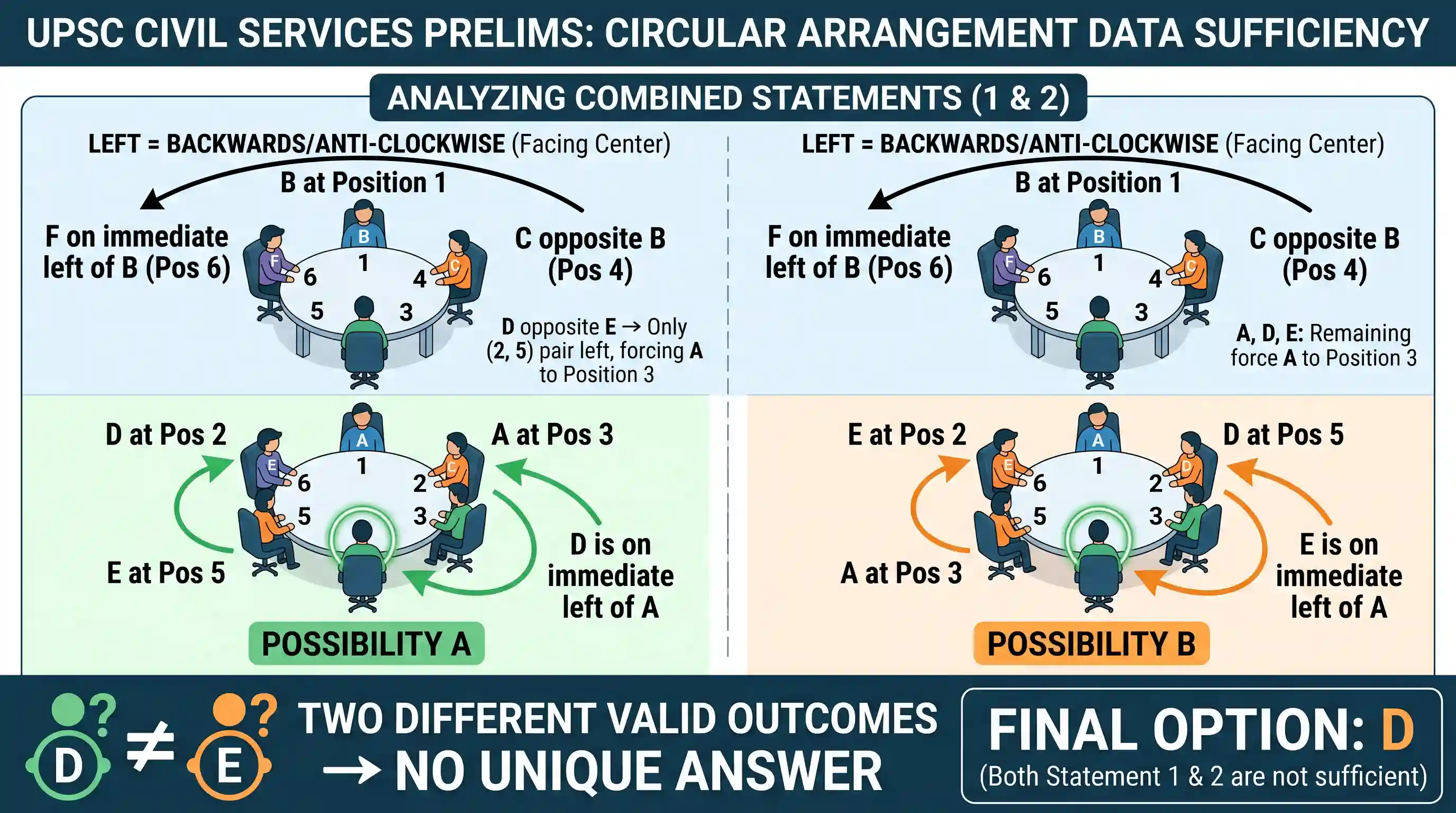
Combining Statement-1 and Statement-2: From Statement-2, let's place B. Let B be at position 1. Then F is on the immediate left of B, so F is at position 6. From Statement-1, C is opposite B. So C is at position 4. Current arrangement (clockwise): B(1), _(2), _(3), C(4), _(5), F(6). The remaining persons are A, D, E. The remaining positions are 2, 3, 5. From Statement-1, D is opposite E. In the remaining positions (2, 3, 5), the only pair of opposite positions is (2, 5). (Position 3 is opposite position 6, which is F). So, D and E must occupy positions 2 and 5. This means A must occupy the remaining position, which is 3. Now we know A is at position 3. The person on the immediate left of A (at position 3) is the person at position 2. However, we have two possibilities for positions 2 and 5: Possibility A: D is at position 2, and E is at position 5. The arrangement is: B, D, A, C, E, F (clockwise). In this case, the immediate left of A is D. Possibility B: E is at position 2, and D is at position 5. The arrangement is: B, E, A, C, D, F (clockwise). In this case, the immediate left of A is E. Since the person on A's immediate left can be either D or E, we cannot uniquely determine the answer. Therefore, both Statement-1 and Statement-2 together are not sufficient.
Based on the analysis, neither statement alone nor both statements together are sufficient to answer the question.
The final answer is D
Related questions
More UPSC Prelims practice from the same subject and topic.
- Prelims 2022CSATLogical Reasoning
Two friends X and Y start running and they run together for 50 m in the same direction and reach a point. X turns right and runs 60 m, while Y turns left and runs 40 m. Then X turns left and runs 50 m…
- Prelims 2022CSATLogical Reasoning
Three persons A, Band C are standing in a queue not necessarily in the same order. There are 4 persons between A and B, and 7 persons between Band C. If there are 11 persons ahead of Cand 13 behind A,…
- Prelims 2022CSATLogical Reasoning
Eight students A, B, C, D, E, F, G and H sit around a circular table, equidistant from each other, facing the centre of the table, not necessarily in the same order. Band D sit neither adjacent to C n…
- Prelims 2022CSATLogical Reasoning
Six lectures A, B, C, D, E and F, each of one hour duration, scheduled between 8:00 am and 2:00 pm Consider the following question and two statements: Question: Which lecture is in the third period? S…
- Prelims 2022CSATLogical Reasoning
What is the value of X in the sequence 20, 10, 10, 15, 30, 75, X?
- Prelims 2022CSATLogical Reasoning
Which date of June 2099 among the following is Sunday if 5 June 2022 is Sunday?