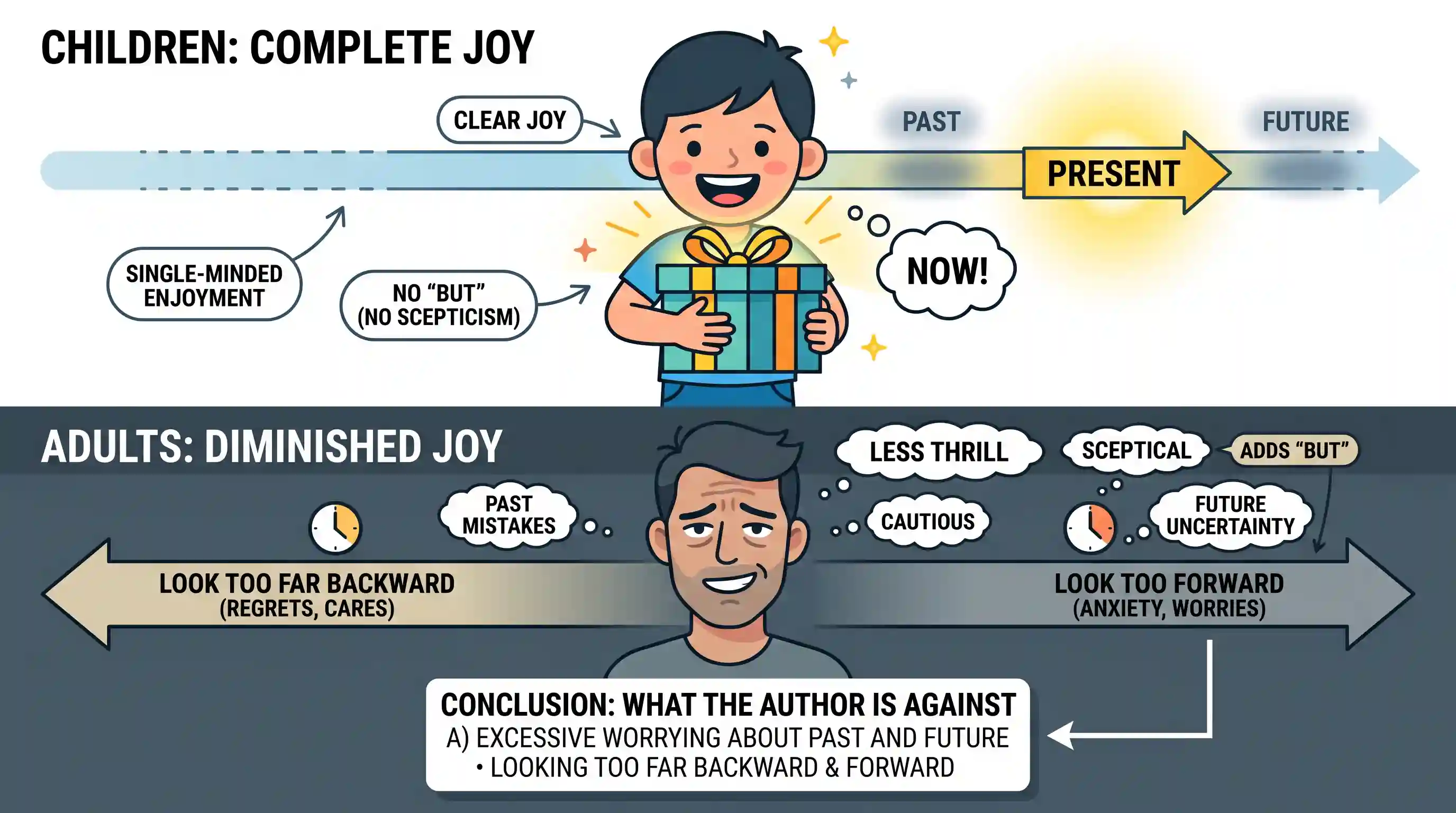
Read the following passages and answer the items that follow the passages. Your answers to these items should be based on the passages only. If presents bring less thrill now that we are grown up, perhaps it is because we have too much already; or perhaps it is because we have lost the fullness of the joy of giving, and with it the fullness of the joy of receiving. Children's fears are poignant, their miseries are acute, but they do not look too forward nor too far backward. Their joys are clear and complete, because they have not yet learnt always to add 'but' to every proposition. Perhaps we are too cautious, too anxious, too sceptical. Perhaps some of our cares would shrink if we thought less about them and entered with more single- minded enjoyment into the happiness that come our way. The author of the passage is against

- Aworrying too much about the past and futureCorrect
- Bbeing in the habit of thinking about presents
- Cnot being thrilled by new things
- Dgiving and receiving joy only partially
Explanation
The author contrasts children's complete joy with adults' diminished joy. The passage states that children "do not look too forward nor too far backward," which contributes to their clear and complete joys. This implies that adults, by contrast, do look too much to the past and future, leading to their anxieties and incomplete joy. The author also suggests that "some of our cares would shrink if we thought less about them and entered with more single-minded enjoyment into the happiness that come our way," which reinforces the idea of being present-focused rather than dwelling on past or future worries.
Option A is correct because the author explicitly highlights that children "do not look too forward nor too far backward," implying that adults do, and this is a cause of their diminished joy and increased cares. The author is against this tendency in adults.
Option B is incorrect because the passage uses presents as an example to illustrate a broader point about lost joy, not as the primary thing the author is against. The author is against the reasons for the lack of thrill, not the act of thinking about presents itself.
Option C is incorrect for similar reasons to B. "Not being thrilled by new things" (like presents) is a symptom or consequence of the underlying issues the author discusses (like being too cautious, anxious, or worrying about past/future), not the core issue itself.
Option D is incorrect because "giving and receiving joy only partially" is presented as a consequence of the adult mindset (e.g., being too cautious, anxious, and looking too much to the past and future), rather than the primary thing the author is against. The author is against the causes that lead to this partial joy.
Related questions
More UPSC Prelims practice from the same subject and topic.
- Prelims 2022CSATReading Comprehension
The main threat to maintaining progress in human development comes from the increasingly evident unsustainability of production and consumption patterns. Current production models rely heavily on foss…
- Prelims 2022CSATReading Comprehension
The main threat to maintaining progress in human development comes from the increasingly evident unsustainability of production and consumption patterns. Current production models rely heavily on foss…
- Prelims 2022CSATReading Comprehension
Unless the forces and tendencies which are responsible for destroying the country's environment are checked in the near future and afforestation of denuded areas is taken up on a massive scale, the ha…
- Prelims 2022CSATReading Comprehension
"In simple matters like shoe- making, we think only a specially trained person will serve our purpose, but in politics, we presume that everyone who knows how to get votes knows how to administer a St…
- Prelims 2022CSATReading Comprehension
The poverty line is quite unsatisfactory when it comes to grasping the extent of poverty in India. It is not only because of its extremely narrow definition of 'who is poor' and the debatable methodol…
- Prelims 2022CSATReading Comprehension
The poverty line is quite unsatisfactory when it comes to grasping the extent of poverty in India. It is not only because of its extremely narrow definition of 'who is poor' and the debatable methodol…