"The social order is a sacred right which is the basis of all other rights. Nevertheless, this right does not come from nature, and must therefore be founded on conventions." With reference to the above passage, which of the following statements is/are correct? 1. Conventions are the sources of rights of man. 2. Rights of man can be exercised only when there is a social order. Select the correct answer using the code given below

- A1 onlyCorrect
- B2 only
- CBoth 1 and 2
- DNeither 1 nor 2
Explanation
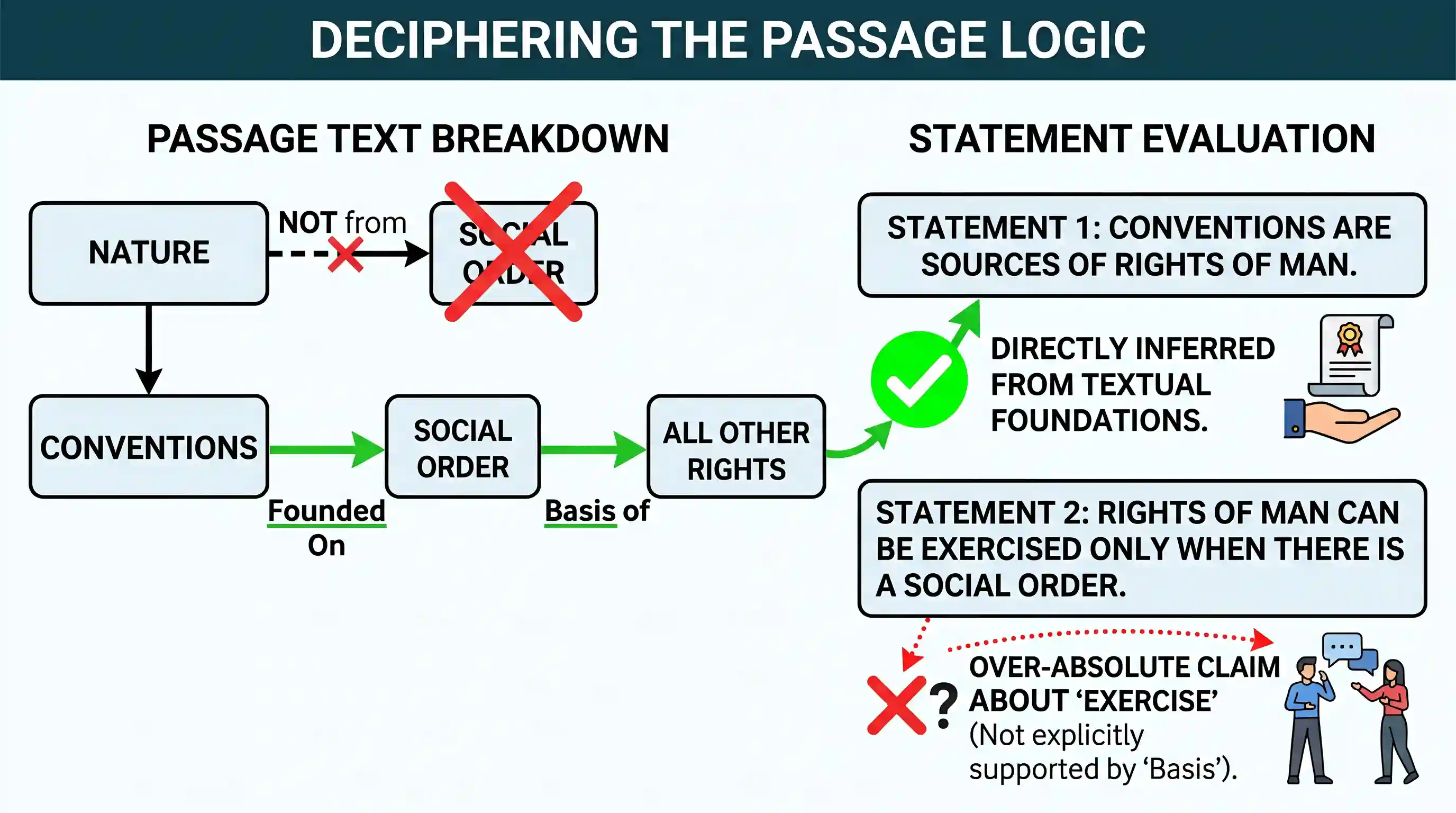
The passage states: "The social order is a sacred right which is the basis of all other rights. Nevertheless, this right does not come from nature, and must therefore be founded on conventions."
Let's analyze each statement:
-
Conventions are the sources of rights of man.
- The passage explicitly states that "The social order... is the basis of all other rights."
- It then clarifies that this "right [social order]... must therefore be founded on conventions."
- If the social order, which is the basis of all rights, is founded on conventions, it logically follows that conventions are the ultimate source of these rights. This statement is strongly supported by the passage.
-
Rights of man can be exercised only when there is a social order.
- The passage states that "The social order... is the basis of all other rights."
- "Basis" implies a fundamental foundation or prerequisite. If social order is the basis, it suggests that these rights depend on social order for their existence and legitimacy.
- However, the statement uses the strong qualifier "only when" for their exercise. While the social order provides the framework for true and legitimate rights, and without it, rights might not properly exist or be recognized, the passage does not explicitly state that the act of exercising any claim or freedom is absolutely impossible without a social order. It's a strong inference, but "only when" makes it an absolute claim about exercisability, which might be considered an overreach beyond what is directly stated by "basis." The passage focuses on the origin and foundation of rights, not necessarily the absolute conditions for their attempted exercise. Given the precision required in UPSC questions, this absolute claim might be considered not directly or fully supported.
Based on this analysis, Statement 1 is a direct and strong inference from the text, while Statement 2, though plausible, makes an absolute claim about "exercisability" that might be considered not explicitly or fully supported by the word "basis" alone, leaving room for a very subtle distinction. Therefore, A is the most accurate answer.
The final answer is A
Related questions
More UPSC Prelims practice from the same subject and topic.
- Prelims 2022CSATReading Comprehension
The main threat to maintaining progress in human development comes from the increasingly evident unsustainability of production and consumption patterns. Current production models rely heavily on foss…
- Prelims 2022CSATReading Comprehension
The main threat to maintaining progress in human development comes from the increasingly evident unsustainability of production and consumption patterns. Current production models rely heavily on foss…
- Prelims 2022CSATReading Comprehension
Unless the forces and tendencies which are responsible for destroying the country's environment are checked in the near future and afforestation of denuded areas is taken up on a massive scale, the ha…
- Prelims 2022CSATReading Comprehension
"In simple matters like shoe- making, we think only a specially trained person will serve our purpose, but in politics, we presume that everyone who knows how to get votes knows how to administer a St…
- Prelims 2022CSATReading Comprehension
The poverty line is quite unsatisfactory when it comes to grasping the extent of poverty in India. It is not only because of its extremely narrow definition of 'who is poor' and the debatable methodol…
- Prelims 2022CSATReading Comprehension
The poverty line is quite unsatisfactory when it comes to grasping the extent of poverty in India. It is not only because of its extremely narrow definition of 'who is poor' and the debatable methodol…