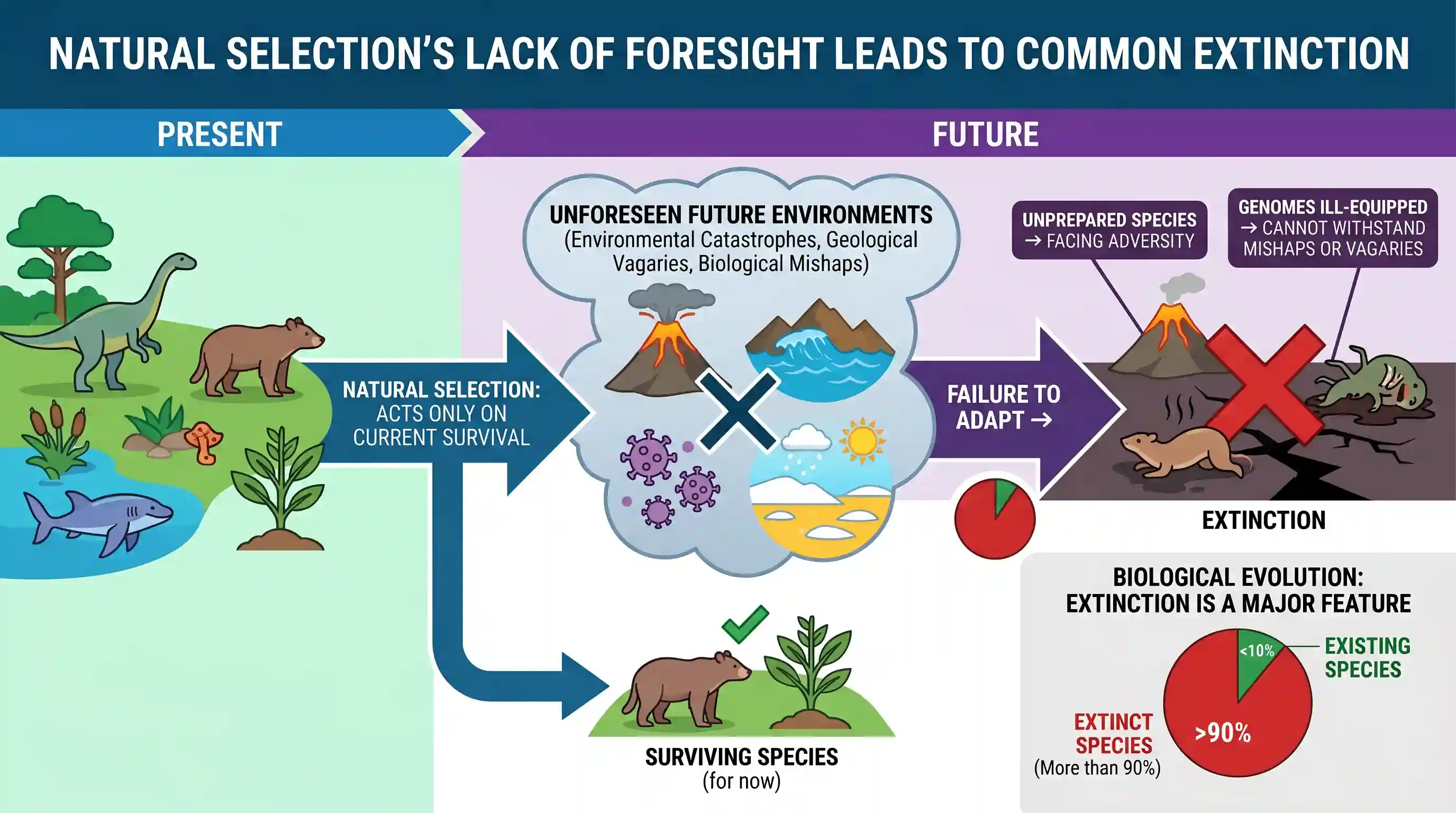
Natural selection cannot anticipate future environments on the earth. Therefore, the set of existing organisms can never be fully prepared for environmental catastrophes that await life. An outcome of this is the extinction of those species which cannot overcome environmental adversity. This failure to survive, in modern terms, can be attributed to the genomes which are unable to withstand geological vagaries or biological mishaps (infections, diseases and so on). In biological evolution on the earth, extinction of species has been a major feature. The earth may presently have up to ten million species, yet more than 90% of species that have ever lived on the earth are now extinct. Once again, the creationist doctrines fail to satisfactorily address why a divine creator will firstly bother to create millions of species and then allow them to perish. The Darwinian explanation for extinct life is once again simple, elegant and at once convincing- organisms go extinct as a function of environmental or biological assaults for which their inheritance deems them ill- equipped. Therefore, the so- called Darwinian theory of evolution is not a theory at all. Evolution happens- this is a fact. The mechanism of evolution (Darwin proposed natural selection) is amply supported by scientific data. Indeed, to date no single zoological, botanical, geological, paleontological, genetic or physical evidence has refuted either of the central two main Darwinian ideas. If religion is not taken into consideration, Darwinian laws are acceptable just like the laws proposed by Copernicus, Galileo, Newton and Einstein- sets of natural laws that explain natural phenomena in the universe. According to the passage, natural selection cannot anticipate future environments on the earth as 1. species not fully prepared to face the environmental changes that await them will face extinction 2. all the existing species would get extinct as their genomes will not withstand biological mishaps 3. inability of the genome to withstand environmental changes would result in extinction 4. extinction of species is a common feature Select the correct answer using the code given below

- A1, 2 and 3
- B2, 3 and 4
- C1, 3 and 4Correct
- D1, 2 and 4
Explanation
The question asks why, according to the passage, natural selection cannot anticipate future environments. We need to evaluate each statement based on the provided text.
-
species not fully prepared to face the environmental changes that await them will face extinction: The passage states, "Natural selection cannot anticipate future environments on the earth. Therefore, the set of existing organisms can never be fully prepared for environmental catastrophes that await life. An outcome of this is the extinction of those species which cannot overcome environmental adversity." This directly supports statement 1.
-
all the existing species would get extinct as their genomes will not withstand biological mishaps: The passage mentions that "extinction of species has been a major feature" and "more than 90% of species that have ever lived on the earth are now extinct." However, it does not state that all existing species would get extinct. It implies that some species will go extinct due to inability to adapt, not necessarily all. Therefore, this statement is too absolute and not supported by the passage.
-
inability of the genome to withstand environmental changes would result in extinction: The passage says, "This failure to survive, in modern terms, can be attributed to the genomes which are unable to withstand geological vagaries or biological mishaps (infections, diseases and so on)." This clearly links the inability of genomes to withstand environmental changes (geological vagaries) or biological mishaps to extinction. So, statement 3 is correct.
-
extinction of species is a common feature: The passage explicitly states, "In biological evolution on the earth, extinction of species has been a major feature." It further emphasizes this by mentioning "more than 90% of species that have ever lived on the earth are now extinct." This confirms that extinction is a common and major feature. So, statement 4 is correct.
Based on the analysis, statements 1, 3, and 4 are correct.
The final answer is C
Related questions
More UPSC Prelims practice from the same subject and topic.
- Prelims 2022CSATReading Comprehension
The main threat to maintaining progress in human development comes from the increasingly evident unsustainability of production and consumption patterns. Current production models rely heavily on foss…
- Prelims 2022CSATReading Comprehension
The main threat to maintaining progress in human development comes from the increasingly evident unsustainability of production and consumption patterns. Current production models rely heavily on foss…
- Prelims 2022CSATReading Comprehension
Unless the forces and tendencies which are responsible for destroying the country's environment are checked in the near future and afforestation of denuded areas is taken up on a massive scale, the ha…
- Prelims 2022CSATReading Comprehension
"In simple matters like shoe- making, we think only a specially trained person will serve our purpose, but in politics, we presume that everyone who knows how to get votes knows how to administer a St…
- Prelims 2022CSATReading Comprehension
The poverty line is quite unsatisfactory when it comes to grasping the extent of poverty in India. It is not only because of its extremely narrow definition of 'who is poor' and the debatable methodol…
- Prelims 2022CSATReading Comprehension
The poverty line is quite unsatisfactory when it comes to grasping the extent of poverty in India. It is not only because of its extremely narrow definition of 'who is poor' and the debatable methodol…