In some places in the world, the productivity of staples such as rice and wheat has reached a plateau. Neither new strains nor fancy agrochemicals are raising the yields. Nor is there much unformed land left that is suitable to be brought under the plough. If global temperature continues to rise, some places will become unsuitable for farming. Application of technology can help overcome these problems. Agricultural technology is changing fast. Much of this change is brought about by affluent farmers in the West/Americas. Techniques developed in the West are being adapted in some places to make tropical crops more productive. Technology is of little use if it is not adapted. In the developing world, that applies as much to existing farming techniques as it does to the latest advances in genetic modification. Extending to the smallholders and subsistence farmers of Africa and Asia the best of today's agricultural practices, in such simple matters as how much fertilizers to apply and when, would lead to a greatly increased availability of food for humanity. So would things like better roads and storage facilities, to allow for the carriage of surpluses to markets and reduce wastage. Based on the above passage, the following assumptions have been made: 1. Growing enough food for future generations will be a challenge. 2. Corporate farming is a viable option for food security in poor countries. Which of the above assumptions is/are valid?

- A1 onlyCorrect
- B2 only
- CBoth 1 and 2
- DNeither 1 nor 2
Explanation
The correct answer is A because only assumption 1 is valid based on the passage.
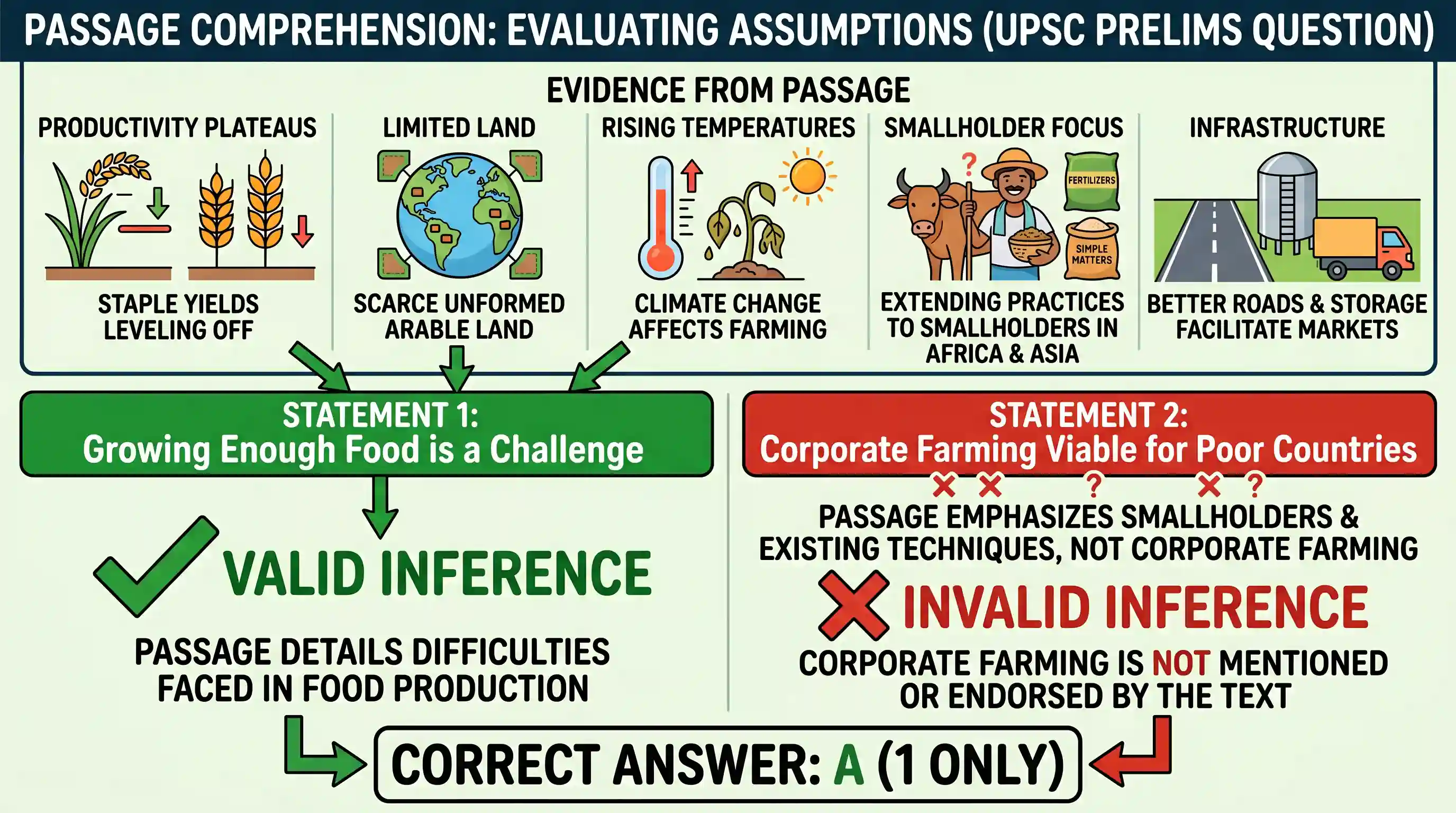
Analysis of Statement 1: "Growing enough food for future generations will be a challenge." The passage explicitly states several challenges: productivity plateaus for staples, limited new land, and the negative impact of rising global temperatures making some places unsuitable for farming. It then discusses how technology and improved practices can help overcome these problems, which inherently implies that these problems pose a challenge to food production. Therefore, this assumption is directly supported by the text.
Analysis of Statement 2: "Corporate farming is a viable option for food security in poor countries." The passage does not mention or endorse corporate farming. While it notes that "much of this change is brought about by affluent farmers in the West/Americas" (referring to agricultural technology development), it then shifts its focus to the developing world, stating that extending "the best of today's agricultural practices" to "smallholders and subsistence farmers of Africa and Asia" would increase food availability. This emphasis on smallholders and improving their existing practices and infrastructure (roads, storage) does not suggest corporate farming as a viable option for food security in poor countries. Therefore, this assumption is not supported by the passage.
Related questions
More UPSC Prelims practice from the same subject and topic.
- Prelims 2022CSATReading Comprehension
The main threat to maintaining progress in human development comes from the increasingly evident unsustainability of production and consumption patterns. Current production models rely heavily on foss…
- Prelims 2022CSATReading Comprehension
The main threat to maintaining progress in human development comes from the increasingly evident unsustainability of production and consumption patterns. Current production models rely heavily on foss…
- Prelims 2022CSATReading Comprehension
Unless the forces and tendencies which are responsible for destroying the country's environment are checked in the near future and afforestation of denuded areas is taken up on a massive scale, the ha…
- Prelims 2022CSATReading Comprehension
"In simple matters like shoe- making, we think only a specially trained person will serve our purpose, but in politics, we presume that everyone who knows how to get votes knows how to administer a St…
- Prelims 2022CSATReading Comprehension
The poverty line is quite unsatisfactory when it comes to grasping the extent of poverty in India. It is not only because of its extremely narrow definition of 'who is poor' and the debatable methodol…
- Prelims 2022CSATReading Comprehension
The poverty line is quite unsatisfactory when it comes to grasping the extent of poverty in India. It is not only because of its extremely narrow definition of 'who is poor' and the debatable methodol…